Atheist Groups Renew Legal Fight Against Arkansas Ten Commandments Monument

Above: Former Sen. Jason Rapert and then-Rep. Kim Hammer unveil Arkansas’ monument commemorating the Ten Commandments in this file photo from 2018. Atheist organizations filed a lawsuit to have the monument removed, but the case has remained in limbo for seven years.

Last Friday, a group of atheist organizations filed a new motion in federal court to remove a monument of the Ten Commandments from the Arkansas Capitol lawn.

In 2015, the Arkansas Legislature authorized a privately funded monument of the Ten Commandments on the Arkansas Capitol Building grounds. The monument is identical to one the U.S. Supreme Court ruled constitutional at the capitol building in Texas.

It was unveiled in 2018, but atheist groups like the Freedom From Religion Foundation and the Satanic Temple quickly filed a federal lawsuit to have the monument removed. The case has been in legal limbo ever since.

Earlier this year the Arkansas Legislature passed a separate law, Act 573 of 2025 by Sen. Jim Dotson (R — Bentonville) and Rep. Alyssa Brown (R — Heber Springs), authorizing privately funded Ten Commandments posters to be displayed in public schools and other public buildings in Arkansas. The measure received strong support in the Arkansas Legislature, but lawyers from the ACLU and a group of atheist organizations filed a federal lawsuit against four public school districts to block Act 573. On August 4, U.S. District Judge Timothy Brooks partially blocked a state law placing copies of the Ten Commandments in Arkansas’ public schools.

The new motion against Arkansas’ Ten Commandments monument argues that the court ruling against the Ten Commandments posters in four Arkansas schools means U.S. District Judge Kristine Baker should rule against Arkansas’ Ten Commandments monument on the capitol grounds.

The new motion claims,

This Court should grant summary judgment for the Cave Plaintiffs, invalidate the Ten Commandments Monument Display Act as violating the Establishment Clause, and order that the Ten Commandments Monument located on the Arkansas State Capitol grounds be permanently removed.

The truth is Arkansas’ monument of the Ten Commandments is identical to one the U.S. Supreme Court ruled constitutional at the Texas Capitol Building in 2005.

As we have said many times, there shouldn’t be anything controversial about a monument honoring the significance of the Ten Commandments.

Historians have long recognized the Ten Commandments as one of the earliest examples of the rule of law in human history, and they have helped shape philosophy and laws in countries around the world.

That’s why the Ten Commandments traditionally have appeared in artwork at courthouses and other public buildings.

Arkansas’ laws commemorating the Ten Commandments honor their historical and cultural legacy. With that in mind, we believe our federal courts eventually will resolve these lawsuits and uphold Arkansas’ Ten Commandments laws as constitutional.

Articles appearing on this website are written with the aid of Family Council’s researchers and writers.

Arkansas Congressman French Hill Praises President Trump’s Order Against Debanking

Last week, President Trump signed an executive order against debanking. The purpose of the order is to guarantee fair banking for all Americans.

Arkansas Congressman French Hill (AR-02), who chairs the House Committee on Financial Services, issued a statement praising the order, saying,

“Targeting Americans for their political beliefs undermines the freedoms our country was built upon and should have no place in our financial system. I commend President Trump for taking decisive action to protect all Americans from politically motivated financial discrimination. The president’s executive order is an important step toward restoring fairness and accountability in our banking system, and the House Financial Services Committee will continue its work to investigate and prevent debanking for lawful businesses.”

Congressman Hill also published the following timeline regarding federal inquiries into debanking:

  • On April 29, 2025the Subcommittee on Financial Institutions, led by Subcommittee Chairman Barr, held a hearing to examine regulatory overreach and debanking.
  • On February 20, 2025, Chairman Hill, Subcommittee Chairman Dan Meuser (PA-09), Subcommittee Chairman Andy Barr (KY-06), and Subcommittee Chairman Bryan Steil (WI-01), sent a letter to Federal Deposit Insurance Corporation (FDIC) with recommendations to help clarify digital asset regulations and prevent debanking.
  • On February, 6, 2025the Subcommittee on Oversight and Investigations, led by Subcommittee Chairman Meuser, held a hearing to discuss debanking efforts under the Biden-Harris Administration.
  • On May 21, 2025, the Committee passed H.R. 2702, the FIRM Act, with bipartisan support, to remove reputational risk from bank supervision. This bill directly aligns with the Federal Reserve’s recent decision to remove reputational risk from their exam process.
  • In March and April 2023, then-Digital Assets, Financial Technology and Inclusion Subcommittee Chairman French Hill, then-Oversight and Investigations Subcommittee Chairman Bill Huizenga, and former Chairman Patrick McHenry sent multiple letters to the Chair of the Board of Governors of the Federal Reserve System, Jerome Powell, then-Chairman of the Federal Deposit Insurance Corporation (FDIC), Martin Gruenberg, and then-Acting Comptroller of the Currency, Michael Hsu, requesting information related to potential coordinated efforts by the agencies to deny banking services to digital asset firms and the ecosystem as a whole. 
  • In March 2023, then-Digital Assets, Financial Technology and Inclusion Subcommittee Chairman French Hill held a hearing to highlight the Biden Administration’s Attack on the Digital Asset Ecosystem.

We have written repeatedly about allegations that major financial institutions have deliberately debanked conservative individuals and organizations.

In 2021 Family Council’s credit card processor abruptly cancelled our account after designating our organization as “high risk.” Unfortunately, this was not an isolated incident. Other organizations have had similar experiences as well.

We deeply appreciate the Trump Administration and congressmen like Rep. French Hill leading the way against debanking. After all, banks that are too big to fail are too big to discriminate.

Articles appearing on this website are written with the aid of Family Council’s researchers and writers.

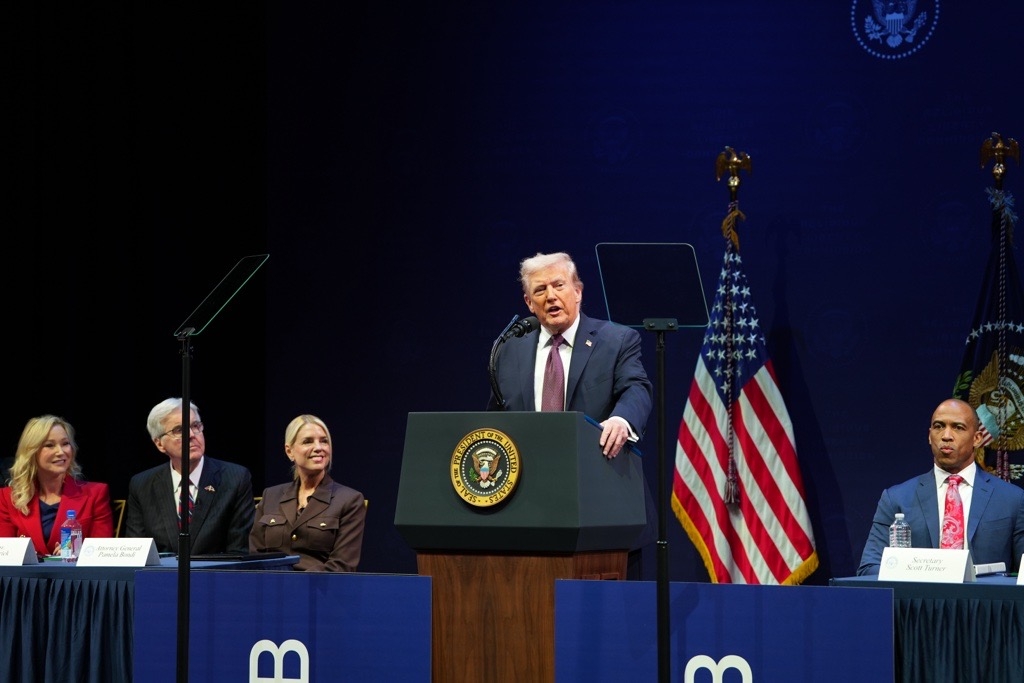
President Trump Signs Executive Order to Target Debanking

On August 7, President Trump signed an executive order “guaranteeing fair banking for all Americans.”

Since 2021, news outlets and congressional testimony have highlighted how federal officials and financial institutions targeted conservative organizations through “reputational risk” policies. Conservatives deemed “high risk” could have their bank accounts closed without warning and without explanation.

President Trump’s new executive order directs federal banking regulators to “remove the use of reputation risk or equivalent concepts that could result in politicized or unlawful debanking.”

The order says,

Financial institutions have engaged in unacceptable practices to restrict law-abiding individuals’ and businesses’ access to financial services on the basis of political or religious beliefs or lawful business activities.  Some financial institutions participated in Government-directed surveillance programs targeting persons participating in activities and causes commonly associated with conservatism and the political right following the events that occurred at or near the United States Capitol on January 6, 2021.

In a separate statement, the White House said,

President Trump believes that no American should be denied access to financial services because of their political or religious beliefs, and that banking decisions must solely be made on the basis of individualized, objective, and risk-based analyses.

We have written repeatedly about allegations that major financial institutions deliberately targeted conservative individuals and organizations.

In 2021 Family Council’s credit card processor terminated our account after designating our organization as “high risk.” 

At 10:29 AM on Wednesday, July 7, 2021, our office received a terse email from our credit card processor — a company owned by JPMorgan Chase — saying, “Unfortunately, we can no longer support your business. We wish you all the luck in the future, and hope that you find a processor that better fits your payment processing needs.”

Within sixty seconds, our account was terminated and Family Council could no longer accept donations online.

We later learned our processor had flagged us as “high risk,” but we were unable to get an explanation from the company. All we could do was speculate that our conservative principles and our public policy work might have had something to do with the decision to close our account.

Unfortunately, this was not an isolated incident. Other organizations have had similar experiences as well. In fact, corporate shareholdersstate attorneys generalcongressmen, and other organizations all have expressed concerns over conservatives being wrongly labeled as “high risk” or “hate groups” and subsequently debanked.

Since then, JPMorgan Chase has taken steps to prevent religiously-motivated debanking. That’s good, but our state and federal government need to make sure this sort of thing never happens to anyone again.

We deeply appreciate the Trump Administration leading the way in getting rid of “reputation risk” policies that have been used to debank conservatives. After all, banks that are too big to fail are too big to discriminate.

Articles appearing on this website are written with the aid of Family Council’s researchers and writers.