Faith Under Fire: Feds Form Task Force to Tackle Anti-Christian Bias

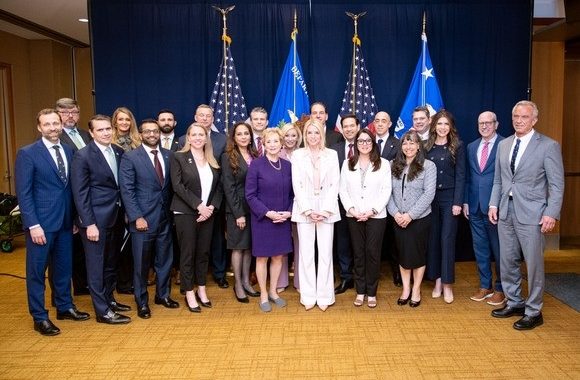
Attorney General Pamela Bondi with members of the Eradicating Anti-Christian Bias Task Force at the U.S. Department of Justice

In April, U.S. Attorney General Pamela Bondi hosted the inaugural meeting of the Task Force to Eradicate Anti-Christian Bias in the federal government.

President Trump established the task force earlier this year via executive order. The task force’s purpose is to “protect the religious freedoms of Americans and end the anti-Christian weaponization of government.”

In recent years news outlets and congressional testimony have alleged that government policies and departments have been weaponized against conservative and Christian organizations.

The U.S. House of Representatives Judiciary Committee and the Select Subcommittee on the Weaponization of the Federal Government released reports last year that found:

  • After the events of January 6, 2021, federal law enforcement officials from the Treasury Department’s Financial Crimes Enforcement Network (FinCEN) and the FBI initiated multiple discussions with financial institutions to discuss ways financial institutions could share customer information with federal law enforcement outside of normal legal processes.
  • Law enforcement and private institutions shared intelligence through a web portal run by the Domestic Security Alliance Council — a partnership led by the FBI and the Department of Homeland Security.
  • The U.S. Treasury Department gave banks and other financial institutions guiding “typologies” — patterns that could be used to identify suspicious people or activities — including search terms and patterns like “TRUMP” and “MAGA”, and encouraged financial institutions to comb through transactions for terms like, “Bass Pro Shops,” “Cabela’s,” and “Dick’s Sporting Goods” when looking for “Homegrown Violent Extremism.”
  • “Americans doing nothing other than shopping or exercising their Second Amendment rights were being tracked by financial institutions and federal law enforcement.”

Last year, Facebook founder and CEO Mark Zuckerberg wrote a letter to the U.S. House Judiciary Committee saying the Biden administration “pressured” his teams to censor content related to the COVID-19 pandemic.

We have written before about how in 2021, Facebook disabled Family Council’s advertising account with virtually no notice or explanation, and our credit card processor abruptly terminated our account after designating us as “high risk.” In both cases, we were left to wonder if our conservative principles played a role in the cancellations.

We applaud the federal government for taking steps to prevent anti-Christian bias in the federal government. No one should face discrimination for their faith.

Articles appearing on this website are written with the aid of Family Council’s researchers and writers.

The Federal Government Colluded with Big Banks to Censor Americans: ADF

Recently our friends at Alliance Defending Freedom discussed how official documents indicate the federal government colluded with big banks and other financial institutions to censor Americans.

Congressional investigations show that after the events of January 6, 2021, the U.S. Treasury Department gave banks and other financial institutions guiding “typologies” — patterns that could be used to identify suspicious people or activities — including search terms and patterns like “TRUMP” and “MAGA.”

The government also encouraged financial institutions to comb through transactions for terms like, “Bass Pro Shops,” “Cabela’s,” and “Dick’s Sporting Goods” when looking for “Homegrown Violent Extremism.”

In a recent video interview about this issue, ADF’s Senior Counsel and Senior Vice President of Corporate Engagement, Jeremy Tedesco, said,

You’re buying guns, you’re shopping at Bass Pro Shops, you’re buying religious texts, you’re giving to religious nonprofits. Under the Biden Administration, you could become [labelled] a domestic violence extremist.

Family Council has written repeatedly about how financial institutions may censor conservative Americans. In 2021 our credit card processor that helped handle our donations terminated our account after designating Family Council as “high risk.”

At 10:29 AM on Wednesday, July 7, 2021, our office received a terse email from our credit card processor — a company owned by JPMorgan Chase — saying, “Unfortunately, we can no longer support your business. We wish you all the luck in the future, and hope that you find a processor that better fits your payment processing needs.”

Within sixty seconds, our account was terminated and and Family Council could no longer accept donations online. All we can do is speculate that our conservative principles and our public policy work might have had something to do with the decision to close our account.

Unfortunately, other organizations have had similar experiences as well. In fact, corporate shareholdersstate attorneys generalcongressmen, and news outlets all have expressed concerns over conservatives being wrongly labeled as “high risk” or “hate groups” and subsequently debanked.

JPMorgan Chase recently took steps to prevent religiously-motivated debanking. That’s good, but our state and federal government need to make sure this sort of thing never happens to anyone again. After all, banks that are too big to fail are too big to discriminate.

Articles appearing on this website are written with the aid of Family Council’s researchers and writers.

Academic Bible Class Enrollment Grows in Arkansas

Data from the Arkansas Department of Education shows 264 public school students enrolled in courses to study the Bible academically this year.

In 2013 Arkansas passed Act 1440 by Rep. Denny Altes (R — Fort Smith) and Sen. Gary Stubblefield (R — Branch) to let public schools offer elective, academic courses that study “the Bible and its influence on literature, art, music, culture, and politics.”

The law says the course must be objective and nonsectarian, and it must meet the same academic standards as other elective courses offered in public schools. Anyone wishing to teach the course must be licensed to teach in the State of Arkansas.

In 2019 the Arkansas Legislature passed Act 1016 by Rep. Joe Cloud (R — Russellville), Rep. Jim Dotson (R — Bentonville), and Sen. Bob Ballinger (R — Ozark). Act 1016 helped make technical clarifications to Act 1440 of 2013.

Over the past 12 years, different school districts in the state have chosen to offer academic courses on the Bible under this type of official state framework. Now data from the Arkansas Department of Education shows 264 public school students enrolled in elective, academic courses on the Bible at 18 schools this year.

The data indicates the number of students choosing to study the Bible academically at school has grown. Last year, 126 students studied the Bible at 10 different schools in Arkansas, and the year before that 125 students learned about the Bible at seven schools.

Below is a list of school districts offering courses on the Bible this school year.

SCHOOL DISTRICTCOURSENUMBER OF STUDENTS
FOUNDERS CLASSICAL ACADEMIES OF ARKANSASAcademic Study of the Bible (0.5 credit)1
VALLEY SPRINGS SCHOOL DISTRICTAcademic Study of the Bible (0.5 credit)10
GURDON SCHOOL DISTRICTAcademic Study of the Bible (0.5 credit)10
MAGNOLIA SCHOOL DISTRICTAcademic Study of the Bible (0.5 credit)13
NETTLETON SCHOOL DISTRICTAcademic Study of the Bible (0.5 credit)19
VAN BUREN SCHOOL DISTRICTAcademic Study of the Bible (0.5 credit)43
FORDYCE SCHOOL DISTRICTAcademic Study of the Bible (0.5 credit)4
MARMADUKE SCHOOL DISTRICTAcademic Study of the Bible (0.5 credit)10
HOPE SCHOOL DISTRICTAcademic Study of the Bible (0.5 credit)1
DIERKS SCHOOL DISTRICTAcademic Study of the Bible (0.5 credit)21
LONOKE SCHOOL DISTRICTAcademic Study of the Bible (0.5 credit)24
DEER MT JUDEA SCHOOL DISTRICTAcademic Study of the Bible (0.5 credit)3
EAST END SCHOOL DISTRICTAcademic Study of the Bible (0.5 credit)17
ACADEMICS PLUS PUBLIC CHARTER SCHOOLSAcademic Study of the Bible (0.5 credit)5
PREMIER HIGH SCHOOLS OF ARKANSASAcademic Study of the Bible (0.5 credit)1
BRYANT SCHOOL DISTRICTAcademic Study of the Bible (0.5 credit)59
SEARCY COUNTY SCHOOL DISTRICTAcademic Study of the Bible (0.5 credit)10
SOUTH SIDE SCHOOL DISTRICT (Van Buren)Academic Study of the Bible (0.5 credit)13

Courts have said the U.S. Constitution does not prevent public school students from being taught about the Bible and its significance throughout human history, provided that the instruction is neutral and educational.

The U.S. Supreme Court’s 1980 Stone v. Graham decision went so far as to say, “the Bible may constitutionally be used in an appropriate study of history, civilization, ethics, comparative religion, or the like.”

This year lawmakers passed S.B. 223, the Religious Rights at Public School Act by Sen. Mark Johnson (R — Little Rock) and Rep. Alyssa Brown (R — Heber Springs). This good law affirms public school students’ and teachers’ religious liberties.

The law does not create any new rights or freedoms, but it does identify existing religious freedoms that are already protected by state and federal law — such as the freedom to pray, discuss religion, or read the Bible during free time at school.

The law also highlights the freedom that schools have to offer academic courses on the Bible under Act 1440 of 2013.

S.B. 223 does not change any laws about the academic study of the Bible in Arkansas, but it does help draw attention to the fact that state law and U.S. Supreme Court rulings let public schools offer these elective courses. It passed with strong support in the Arkansas Senate and Arkansas House, and Gov. Sanders signed it into law last month as Act 400 of 2025.

It’s good to see Arkansas’ schools offering these academic courses on the Bible to students across the state. After all, no single book has been more influential over our civilization than the Bible.

Articles appearing on this website are written with the aid of Family Council’s researchers and writers.