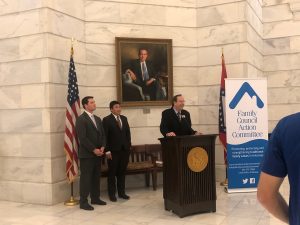
 The following is a press release from Family Council Action Committee. You can see video of Family Council Action Committee’s press conference here.
FOR IMMEDIATE RELEASE
Monday, March 5, 2018
At a press conference on Monday, Family Council Action Committee formally announced its opposition to Issue One, a proposed constitutional amendment restricting the amount of money awarded in lawsuits.
Executive Director Jerry Cox released a statement saying, “We oppose Issue One because it puts a price tag on human life. Most people would agree that we should never put a value on human life unless the word ‘priceless’ is involved. Issue One not only puts a dollar value on human life, but a pretty low value at that—just $500,000.”
Cox explained how Issue One places a dollar value on human life. “Issue One is a being billed as a tort reform measure. Sadly, like too many things in politics today, what we’re told and what we will get are two very different things. Issue One limits noneconomic damages in lawsuits at $500,000 for injuries such as pain and suffering or mental anguish. That might be okay when you’re talking about people suing a restaurant because they spilled hot coffee on themselves, but it’s another thing when you’re talking about a grandmother who dies in a nursing home because the facility didn’t take care of her, or if a drunk driver paralyzes your child for life. If your grandmother dies because her nursing home was negligent, you can’t sue the facility for economic damages like lost wages because nursing home residents aren’t employed, which means under the law they have no “economic value” such as lost wages. Noneconomic damages are all they have. Issue One basically guarantees the nursing home won’t have to pay more than $500,000 if it is responsible for your grandma’s death.”
Cox said Issue One treats young children, elderly adults, and others who do not earn an income as if their lives are not as valuable as everyone else’s. “This amendment sets the going rate for people killed or injured due to the negligence of others. Retired husband or wife: $500,000. Homemaker with four young children, but no outside income: $500,000. Mentally-disabled child: $500,000. Family man on disability: $500,000. But wealthy wage earners are treated better. They could collect millions of dollars in economic damages because of projected future earnings and lost wages. “Currently, any resident of a long-term health care facility who is abused or neglected can take the case to court. This goes for all other injury lawsuits, as well. There, a jury of everyday Arkansans hears the facts of the case and then awards damages based on what they believe to be fair and just. This jury system is a guaranteed constitutional right enjoyed by every person. After all, everyone who needs it should have their day in court and expect justice. Issue One is an insult to justice. Issue One ties the hands of judges and juries by letting the State set an arbitrary, one-size-fits-all value of no more than $500,000 in noneconomic damages,” Cox said.
Cox said Issue One ultimately does not stop frivolous lawsuits. “The backers of this amendment could have written a proposal that focused on preventing lawyers from enriching themselves on frivolous lawsuits. They could have written an amendment that addressed some of the medical malpractice problems that good physicians face. Instead they wrote an amendment that puts a price tag on human life and leaves the door wide open for the nursing home industry to neglect our loved ones. Nursing home neglect already is too common, even with the threat of huge lawsuits. If Issue One passes, that problem is simply going to get worse.”
Family Council Action Committee Political Director Ken Yang rolled out a seven-point plan for defeating Issue One. The plan includes rallying faith leaders, mobilizing a statewide grassroots network, a direct mail and social media effort, conducting speaking engagements, earned media, voter’s guides, and a get-out-the-vote campaign.
Family Council Action Committee is a conservative 501(c)(4) organization based in Little Rock, Arkansas.
###
READ MORE


 Last week 16 state attorneys general filed an amicus brief in the Eighth Circuit Court of Appeals opposing pro-life laws the Arkansas Legislature passed in 2017.

 Last summer the Trump Administration announced it no longer would fund the Office of Adolescent Health’s Teen Pregnancy Prevention Program.