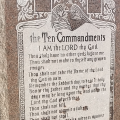

The Ten Commandments are going back to school in Louisiana this year.
In 2024, Louisiana passed a law allowing Ten Commandments displays in public school classrooms, but the measure drew immediate legal challenges from groups like the ACLU. However, the 5th U.S. Circuit Court of Appeals ruled the legal challenge was “premature” because the displays had not actually been put up in schools yet. The judges noted that deciding whether the displays are constitutional or not would force the court “to hypothesize an open-ended range of possible classroom displays,” the court said. “[That] is not judging; it is guessing.”
KSLA reports some Louisiana schools began displaying the Ten Commandments during the past school year while others plan to begin displaying them this year.
In April, the 5th U.S. Circuit Court of Appeals said that a Texas law placing the Ten Commandments in school classrooms did not violate the Constitution. The court noted that “no child is required to recite the Commandments, believe them, or affirm their divine origin.”
The legal battles over the Ten Commandments in Texas and Louisiana directly relate to a similar legal battle in Arkansas.
Last year, lawmakers passed Act 573 of 2025 by Sen. Jim Dotson (R — Bentonville) and Rep. Alyssa Brown (R — Heber Springs) requiring privately-funded copies of the Ten Commandments to be displayed in public schools and other public buildings in Arkansas. The measure received strong support from the Arkansas Legislature.
However, lawyers from the ACLU and a group of atheist organizations sued to block the law, and the federal judge presiding over the case issued decisions claiming the Ten Commandments posters would pressure children “to observe, meditate on, venerate, and follow the State’s favored religious text, and to suppress expression of their own religious beliefs and backgrounds at school.”
Arkansas Attorney General Tim Griffin has asked the 8th Circuit to let reverse the lower court decision and let Arkansas follow Act 573.
Nothing in Act 573 “pressures” students. In 2017, Arkansas passed the National Motto Display Act allowing the national motto — “In God We Trust” — to be displayed in Arkansas’ classrooms along with the U.S. flag and the Arkansas flag. Act 573 amended the National Motto Display Act to add the Ten Commandments to the list of historical items displayed in school.
Over the years, the U.S. Supreme Court has ruled that states are free to honor and recognize documents or symbols that are important to our nation’s history — like the Ten Commandments or the national motto. Courts have also ruled that public school students are free to study religious texts like the Bible academically.
During her testimony for Act 573 last year, Rep. Alyssa Brown noted that the U.S. Supreme Court now uses a “longstanding history and tradition test” to decide if it is constitutional to display something like a copy of the Ten Commandments. Rep. Brown said, “The Ten Commandments without a doubt will pass this longstanding history and tradition test.”
We believe our federal courts will agree and uphold Act 573 as constitutional.
Articles appearing on this website are written with the aid of Family Council’s researchers and writers.