

Florida Lawmakers Add Surrogacy Ban to Foreign Interference Measure

Last week, Florida lawmakers amended a foreign interference bill to prohibit commercial surrogacy contracts with citizens of certain countries.

In commercial surrogacy, corporate agencies hire women to carry children for paying customers — some of whom may be foreign nationals.

Florida’s H.B. 905 is intended to stop China, Russia, Iran, North Korea, Cuba, Venezuela, and Syria from interfering in business or politics in the Sunshine State. The measure reportedly would prevent state and local governments from contracting with individuals and businesses closely associated with those countries when it comes to matters like critical infrastructure or information technology.

On March 3, the Florida House of Representatives amended the bill to address commercial surrogacy contracts as well. The amendment effectively prevents, for example, a Russian or Chinese citizen from signing a commercial surrogacy contract with someone in Florida.

Arkansas U.S. Senator Tom Cotton and Florida U.S. Sen. Rick Scott recently urged the U.S. Department of Justice to investigate surrogacy centers operated by foreign nationals.

In a letter to U.S. Attorney General Pam Bondi, the senators wrote,

“Recent reports have uncovered more than 107 Chinese-owned surrogacy agencies operating in Southern California alone. These agencies cater almost exclusively to wealthy Chinese clients, and some are affiliated with Chinese state-owned entities. Chinese nationals pay women living in the United States more than $50,000 to serve as surrogates. The children are born on United States soil and granted automatic citizenship. And in most cases, the infants are promptly flown to China and raised there under the direct influence of the Chinese Communist Party.”

We have written many times about how commercial surrogacy is a largely unregulated industry that exploits women and hurts children.

Unlike many other countries, the United States has relatively few restrictions on surrogacy — and that’s a problem.

Last year The Wall Street Journal uncovered how Chinese billionaires are taking advantage of America’s surrogacy industry to create what some call “mega-families” with dozens or even hundreds of children.

The Wall Street Journal also has written about allegations of financial fraud among commercial surrogacy businesses.

In December, The New York Times and NBC News both reported about investigations into a surrogacy agency that abruptly shutdown, causing clients to lose an estimated $2 – $5 million total.

News outlets have reported that a sex offender convicted of crimes involving children was able to obtain a child through surrogacy in Pennsylvania as a result of lax state regulations.

And The New Yorker reported last month that a wealthy couple in Los Angeles allegedly used a surrogacy agency they operated to hire dozens of women across the U.S. to carry more than 20 children for them. According to the magazine, the children were removed from the home and placed in foster care after one of them was hospitalized with injuries “consistent with ‘those sustained during a car accident or from being shaken.’”

Stories like these underscore why social commentators and policymakers worldwide have raised concerns about commercial surrogacy.

It’s bad when commercial surrogacy goes wrong — but it’s important to remember that surrogacy never “goes right” either.

Commercial surrogacy deliberately deprives children of their biological mothers or fathers.

It treats pregnancy like a “service” that can be purchased.

It treats women like commodities, and it treats children like products that can be made to order and sold for profit.

Commercial surrogacy also relies heavily on in vitro fertilization and other reproductive technologies that have serious problems of their own.

Human beings are not products that can be made to order, bought, and sold. That’s why it’s essential for policymakers to enact real restrictions on commercial surrogacy contracts and agencies.

Articles appearing on this website are written with the aid of Family Council’s researchers and writers.
Pro-Life Advocate Speaks Out Against Surrogacy

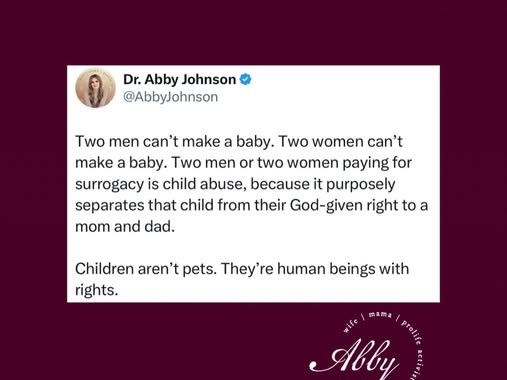
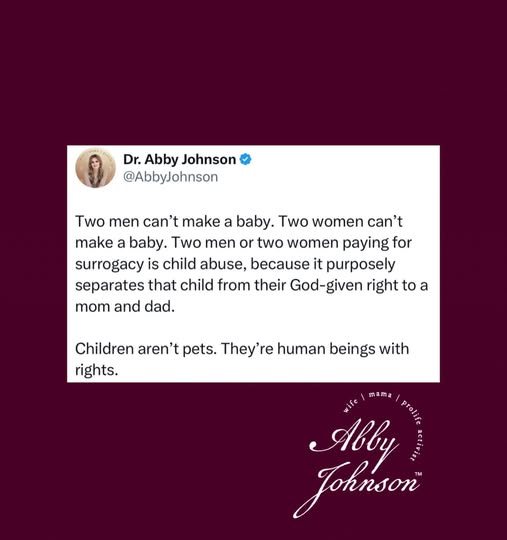
Pro-life advocate Dr. Abby Johnson recently posted a statement on social media opposing surrogacy, calling it “child abuse.”

Dr. Johnson was a Planned Parenthood clinic director until 2009, but she became pro-life after witnessing an ultrasound-guided abortion. Today she is a pro-life author and speaker and an advocate for women and unborn children.

In a statement posted last week, Dr. Johnson criticized gestational surrogacy, saying:

Two men can’t make a baby. Two women can’t make a baby. Two men or two women paying for surrogacy is child abuse, because it purposely separates that child from their God-given right to a mom and dad. Children aren’t pets.

They’re human beings with rights.

We have written many times about how surrogacy — especially commercial surrogacy — exploits women and hurts children.

In commercial surrogacy arrangements, corporate agencies hire women to carry children for paying customers.

Unlike many other countries, the United States has relatively few regulations when it comes to surrogacy — and that’s a problem.

Last year, news outlets reported that a sex offender convicted of crimes involving children was able to obtain a child through surrogacy in Pennsylvania as a result of lax state regulations.

The New Yorker reported last week that a wealthy couple in Los Angeles allegedly used a surrogacy agency they operated to hire dozens of women across the U.S. to carry more than 20 children for them. According to the magazine, the children were removed from the home and placed in foster care after one of them was hospitalized with injuries “consistent with ‘those sustained during a car accident or from being shaken.'”

Last year The Wall Street Journal uncovered how Chinese billionaires are exploiting America’s surrogacy industry to create what some call “mega-families” with dozens or even hundreds of children.

The Wall Street Journal also has written about allegations of financial fraud among commercial surrogacy businesses.

In December, The New York Times and NBC News both reported about investigations into a surrogacy agency that abruptly shutdown, causing clients to lose an estimated $2 – $5 million total.

Stories like these underscore why social commentators and policymakers worldwide have raised concerns about commercial surrogacy and how it financially pressures women.

It’s bad when commercial surrogacy goes wrong — but it’s important to remember that surrogacy never “goes right” either.

Commercial surrogacy deliberately deprives children of their biological mothers or fathers.

It treats pregnancy like a “service” that can be purchased.

It treats women like commodities, and it treats children like products that can be made to order and sold for profit.

Commercial surrogacy also relies heavily on in vitro fertilization and other reproductive technologies that have serious problems of their own.

Family Council has opposed commercial surrogacy in Arkansas, but unfortunately, Arkansas’ commercial surrogacy laws are very lax.

Since 2017, Family Council has supported legislation to prohibit commercial surrogacy in Arkansas. So far, those restrictions have not passed.

Human beings are not products that can be made to order, bought, and sold. That’s why Family Council opposes commercial surrogacy — and why we will continue to oppose it.

Articles appearing on this website are written with the aid of Family Council’s researchers and writers.

Chinese Billionaires Exploit U.S. Surrogacy Laws to Build “Mega-Families”

A troubling report from The Wall Street Journal reveals how Chinese billionaires are exploiting America’s largely unregulated surrogacy industry to create what some call “mega-families” with dozens or even hundreds of children.

Commercial surrogacy is a practice where companies and wealthy couples pay women thousands of dollars to carry children for them.

The newspaper uncovered the case of a Chinese video game executive who claims to have fathered more than 100 children through American women hired as surrogate mothers. A California family court judge noticed multiple requests from the same Chinese billionaire filed surrogacy petitions seeking parental rights to multiple unborn children.

The Wall Street Journal writes,

Several of his kids were being raised by nannies in nearby Irvine as they awaited paperwork to travel to China. He hadn’t yet met them, he told the judge, because work had been busy. . . .

The judge denied his request for parentage—normally quickly approved for the intended parents of a baby born through surrogacy, experts say. The decision left the children he’d paid for to be born in legal limbo.

The article highlights other cases — including a wealthy Chinese executive who “hired U.S. models and others as egg donors to have 10 girls, with the aim of one day marrying them off to powerful men.”

Social commentators and policymakers worldwide have raised concerns about how commercial surrogacy financially pressures women into providing children for paying customers.

Unlike many other countries, the United States has few regulations governing surrogacy arrangements. This creates opportunities for exploitation and abuse that harm women, children, and families.

It’s bad when commercial surrogacy goes wrong — but it’s important to remember that surrogacy never “goes right” either.

Commercial surrogacy deliberately deprives children of their biological mothers or fathers.

It treats pregnancy like a “service” that can be purchased.

It treats women like commodities, and it treats children like products that can be made to order and sold for profit.

Commercial surrogacy also relies heavily on in vitro fertilization and other reproductive technologies that have serious problems of their own.

In California, surrogate Brittney Pearson’s story shows some of what is wrong with surrogacy.

After Pearson was diagnosed with an aggressive form of cancer, doctors recommended inducing labor early and caring for the baby in the NICU while she started chemo. However, that isn’t what the same-sex couple paying Brittney Pearson as their commercial surrogate wanted.

Even though she was 24 weeks pregnant and the baby might have been able to survive outside the womb, the men wanted Brittney to have an abortion. If the baby were born alive, the men asked that no life-saving measures be taken for the baby.

With her cancer having spread to her liver, Pearson found a hospital to induce birth. The child died shortly after being born on Father’s Day, June 18, 2023.

All of this was made possible by state laws that facilitate commercial surrogacy and treat the intended parents in surrogacy arrangements as the legal parents of the child.

Stories like these underscore why Family Council has opposed commercial surrogacy in Arkansas. Unfortunately, Arkansas’ commercial surrogacy laws are very lax.

Since 2017, Family Council has supported legislation to prohibit commercial surrogacy in Arkansas. So far, those restrictions have not passed.

Human beings are not products that can be bought or sold. That’s why Family Council opposes commercial surrogacy — and will continue to oppose it.

Articles appearing on this website are written with the aid of Family Council’s researchers and writers.