Founder of “Have My Baby in Miami” Pleads the Fifth During Congressional Inquiry into Birth Tourism
The founder of the company Have My Baby in Miami invoked his Fifth Amendment right not to answer a series of questions about birth tourism during a House Oversight Committee task force hearing last week.
U.S. citizenship is guaranteed under the Fourteenth Amendment for “All persons born or naturalized in the United States, and subject to the jurisdiction thereof,” and courts have held that nearly everyone born within the country’s boundaries is a U.S. citizen.
But testimony before members of Congress has shown that foreign nationals are using fraudulent tourist visas and international surrogacy contracts to have children born on American soil with U.S. citizenship.
This is commonly known as “birth tourism,” and people who facilitate it may be breaking federal laws.
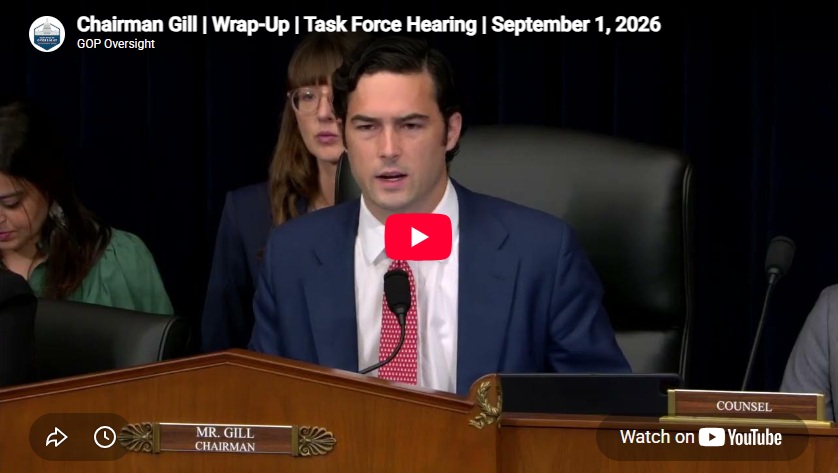
On September 1, the House Oversight Committee’s Task Force on Defending Constitutional Rights and Exposing Institutional Abuses conducted a hearing regarding birth tourism. During the hearing, Task Force Chairman Brandon Gill (R-Texas) asked Dr. Wladimir Lorentz, founder of Have My Baby in Miami, whether his business facilitated birth tourism. Dr. Lorentz pled the Fifth in response to the questions.
A transcript of the hearing shows Dr. Lorentz declined to answer questions regarding whether Have My Baby in Miami facilitated birth tourism for members of the Chinese Communist Party and terrorist organizations:
Task Force Chairman Gill: “Does your business help children of members of the Chinese Communist Party obtain American citizenship?”
Dr. Lorentz: “On the advice of counsel, I respectfully decline to answer the question on the grounds that a truthful answer may tend to incriminate me, and I invoke my rights under the Fifth Amendment to the United States Constitution.”
Task Force Chairman Gill: “Have you ever facilitated the childbirth in America for a member of Tren de Aragua, MS-13, or any other narco-terrorist organization?”
Dr. Lorentz: “On the advice of counsel, I respectfully decline to answer the question on the grounds that a truthful answer may tend to incriminate me, and I invoke my rights under the Fifth Amendment to the United States Constitution.”
Peter Schweizer, President of the Government Accountability Institute, testified before the U.S. Senate in March that between 750,000 and 1.5 million Chinese babies have been born in the U.S. specifically to obtain American citizenship — with the intention of being raised in China.
In his testimony, Schweizer said:
“These individuals grow up in China, often educated in CCP-controlled schools with distorted views of U.S. history, values, and culture. They have no lived connection or demonstrated allegiance to our country, yet they possess full rights as U.S. citizens: the ability to vote in elections, relocate here at will, and—upon turning 21—sponsor their parents as permanent residents.”
Birth tourism often relies on false visa applications — which violates federal law. The U.S. Department of Justice has taken steps to address this type of fraud. But birth tourism also sometimes uses surrogate mothers who are hired to bear children for paying customers in other countries.
We have written repeatedly how commercial surrogacy laws in the U.S. make it possible for corporations and wealthy couples to pay women thousands of dollars to carry children for them, and news outlets report Chinese nationals are exploiting America’s largely unregulated surrogacy industry to acquire children born in the U.S. with U.S. citizenship.
Arkansas U.S. Senator Tom Cotton and Florida U.S. Senator Rick Scott recently urged the U.S. Department of Justice to investigate surrogacy centers operated by foreign nationals, writing:
“Recent reports have uncovered more than 107 Chinese-owned surrogacy agencies operating in Southern California alone. These agencies cater almost exclusively to wealthy Chinese clients, and some are affiliated with Chinese state-owned entities. Chinese nationals pay women living in the United States more than $50,000 to serve as surrogates. The children are born on United States soil and granted automatic citizenship. And in most cases, the infants are promptly flown to China and raised there under the direct influence of the Chinese Communist Party.”
All of this underscores some of the reasons Family Council has opposed commercial surrogacy in Arkansas.
Social commentators and policymakers worldwide have raised concerns about how commercial surrogacy financially pressures women into providing children for paying customers.
Buyers often try to coerce commercial surrogates into having abortions for various reasons.
Commercial surrogacy deliberately deprives children of their biological mothers or fathers.
It exploits women, and it treats children like commodities that can be made to order and sold for profit.
Human beings are not products that can be manufactured, bought, or sold. Our laws need to respect that fact. Policymakers should take steps to address commercial surrogacy and birth tourism in America.
Articles appearing on this website are written with the aid of Family Council’s researchers and writers.