Story Underscores How Commercial Surrogacy Hurts Women and Unborn Children

A recent story from the pro-life group Live Action underscores how commercial surrogacy contracts turn women and unborn children into commodities.

In commercial surrogacy, corporate agencies hire women to carry children for paying customers. But if those customers back out of the contract, they may pressure the surrogate to abort the child. Live Action writes:

Unlike many other countries, the United States has relatively few restrictions on surrogacy — and that’s a problem.

News outlets have reported that a sex offender convicted of crimes involving children was able to obtain a child through surrogacy in Pennsylvania as a result of lax state regulations.

The Daily Wire recently visited several homes in Houston that the State of Texas says are helping Chinese nationals travel to the U.S. on tourist visas “for the sole purpose of giving birth.”

Last year The Wall Street Journal uncovered how Chinese billionaires are taking advantage of America’s surrogacy industry to create what some call “mega-families” with dozens or even hundreds of children.

The Wall Street Journal also has written about allegations of financial fraud among commercial surrogacy businesses.

In December, The New York Times and NBC News both reported about investigations into a surrogacy agency that abruptly shutdown, causing clients to lose an estimated $2 – $5 million total.

The list goes on.

Stories like these underscore why social commentators and policymakers worldwide have raised concerns about commercial surrogacy.

It’s bad when commercial surrogacy goes wrong — but it’s important to remember that surrogacy never “goes right” either.

Commercial surrogacy deliberately deprives children of their biological mothers or fathers.

It treats pregnancy like a “service” that can be purchased, and it treats women like commodities.

Human beings are not products that can be made to order and sold at a profit, but that is what commercial surrogacy does to unborn children. That’s why it’s essential for policymakers to enact real restrictions on commercial surrogacy contracts and agencies.

Articles appearing on this website are written with the aid of Family Council’s researchers and writers.

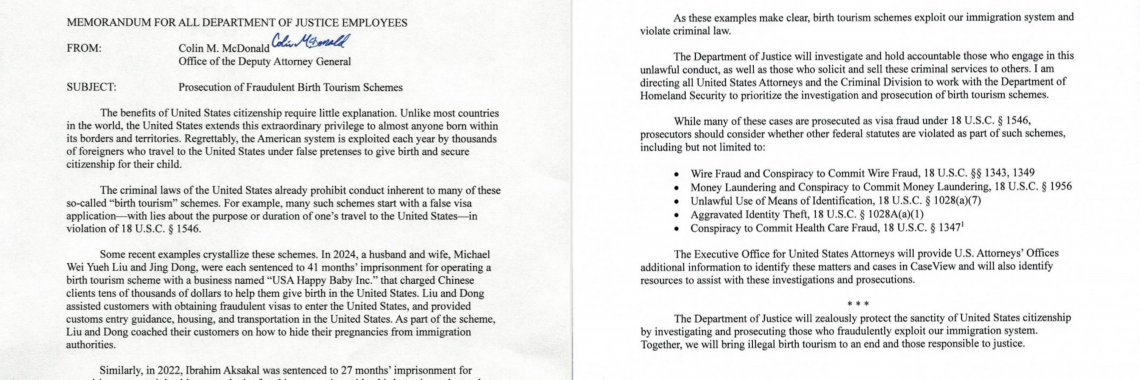
U.S. Department of Justice Memo Directs Prosecutors to Address Fraudulent “Birth Tourism”

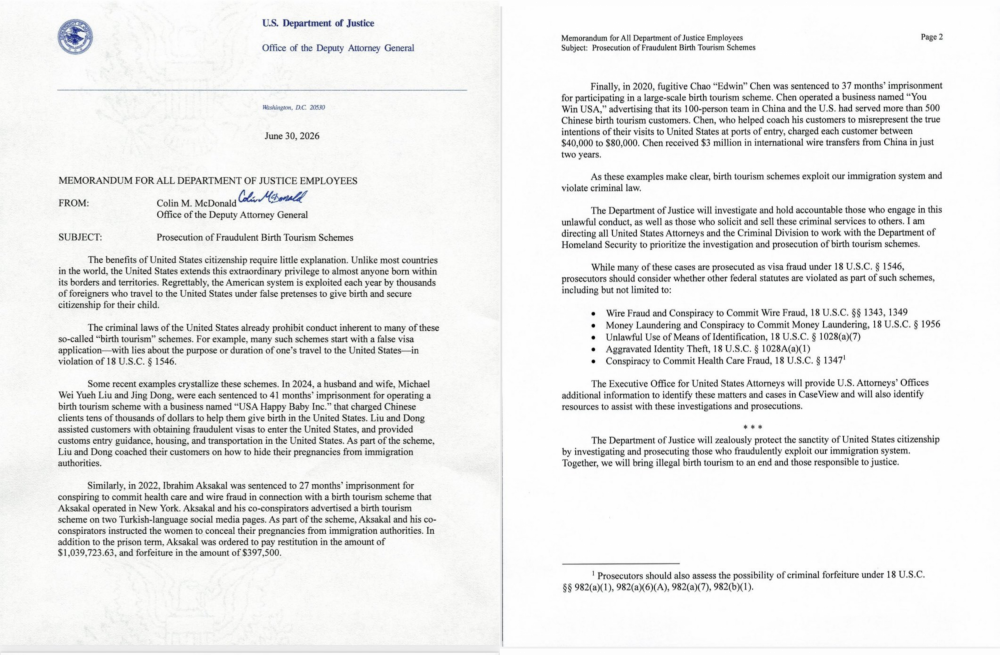
Last week, the U.S. Department of Justice issued a memo directing prosecutors to address fraudulent “birth tourism” in the United States.

U.S. citizenship is guaranteed under the Fourteenth Amendment for “All persons born or naturalized in the United States, and subject to the jurisdiction thereof,” and courts have held that nearly everyone born within the country’s boundaries is a U.S. citizen. But testimony before members of Congress has shown that foreign nationals are using fraudulent tourist visas and international surrogacy contracts to have children born on American soil with U.S. citizenship — a practice commonly referred to as “birth tourism.”

Peter Schweizer, President of the Government Accountability Institute, testified before the U.S. Senate in March that between 750,000 and 1.5 million Chinese babies have been born in the U.S. specifically to obtain American citizenship — with the intention of being raised in China. In his testimony, Schweizer said:

These individuals grow up in China, often educated in CCP-controlled schools with distorted views of U.S. history, values, and culture. They have no lived connection or demonstrated allegiance to our country, yet they possess full rights as U.S. citizens: the ability to vote in elections, relocate here at will, and—upon turning 21—sponsor their parents as permanent residents.

The Daily Wire recently visited several homes in Houston that the State of Texas says are helping Chinese nationals travel to the U.S. on tourist visas “for the sole purpose of giving birth.” The homes are tied to a birthing center that has allegedly facilitated the births of more than 1,000 American-born babies who are then taken back to China. Because the children are born on U.S. soil, they receive birthright citizenship — even though the parents intend to raise the children in China.

Birth tourism often relies on false visa applications — which violates federal law. Now the U.S. Department of Justice appears to be prepared to address the issue.

In a memo released June 30, the DOJ said, “The Department of Justice will investigate and hold accountable those who engage in this unlawful conduct, as well as those who solicit and sell these criminal services to others.” The memo notes that while most of these cases may be prosecuted as visa fraud, prosecutors should consider other possible violations — such as wire fraud, money laundering, identity theft, health care fraud, and others.

Birth tourism wrongly exploits birthright citizenship, but when it’s done in conjunction with commercial surrogacy, it also demeans women and children.

We have written repeatedly how commercial surrogacy laws in the U.S. make it possible for corporations and wealthy couples to pay women thousands of dollars to carry children for them, and news outlets report Chinese nationals are exploiting America’s largely unregulated surrogacy industry to acquire children born in the U.S. with U.S. citizenship.

Last year The Wall Street Journal uncovered how Chinese billionaires are taking advantage of America’s surrogacy industry to create what some call “mega-families” with dozens — or even hundreds — of children. One wealthy Chinese executive allegedly “hired U.S. models and others as egg donors to have 10 girls, with the aim of one day marrying them off to powerful men.”

Arkansas U.S. Senator Tom Cotton and Florida U.S. Senator Rick Scott recently urged the U.S. Department of Justice to investigate surrogacy centers operated by foreign nationals, writing:

“Recent reports have uncovered more than 107 Chinese-owned surrogacy agencies operating in Southern California alone. These agencies cater almost exclusively to wealthy Chinese clients, and some are affiliated with Chinese state-owned entities. Chinese nationals pay women living in the United States more than $50,000 to serve as surrogates. The children are born on United States soil and granted automatic citizenship. And in most cases, the infants are promptly flown to China and raised there under the direct influence of the Chinese Communist Party.”

Social commentators and policymakers worldwide have raised concerns about how commercial surrogacy financially pressures women into providing children for paying customers.

That’s part of the reason Family Council has opposed commercial surrogacy in Arkansas.

Commercial surrogacy deliberately deprives children of their biological mothers or fathers.

It treats pregnancy like a “service” that can be purchased.

It treats women like commodities, and it treats children like products that can be made to order and sold for profit.

Human beings are not products that can be manufactured and exported to other countries. Our laws need to respect that fact. Policymakers should take steps to address commercial surrogacy and “birth tourism” in America.

Articles appearing on this website are written with the aid of Family Council’s researchers and writers.
Poll: Most Americans Say Suicide Is Wrong — But Many Support Physician-Assisted Suicide Anyway

A new Gallup poll shows most Americans believe suicide in general is morally wrong, but opinions are split over physician-assisted suicide.

Gallup’s annual Values and Beliefs survey measures Americans’ views on a wide variety of behaviors — like gambling, human cloning, divorce, and so on.

This year’s survey found 70% of Americans say suicide is morally wrong, which is a strong majority.

But here’s the contradiction: views on “doctor-assisted suicide” are nearly evenly split, with a staggering 49% of Americans saying physician-assisted suicide is morally acceptable.

It seems like many people may believe that suicide is wrong — except in certain cases or when a doctor assists with the suicide. That should concern every pro-life Arkansan.

Physician-assisted suicide is typically sold to the public as a “compassionate” option for people facing terminal illness. But experience has shown that assisted suicide doesn’t help people who are sick or dying, and it doesn’t remain limited to a few cases.

In Oregon — the first state to legalize physician-assisted suicide back in 1997 — a record 637 lethal prescriptions were written last year. Of those patients, only two were referred for psychiatric evaluation before receiving a prescription for suicide. That is a serious failure.

Data shows many of these patients are lonely and feel like they are losing control over their lives. They need counseling and support — not a deadly prescription.

Assisted suicide fundamentally changes the doctor-patient relationship from healing to killing. The Hippocratic Oath promises to “first, do no harm.” Prescribing lethal drugs violates that sacred trust.

The slippery slope is real. In Canada, Belgium, and Netherlands, assisted suicide has expanded far beyond rare, terminal illnesses. Canada is on pace to record its 100,000th assisted suicide death this summer. What starts as a “compassionate choice” eventually becomes routine killing.

In parts of the U.S. where physician-assisted suicide is legal, insurance companies have refused to pay for patients’ medical care, but have offered to cover assisted suicide drugs.

Being pro-life means believing innocent human life is sacred from conception until natural death. Just like abortion, euthanasia and assisted suicide violate the sanctity of innocent human life.

That’s why Family Council has strongly opposed assisted suicide legislation in Arkansas. In 2019 and 2021, Arkansas lawmakers wisely rejected very bad end-of-life legislation. Family Council worked closely with our friends in the legislature to stop those proposals.

Gallup’s survey shows Americans understand that suicide is wrong. We should remember that holds true even when activists try to dress it up as “medicine.”

Articles appearing on this website are written with the aid of Family Council’s researchers and writers.