

Last week, attorneys representing individuals and atheist organizations opposed to Arkansas’ Ten Commandments monument filed legal briefs with the 8th Circuit Court of Appeals.
In 2015, the Arkansas General Assembly passed a law authorizing a privately funded monument of the Ten Commandments at the Capitol Building in Little Rock, and the monument was finally unveiled three years later. But almost immediately, atheist groups filed a lawsuit to remove the monument from the Capitol grounds. The case languished in federal court until a judge ruled against the monument earlier this year.
Arkansas Attorney General Tim Griffin has appealed to the 8th Circuit Court of Appeals to keep the Ten Commandments monument on the State Capitol grounds. Last week, attorneys for the Satanic Temple, the Freedom From Religion Foundation, the American Humanist Association, the ACLU, and others filed legal briefs arguing the monument is unconstitutional and should be removed.
But as Family Council pointed out in an amicus brief filed over the summer, the district court in Little Rock went against U.S. Supreme Court precedent when it ruled against the monument earlier this year.
The U.S. Supreme Court reviews monuments like Arkansas’ in light of their longstanding history and tradition. Historians have long recognized the Ten Commandments as one of the earliest examples of the rule of law in human history, and they have helped shape philosophy and laws in countries around the world.
That’s why the Ten Commandments have traditionally appeared in artwork at public buildings across America.
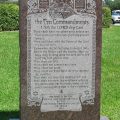
Arkansas’ monument commemorates that same historical and cultural legacy. It’s also identical to a monument the U.S. Supreme Court ruled constitutional at the Texas Capitol Building in 2005. With all of that in mind, we believe our federal courts will ultimately let Arkansas’ Ten Commandments monument remain on the State Capitol grounds.
Articles appearing on this website are written with the aid of Family Council’s researchers and writers.
Related posts:
 Arkansas Attorney General Asks 8th Circuit to Keep Ten Commandments Monument on Capitol Grounds
 Atheist Groups Ask Federal Judge to Rule Against Arkansas’ Ten Commandments Monument
Atheist Groups Continue Legal Battle Against Arkansas’ Ten Commandments Monument
Atheist Groups Renew Legal Fight Against Arkansas Ten Commandments Monument
Atheist Groups Ask Federal Judge to Rule Against Arkansas’ Ten Commandments Monument
Atheist Groups Continue Legal Battle Against Arkansas’ Ten Commandments Monument
Atheist Groups Renew Legal Fight Against Arkansas Ten Commandments Monument