Family Council Supports Amendment Requiring Ballot Measures to Pass in a Majority of Counties

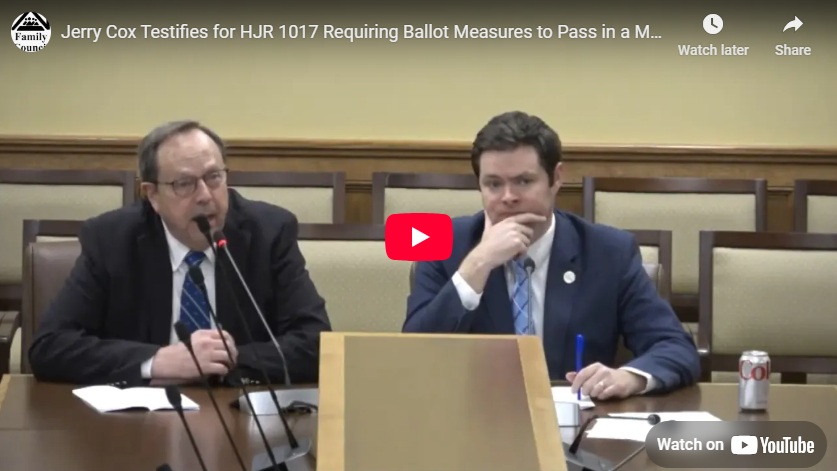
On Monday evening Family Council President Jerry Cox testified in support of a proposed amendment that would require ballot measures to pass in a majority of Arkansas’ counties in order to become law.

As we have written many times this year, the Arkansas Constitution lets canvassers circulate petitions to place measures on a general election ballot. Its original intent was to give citizens a way to function as a “legislative body.” Unfortunately, powerful special interests have used the initiative process to put flawedmisleading, and deceptive measures on the ballot in Arkansas.

If a campaign has enough money, it can hire hundreds of petition canvassers to collect signatures to place a measure on the ballot, and it can run deceptive advertising to support that ballot measure.

The way Arkansas’ ballot initiative process works right now, voters in a handful of counties can decide the outcome of a ballot measure that impacts every corner of the state, because the Arkansas Constitution only requires ballot measures to receive a simple majority vote in order to pass.

That means special interest groups who back a ballot measure can focus on campaigning for their measure in a handful of populated areas. A ballot measure that is really bad for rural Arkansans might pass if enough voters in the metropolitan areas support it.

H.J.R. 1017 by Rep. David Ray (R — Maumelle) and Sen. John Payton (R — Wilburn) would require ballot measures to pass with a majority vote statewide and in a majority of Arkansas’ counties in order to become law.

This means under H.J.R. 1017, a constitutional amendment, initiated act, or a measure referred by the Arkansas Legislature would need to receive at least 51% of the vote statewide, and it would need to pass in at least 38 of Arkansas’ 75 counties.

H.J.R. 1017 is a good measure that would keep metropolitan areas from running roughshod over rural communities, and it would help ensure ballot measure sponsors actually campaign statewide instead of focusing on Arkansas’ cities.

You can watch Family Council President Jerry Cox’s committee testimony on H.J.R. 1017 below.

Bill Addressing Paid Petition Canvassing Heads to Arkansas Senate

On Monday the Arkansas House of Representatives overwhelmingly passed a good bill clarifying the definition of “paid canvasser” in the state’s ballot initiative laws.

The Arkansas Constitution lets canvassers circulate petitions to place measures on a general election ballot. Its original intent was to give citizens a way to function as a “legislative body.” Unfortunately, powerful special interests have used the initiative process to put flawedmisleading, and deceptive measures on the ballot in Arkansas.

If a campaign has enough money, it can hire hundreds of petition canvassers to collect signatures to place a measure on the ballot.

Last month pro-life leaders testified in committee that canvassers for the 2024 Arkansas Abortion Amendment allegedly violated state law and were paid $500 bonuses for “altercations” with pro-lifers who opposed the abortion amendment.

H.B. 1714 by Rep. Ryan Rose (R — Van Buren) and Sen. Kim Hammer (R — Benton) clarifies the definition of a “paid canvasser” in state law.

Current law says that anyone who receives anything of value in return for soliciting signatures on a petition is a paid canvasser. Paid canvassers are subject to certain laws that do not apply to volunteer canvassers.

H.B. 1714 further clarifies that receiving anything of value includes receiving payment for items like food, lodging, travel, bonuses, fees, gift cards, and other payments associated with obtaining signatures on a petition. This will help bring better clarity to state law.

Arkansas’ ballot initiative process has become the opposite of what it was intended to be, and if lawmakers do not act soon, the problem is simply going to get worse.

H.B. 1714 now goes to the Arkansas Senate for consideration.

The Following Representatives Voted FOR H.B. 1714

  • Achor
  • Andrews
  • Beaty Jr.
  • Beck
  • Bentley
  • S. Berry
  • Breaux
  • Brooks
  • A. Brown
  • K. Brown
  • M. Brown
  • N. Burkes
  • R. Burkes
  • Joey Carr
  • John Carr
  • Cavenaugh
  • Childress
  • C. Cooper
  • Cozart
  • Dalby
  • Duke
  • Eaton
  • Eaves
  • Eubanks
  • Furman
  • Gazaway
  • Gonzales
  • Gramlich
  • Hall
  • Hawk
  • Henley
  • Holcomb
  • Hollowell
  • Jean
  • L. Johnson
  • Ladyman
  • Long
  • Lundstrum
  • Lynch
  • Maddox
  • McAlindon
  • McClure
  • McCollum
  • M. McElroy
  • McGrew
  • B. McKenzie
  • McNair
  • S. Meeks
  • Milligan
  • J. Moore
  • K. Moore
  • Nazarenko
  • Painter
  • Pearce
  • Pilkington
  • Puryear
  • Ray
  • Richmond
  • Rose
  • Rye
  • R. Scott Richardson
  • M. Shepherd
  • Steimel
  • Torres
  • Tosh
  • Underwood
  • Unger
  • Vaught
  • Walker
  • Wardlaw
  • Warren
  • Wing
  • Womack
  • Wooldridge
  • Wooten
  • Speaker Evans

The Following Representatives Voted AGAINST H.B. 1714

  • F. Allen
  • Barnes
  • Barnett
  • Clowney
  • A. Collins
  • Ennett
  • D. Garner
  • Hudson
  • J. Mayberry
  • McCullough
  • McGruder
  • Perry
  • J. Richardson
  • T. Shephard
  • Springer
  • Steele
  • D. Whitaker
  • Gonzales Worthen

The Following Representatives Did Not Vote

  • Barker
  • Crawford
  • Duffield
  • K. Ferguson
  • Magie
  • Schulz

Articles appearing on this website are written with the aid of Family Council’s researchers and writers.

Bill Filed to Protect Physical Privacy in Shelters, State Buildings, Jails

On Monday, lawmakers filed legislation protecting people’s physical privacy and safety in certain shelters, in state and local jails, and in public buildings.

The measure is similar to a law Arkansas passed in 2023 to protect privacy in public schools and on overnight school trips.

S.B. 486 by Sen. Blake Johnson (R — Corning) and Rep. Mary Bentley (R — Perryville) protects physical privacy and safety of Arkansans in showers, locker rooms, changing rooms, restrooms, and sleeping quarters in government buildings and in state and local jails.

The bill also applies to changing rooms, restrooms, and sleeping quarters in shelters for victims of domestic violence.

S.B. 486 would require these facilities to be designated for “male” or “female” use. The bill generally requires people to use the facility that corresponds to their biological sex.

Over the years, we have seen efforts to house men with women in jails, let men stay in women’s shelters, and give men access to women’s changing areas, locker rooms, showers, and restrooms.

S.B. 486 is common sense legislation narrowly tailored to protect physical privacy and safety in public buildings and shelters in Arkansas.

You Can Read The Bill Here.

Articles appearing on this website are written with the aid of Family Council’s researchers and writers.