Arkansas House Committee Advances Two Good Bill Addressing Ballot Initiatives

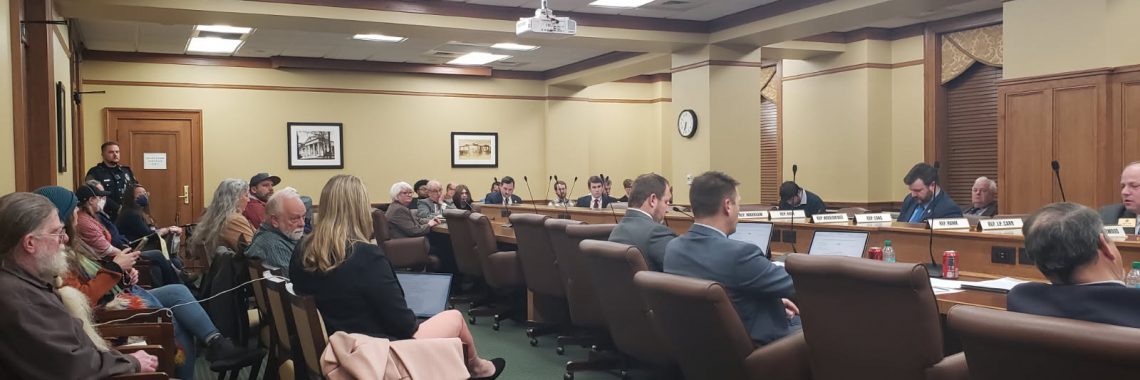
On Monday the Arkansas House State Agencies Committee advanced two good bills strengthening Arkansas’ laws concerning ballot initiatives.

S.B. 208 by Sen. Kim Hammer (R — Benton) and Rep. Kendon Underwood (R — Cave Springs) requires petition canvassers to verify a person’s identity via photo ID before obtaining the person’s signature on a petition. This helps prevent people from fraudulently signing someone else’s name on a petition.

S.B. 211 by Sen. Kim Hammer (R — Benton) and Rep. Kendon Underwood (R — Cave Springs) requires petition canvassers to file an affidavit with the Secretary of State verifying that the canvasser complied with the Arkansas Constitution and all Arkansas laws concerning canvassing, perjury, forgery, and fraud in the process of gathering signatures.

Both bills have already passed the Arkansas Senate. They now go to the entire Arkansas House of Representatives for a final vote.

As we have said many times, Arkansas’ ballot initiative process has become the opposite of what it was intended to be. Its original intent was to give citizens a way to enact laws and amendments on their own. But today, powerful special interests are able to exploit the ballot initiative process for personal gain.

Pro-life leaders have provided committee testimony alleging that canvassers for the 2024 Arkansas Abortion Amendment violated state law and were paid $500 bonuses for “altercations” with pro-lifers who opposed the abortion amendment.

If the Arkansas Legislature does not enact good laws that bring accountability and transparency to the ballot initiation process, these problems will simply continue to get worse.

Articles appearing on this website are written with the aid of Family Council’s researchers and writers.

Resolution Filed Recognizing Home Schooling in Arkansas

Above: Rep. Cooper presents legislation in this file photo from 2021.

On Monday Rep. Cameron Cooper (R — Romance) filed H.R. 1046 recognizing February 26 as Homeschool Day at the Arkansas State Capitol.

The resolution highlights many of the good things about home schooling and celebrates home schooling’s legacy in Arkansas, saying,

WHEREAS, over thirty thousand (30,000) students were homeschooled in Arkansas during the 2023-2024 school year; and

WHEREAS, homeschooling offers flexibility, efficiency, and effectiveness in teaching students in Arkansas, and this benefit allows homeschooling families to offer increased opportunities for community involvement and service to others for their children; and

WHEREAS, homeschooling is not a one-size-fits-all plan, and the education can be customized to the student’s learning styles and preferences and can be beneficial to students with special needs; and

WHEREAS, homeschooling provides benefits in academics, mental health, physical health, and social development; and

WHEREAS, homeschooling encourages autonomy and independence and allows children to harness their own unique qualities and interests; and

WHEREAS, homeschooling offers opportunities for students to learn entrepreneurship and often to begin working on their own small businesses; and

WHEREAS, homeschooling emphasizes family as a foundation for social development and development of faith; and

WHEREAS, homeschooling is accommodating to special situations and works well for military families, families who travel, and families contending with illness and challenging work schedules; and

WHEREAS, homeschooling parents are able to value an individual student’s potential and focus on this individual potential instead of minimum standards and standardized testing, and these parents are allowed to shape homeschooling so that learning for the students can be reactive to new methods and new concepts regarding positive child development; and

WHEREAS, homeschooling provides for a focus on life skills that students can use as they progress into adulthood as homeschooling allows students to dedicate time to learning anything from cooking to budgeting,

NOW THEREFORE,

BE IT RESOLVED BY THE HOUSE OF REPRESENTATIVES OF THE NINETY-FIFTH GENERAL ASSEMBLY OF THE STATE OF ARKANSAS:

THAT the House of Representatives recognize February 26, 2025, as Homeschool Day at the State Capitol.

Home schooling in Arkansas has surged since the COVID-19 pandemic. In 2019 there were a little less than 22,000 homeschoolers in Arkansas. In early 2020, those numbers climbed to 22,249. By 2023, homeschooling had risen to 30,000 students. And last year homeschooling surged again, to 32,767 students.

Family Council has always believed families deserve options when it comes to education. That’s one reason we support home schooling.

Research shows parental involvement generally is tied to better educational outcomes for children. That’s true no matter how families choose to educate their children — but home schooling is particularly good for many families, because it lets them choose the education that’s best for them. That’s good for everyone.

Family Council’s home school division, the Education Alliance, is hosting Home School Day at the Capitol on February 26. You can learn more about this free event here.

Articles appearing on this website are written with the aid of Family Council’s researchers and writers.
Several Bills in Play to Strengthen Arkansas’ Initiative Process

Several good bills that would strengthen Arkansas’ ballot initiative process are working their way through the state legislature.

Arkansas’ ballot initiative process has become the opposite of what it was intended to be. Its original intent was to provide citizens a means of functioning as a “legislative body.” But today, powerful special interests have used our own ballot initiative process against us.

Pro-life leaders gave committee testimony last week alleging that canvassers for the 2024 Arkansas Abortion Amendment violated state law and were paid $500 bonuses for “altercations” with pro-lifers who opposed the abortion amendment.

If the Arkansas Legislature does not enact good laws that bring accountability and transparency to the ballot initiation process, these problems will simply continue to get worse.

Below is a rundown of some of the good bills lawmakers are considering to bring greater accountability to the ballot initiative process.

H.B. 1221 by Rep. David Ray (R — Maumelle) and Sen. Kim Hammer (R — Benton) clarifies Arkansas’ laws concerning initiatives and referenda. The bill makes it clear that petition signatures expire at the end of a General Election cycle. This would prevent canvassers from collecting signatures across multiple election cycles and help ensure sponsors don’t submit old signatures that are outdated or more likely to be invalid. The bill has passed the Arkansas House and the Senate State Agencies Committee. It is slated to go before the entire Arkansas Senate for a final vote. See How Your Representative Voted HereRead The Bill Here.

H.B. 1222 by Rep. David Ray (R — Maumelle) and Sen. Kim Hammer (R — Benton) clarifies Arkansas’ laws concerning initiatives and referenda. The bill says the Arkansas Attorney General cannot approve a measure’s sponsors to begin collecting signatures to place a measure on the ballot if the measure conflicts with the U.S. Constitution or federal law. The bill also prevents sponsors from asking the attorney general to certify conflicting measures. The bill has passed the Arkansas House and the Senate State Agencies Committee. It is slated to go before the entire Arkansas Senate for a final vote.  See How Your Representative Voted HereRead The Bill Here.

S.B. 207 by Sen. Kim Hammer (R — Benton) and Rep. Kendon Underwood (R — Cave Springs) requires petition canvassers to inform people that petition fraud is a crime before obtaining their signatures on a petition. The bill has passed the Arkansas Senate, and it is slated to go before the House State Agencies Committee next. See How Your Senator Voted HereRead The Bill Here.

S.B. 208 by Sen. Kim Hammer (R — Benton) and Rep. Kendon Underwood (R — Cave Springs) requires canvassers to verify a person’s identity via photo ID before obtaining the person’s signature on a petition. This helps prevent people from fraudulently signing someone else’s name on a petition. The bill has passed the Arkansas Senate, and it is slated to go before the House State Agencies Committee next. See How Your Senator Voted HereRead The Bill Here.

S.B. 209 by Sen. Kim Hammer (R — Benton) and Rep. Kendon Underwood (R — Cave Springs) clarifies that the signatures a canvasser collects will not count if the Secretary of State finds the canvasser has violated Arkansas’ laws concerning canvassing, perjury, forgery, or fraud in the process of gathering signatures. The bill has initially passed the Arkansas Senate, but its sponsor is working to garner enough votes to adopt the bill’s emergency clause as well. See How Your Senator Voted HereRead The Bill Here.

S.B. 210 by Sen. Kim Hammer (R — Benton) and Rep. Kendon Underwood (R — Cave Springs) requires people to read the ballot title of the measure before signing a petition. The ballot title includes a summary of the ballot measure. Reading the ballot title helps ensure people understand the measure before they sign a petition to place the measure on the ballot. The bill has initially passed the Arkansas Senate, but its sponsor is working to garner enough votes to adopt the bill’s emergency clause as well. See How Your Senator Voted HereRead The Bill Here.

S.B. 211 by Sen. Kim Hammer (R — Benton) and Rep. Kendon Underwood (R — Cave Springs) requires petition canvassers to file an affidavit with the Secretary of State verifying that the canvasser complied with the Arkansas Constitution and all Arkansas laws concerning canvassing, perjury, forgery, and fraud in the process of gathering signatures. The bill has passed the Arkansas Senate, and it is slated to go before the House State Agencies Committee next. See How Your Senator Voted HereRead The Bill Here.

S.B. 212 by Sen. Kim Hammer (R — Benton) and Rep. Kendon Underwood (R — Cave Springs) creates the Document Validity Division within the Arkansas Secretary of State’s office to investigate, subpoena, and nullify fraudulent or false documents related to ballot initiatives. The bill is still in the Senate State Agencies Committee. Read The Bill Here.