This Supreme Court Ruling Has Major Implications for Free Speech

In a monumental decision last week, the U.S. Supreme Court affirmed that counseling conversations are speech and that states cannot silence viewpoints in the counseling room.

In 2019, Colorado enacted a law prohibiting licensed counselors from engaging in “conversion therapy.” Under that law, counselors are free to engage in pro-LGBT counseling, but they cannot help people who want to overcome their same-sex attraction or gender confusion.

But last week the Court delivered an 8-1 opinion saying that Colorado’s law against so-called “conversion therapy” violates the First Amendment.

Our friends at Alliance Defending Freedom helped litigate the case. In a statement, ADF said:

Kaley Chiles is a licensed professional counselor in Colorado who seeks to listen, guide, and help young people find peace in their own bodies. With their parents’ support, these clients come to her by choice—seeking honest, compassionate care.

But a Colorado law passed in 2019 forbids her from helping kids find peace in their own bodies, even when that’s exactly what they want. If she does, she faces crushing fines and the potential loss of her license.

Colorado’s counseling censorship law violates Kaley’s freedom of speech and that of her clients by censoring and prohibiting certain private client-counselor conversations regarding gender identity that the government disfavors while allowing—even encouraging—conversations the government favors.

This is clear, viewpoint-based censorship.

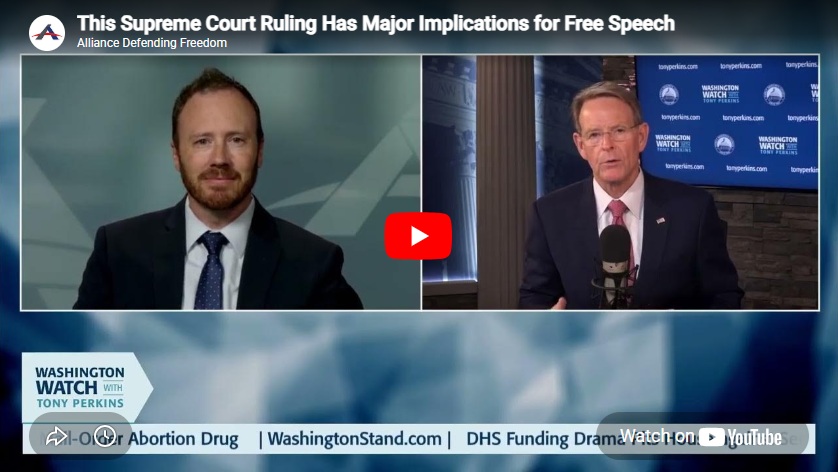
In a video interview with Family Research Council’s Tony Perkins, ADF senior counsel Jake Warner said, “Colorado has been no respecter of the First Amendment. ADF has litigated multiple cases, including up to the U.S. Supreme Court against the state of Colorado in its effort to censor ideas that it disagrees with.”

Warner also said the ruling helps protect counselors not only in Colorado, but in at least 23 other states and over 100 local jurisdictions around the country that have enacted similar bans on “conversion therapy.”

Many people want counselors to help them overcome unwanted same-sex attraction or gender dysphoria, and many medical experts — like the American College of Pediatricians and the HHS — believe that encouraging a child to disagree with his or her biological sex is harmful.

In Arkansas, multiple “conversion therapy” bans have been filed at the Capitol over the years, but none have passed. The U.S. Supreme Court’s decision in this case shows that Arkansas’ lawmakers were right not to enact these flawed measures.

Articles appearing on this website are written with the aid of Family Council’s researchers and writers.

U.S. Supreme Court Rejects Colorado’s “Conversion Therapy” Ban

Last week the U.S. Supreme Court overwhelmingly ruled against a Colorado law censoring counselors who work with people suffering from gender dysphoria.

In 2019, Colorado enacted a law prohibiting licensed counselors from engaging in “conversion therapy.” Under that law, counselors are free to engage in pro-LGBT counseling, but they cannot help people who want to overcome their same-sex attraction or gender confusion.

In an 8-1 opinion delivered last Tuesday, the Court held that Colorado’s law against so-called “conversion therapy” violates the First Amendment.

This is good news. Over the years, many states have passed laws like Colorado’s infringing free speech and the free exercise of religion among licensed healthcare professionals.

Many people want counselors to help them overcome unwanted same-sex attraction or gender dysphoria, and many medical experts — like the American College of Pediatricians and the HHS — believe that encouraging a child to disagree with his or her biological sex is harmful.

In Arkansas, multiple “conversion therapy” bans have been filed at the Capitol over the years, but none have passed. The U.S. Supreme Court’s decision in this case shows that Arkansas’ lawmakers were right not to enact these flawed measures.

Articles appearing on this website are written with the aid of Family Council’s researchers and writers.

Federal Appeal Process Continues Over Arkansas’ Ten Commandments Law

Last week, U.S. District Judge Timothy Brooks issued a final decision against the Ten Commandments in a group of Arkansas school districts, but higher federal courts are already weighing arguments from the case.

Last year the Arkansas Legislature passed Act 573 by Sen. Jim Dotson (R — Bentonville) and Rep. Alyssa Brown (R — Heber Springs). This good law requires privately-funded copies of the Ten Commandments to be displayed in public schools and other public buildings across the state. The measure received strong support in the Arkansas Legislature, and Governor Sanders signed it into law last April.

However, it did not take long for attorneys from the ACLU and a group of atheist organizations to sue to block Act 573. Last week, Judge Brooks in Fayetteville issued a final bad ruling against Act 573 in that lawsuit.

Fortunately, Arkansas Attorney General Tim Griffin has intervened in the case, and his office has already appealed previous rulings Judge Brooks made against Act 573 last year.

Amicus briefs in support of Act 573 have already been filed at the Eighth U.S. Circuit Court of Appeals in St. Louis.

It’s also worth noting a federal appeals court sided with the State of Louisiana last month in a similar case over the Ten Commandments.

In 2024, Louisiana passed a law allowing Ten Commandments displays in public school classrooms, but the measure drew immediate legal challenges from groups like the ACLU — just like Arkansas’ Act 573 did.

Fortunately, the Fifth U.S. Circuit Court of Appeals ruled that a lower court was wrong to block Louisiana’s Ten Commandments law.

Over the years, the U.S. Supreme Court has ruled that states are free to honor and recognize documents or symbols that are important to our nation’s history — like the Ten Commandments or the national motto.

The Ten Commandments are one of the earliest examples of the rule of law, and they have had a profound impact in shaping our society and our government.

In his motion for summary judgment in Arkansas’ Ten Commandments case, Attorney General Tim Griffin wrote:

The Ten Commandments “have been the most influential law code in history.” … And displays and depictions of the decalogue and of Moses throughout government buildings and property reflect the significance of the Ten Commandments to our Nation’s history and heritage. … Act 573 does not violate the Establishment Clause because it is consistent with historical practices and understandings and does not bear any of the hallmarks of religious establishment.

During her testimony in support of Act 573 last year, Rep. Alyssa Brown noted that the U.S. Supreme Court now uses a “longstanding history and tradition test” to decide if it is constitutional to display something like a copy of the Ten Commandments. Rep. Brown said, “The Ten Commandments without a doubt will pass this longstanding history and tradition test.”

We believe our federal courts ultimately will agree and uphold Act 573 as constitutional.

Articles appearing on this website are written with the aid of Family Council’s researchers and writers.