

Witchcraft Now Out of Stock on Etsy

The online marketplace Etsy has reportedly removed witches selling blessings and curses from its platform.

Etsy is a popular site where people sell handmade and vintage items. The platform’s seller policies generally prohibit people from marketing “metaphysical services” such as healing, spellcasting, prayer, and so on. In other words, Etsy prohibits people from buying or selling prayers, blessings, or curses.

However, Etsy has had trouble with witches marketing curses on its website. Our friends at Axis write:

The conversation about Etsy witches came to a head in September, after the writer of a since-deleted article from Jezebel claimed to have paid Etsy witches to curse Charlie Kirk two days before his assassination (even though the curses were only supposed to involve minor inconveniences). The sale of anything that promises life change has been officially banned from Etsy since 2015 (which would also include selling prayer services)—but according to The Daily Dot, the popularity of Etsy witches has only grown since then. This popularity speaks to a view of spirituality as primarily a means of getting what we want—and to a view of “alternative” spiritual practices offering a greater sense of agency.

We have written before about how popular the occult and its cheap spirituality have become in recent years.

In 2021, “WitchTok” videos on TikTok garnered an astounding 18.7 billion views.

In October of 2017 the news outlet MarketWatch ran a story titled “Why millennials are ditching religion for witchcraft and astrology.” The article highlighted growing interest in the occult among young adults.

CBS News recently reported that astrology has become a $3 billion industry — “and it’s only getting bigger,” they say. In fact, some financial experts estimate that figure could go as high as $22.8 billion worldwide in the next five years.

In Arkansas, pro-abortion witches said they were placing jar hexes and candle curses on pro-lifers after the 2024 Arkansas Abortion Amendment failed to qualify for the ballot. While some people might think that sounds like a weird joke, we have every reason to believe these individuals were serious.

Christians need to remember three things when it comes to witchcraft:

First, that the Bible soundly condemns witchcraft. There is no question about that.

Second, Christianity was birthed in a time when paganism and witchcraft were commonplace. The early apostles encountered the occult on several occasions. — such as Acts chapters 17 and 19. If Christianity could overcome those cultures, Christianity can overcome the present one as well.

And third, only the gospel can give people the spiritual rest they seek. Amid bondage and uncertainty, scripture promises believers freedom and hope.

It’s good to see Etsy removing witchcraft from its platform. This kind of spirituality can’t give people what they are looking for. Only Christ can do that.

Articles appearing on this website are written with the aid of Family Council’s researchers and writers.

“WitchTok” and the Popularity of the Occult Online

As Halloween approaches, a few news outlets have published stories about a social media trend among teens and young adults: WitchTok.

The name comes from TikTok — a social media platform where users share videos of themselves.

Videos labeled “WitchTok” on the platform primarily seem to be focused on the practice of witchcraft and the occult. As University of Cambridge professor Rebekah King recently noted in an article at The Conversation, videos labeled “WitchTok” have garnered an astounding 18.7 billion views.

WitchTok is just the latest example of young adults warming to the occult.

In October of 2017 the news outlet MarketWatch ran a story titled “Why millennials are ditching religion for witchcraft and astrology.” The article highlighted growing interest in the occult among young adults.

Psychic services — which include everything from palm reading to horoscopes — are now a multi-billion dollar industry.

Popular phone apps offer advice based on the zodiac.

Something once relegated to tabloids and the back pages of newspapers is now mainstream.

The growing interest in the occult arguably is a symptom of spiritual restlessness. The phrase “spiritual but not religious” is popular among young adults who are reluctant to commit to a faith. As St. Augustine said long ago, our hearts are restless until they find their rest in God. The growing fascination with the occult may be a result of that restlessness.

Christians need to remember three things.

First, that the Bible soundly condemns witchcraft. There is no question about that.

Second, Christianity was birthed in a time when paganism and witchcraft were commonplace. The early apostles encountered the occult on several occasions. — such as Acts chapters 17 and 19. If Christianity could overcome those cultures, Christianity can overcome the present one as well.

And third, only the gospel can give people the spiritual rest they seek. Amid bondage and uncertainty, scripture promises believers freedom and hope.

“WitchTok” can’t give people what they are looking for, but Christ can.

Witchcraft as Cheap Spirituality

Our friends at the Colson Center for Christian Worldview have released a commentary on the growing interest in the occult among Millennials.

John Stonestreet writes,

The owner of one so-called “metaphysical boutique” in New York says business has never been better. Her occult accessories fly off shelves and into the apartments of educated, urban young people. For those who want to go even deeper, her establishment offers workshops like “Witchcraft 101,” “Astrology 101,” and “Spirit Séance.” . . . .

All told, practices like astrology, aura reading, mediumship, tarot-cards, etc., generate a staggering $2 billion annually.

So what do we make of this exodus from organized religion and into the arms of new expressions of old paganism? Well, for one thing, it shows young people have no idea what they’re actually buying into. As my colleague, Roberto Rivera, wrote at BreakPoint.org, witchcraft and occult spirituality has been marketed the last few decades as sanitized, consumer-friendly versions of the real thing. Sorcery and star signs may be in vogue now, but one need only look at the preserved bodies of human sacrifices from Iron-Age Europe to know what sort of world this worldview creates.

You can read the entire commentary here or listen to it below.

[audio:http://www.breakpoint.org/wp-content/uploads/2017/11/112117_BP.mp3|titles=Millennials Spellbound by the Occult by John Stonestreet]

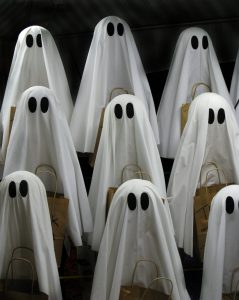
Photo Credit: By Paul Sapiano from San Diego, USA (Trick Or Treat.) [CC BY 2.0 (http://creativecommons.org/licenses/by/2.0) or CC BY 2.0 (http://creativecommons.org/licenses/by/2.0)], via Wikimedia Commons.