
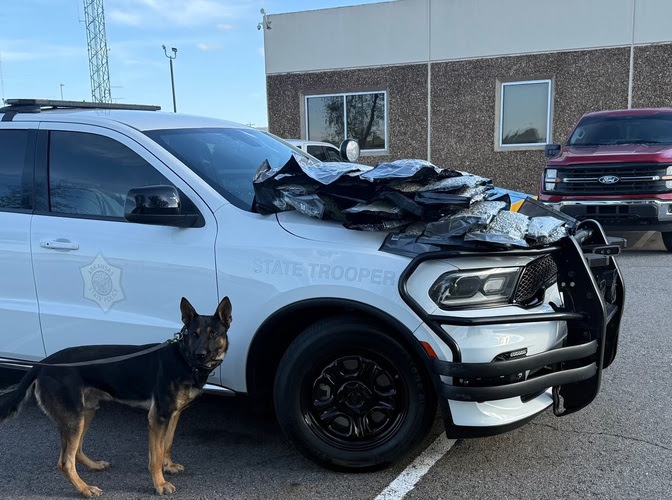
On September 23, state troopers intercepted nearly 60 pounds of illegal marijuana and 200 grams of THC vape products during back-to-back traffic stops on I-40.
Nationwide, many states have legalized marijuana to varying degrees, and federal regulators have eased restrictions on the drug. But legalization has actually emboldened drug cartels to ship illicit marijuana across the country — including through states like Arkansas.
In a statement, the Arkansas State Police said:
“Around 2:15 p.m., Troopers stopped a Nissan Rogue traveling eastbound on I-40 near mile marker 72 for traffic violations.
“A search of the vehicle revealed suitcases containing 30 individually packaged bundles of illegal marijuana with a combined weight of approximately 30 pounds. The driver, Darnell Keith Russell Reed, 39, of Waynesboro, Va., was arrested along with passenger, Ashley Renee Carter, 36, also of Waynesboro. Troopers also seized $4,510 in cash from Carter. Reed and Carter were transported to the Pope County Detention Center. Both are being held on charges of Possession of Drug Paraphernalia and Possession of a Controlled Substance with Purpose to Deliver. Reed was also found to be driving on a suspended license.
“Around 4:15 p.m., Troopers stopped a Ford Bronco Sport traveling eastbound on I-40 near mile marker 77 for a traffic violation.
“A search of the vehicle uncovered 29 vacuum-sealed packages of illegal marijuana, weighing about 29 pounds, and 100 THC vape cartridges.
“The driver, Jermaine Bowers, 35, was arrested and transported to the Pope County Detention Center, where he was charged with Possession of a Controlled Substance with Purpose to Deliver.”
I-40 is part of a major drug trafficking corridor that passes through Arkansas, and the Arkansas State Police routinely intercept marijuana from other parts of the country that appears to be intended for the black market.
Contrary to popular belief, legalizing marijuana does not weaken the black market. If anything, it makes the black market stronger.
Authorities in California seized more than 63,000 pounds of illegal marijuana from April to June of this year and made multiple raids at illegal marijuana sites over the summer. Law enforcement officers have told news outlets that legalization has been “a total failure in California,” saying the state had been inundated with black market marijuana.
The U.S. Department of Justice has said organized crime from Mexico and China may be making millions of dollars from marijuana grown on U.S. soil. Grow sites often use illegal pesticides that poison users and pollute the local environment.
These illegal marijuana operations often are believed to be tied to labor trafficking and violent crime, contributing to what some have called “modern day slavery on American soil.”
However, the problem is much larger than illegal grow sites.
In many cases marijuana may be grown legally but then illegally diverted to the black market. In Oklahoma, for example, growers produce an estimated 60 times more marijuana than Oklahomans can legally use. Authorities say much of Oklahoma’s marijuana is sold on the black market.
In Arkansas, marijuana’s supporters have argued that legalization could decrease Arkansas’ crime problems or be good for police, but experience shows that has not been the case in other states.
All of this underscores what we have said for years: Marijuana may be many things, but “harmless” simply is not one of them.
Articles appearing on this website are written with the aid of Family Council’s researchers and writers.
Related posts:
 Arkansas State Police Seized More Than 775 Pounds of Illegal Drugs in February Traffic Stops
 Arkansas State Police Seize More Than 400 Pounds of Illicit Marijuana From Out of State in Single Traffic Stop
 Arkansas State Troopers Seize 248 Pounds of Illegal Marijuana from Out of State in Christmas Eve Traffic Stop
 Arkansas Authorities Seize 500+ Pounds of Illegal Marijuana From Out of State in Single Traffic Stop