Family Council Joins Brief Defending States’ Authority to Protect Life

Last week, Family Council joined 37 other organizations in a federal legal brief against mail-order abortion drugs.

Arkansas law generally prohibits abortion except to save the life of the mother, and it is a crime for an abortionist to mail abortion drugs like RU-486 into the state. But under the Biden Administration, the U.S. Food and Drug Administration began allowing mail-order abortion drugs. Pro-abortion states have also enacted “shield laws” for abortionists who mail abortion drugs into states like Arkansas.

All of that has undermined Arkansas’ good, pro-life laws that protect women and unborn children from abortion.

In response, the State of Missouri has filed a federal lawsuit challenging the FDA’s mail-order abortion drug protocols. Last week, Family Council joined an amicus brief led by Advancing American Freedom in that lawsuit.

The brief urges the Court to defend the states’ ability to enact and enforce their pro-life laws that protect women and unborn children from abortion drugs.

This is the second time in less than two months that Family Council has participated in amicus briefs against abortion drugs. In February, we also joined a legal brief in Louisiana’s lawsuit against the FDA’s abortion-by-mail policy.

A good court ruling in these cases could help stop the flow of abortion drugs across state lines.

New evidence shows that abortion drugs are much more dangerous than the FDA previously thought.

A recent study by the experts at the Ethics and Public Policy Center found abortion drugs are at least 22 times more dangerous than the U.S. Food and Drug Administration labeling indicates. Nearly 11% of women experience serious health complications from abortion pills — including sepsis, infection, and life-threatening hemorrhage.

These drugs should not be available at all — much less through the mail.

Family Council is pleased to join with so many other excellent groups who are willing to stand up for innocent human life in court.

You Can Read The Amicus Brief Here.

Articles appearing on this website are written with the aid of Family Council’s researchers and writers.

The Bible Does Not Support Abortion: Guest Column

In February, James Talarico, a U.S. Senate candidate from Texas, claimed that the biblical story of the Annunciation from the Gospel of Luke supports his proabortion position. On the Joe Rogan podcast, Talarico asserted that because the angel sought Mary’s consent, a woman has a right to choose her own procreative destiny. 

The most obvious flaw with this assertion is that the angel did not ask Mary’s permission. In fact, the angel of the Lord said, “And behold, you will conceive in your womb and bear a son, and you shall call his name Jesus.” Mary submits to accept God’s will, but the only person with questions in that conversation was Mary. The angel declared what was going to happen. Mary was humbled and accepted it as the calling on her life. 

The deeper flaw in this and most other proabortion arguments is the assumption that whatever is in the womb is not a human life worth protecting. The inherent value of life in the womb—as evident throughout Scripture from Psalms to Jeremiah to Isaiah to Job to Joshua–is something Christians have insisted upon since the earliest days of the Church. To deny that theological reality, as Talarico did, is also to commit a Christological heresy. In the same chapter in Luke, Elizabeth declared that her baby, who was John the Baptist, leapt in her womb when he heard the voice of “the mother of her Lord.” In other words, both John in the womb and Elizabeth out of the womb sensed that the Lord was present though still in His mother’s womb.  

Other passages of Scripture that are wrongly used to argue for abortion include Exodus 21. In the middle of several laws covering violent crimes, the text reads, “When men strive together and hit a pregnant woman, so that her children come out, but there is no harm, the one who hit her shall surely be fined.” If there is harm, the passage continues, then there is a harsh penalty.  

Pro-abortionists argue in this passage that only harm to the woman matters and the child is not as valuable. However, the more reasonable interpretation is if,because of a fight, a woman goes into premature labor and the baby lives, then “there is no harm.” Thus, there’s a financial penalty. If the baby dies or is injured—“if there is harm”—the attacker should face punishment up to death. 

Another example is Numbers 5. In a list of rules, Moses provided a test for a husband’s claim of his wife’s unfaithfulness. The accused woman was to take an oath of innocence and drink a mix of water and dirt from the tabernacle floor. If innocent, nothing would happen. If guilty, then, among other things, she would become infertile. 

It is a strange passage, and theologians differ on how best to understand it. Some suggest it is a psycho-somatic test to root out a woman’s guilty conscience. Others think it a sneaky way for a defenseless woman to escape her husband’s jealousy. Pro-abortionists assert that it is an example of an abortion ordered by God’s law. For that to be the case, however, the punishment would involve the death of a baby. However, the curse reference here is not the ending of a current pregnancy but the prevention of future ones. 

These etymological gymnastics attempts aside, the Bible is consistent. Human life is sacred. In the womb, babies are valued, purposed, and yes, human. Throughout the biblical text, including war and sacrifice as in Leviticus2 Kings, or Jeremiah, the worst crimes and horrors someone can commit are to murder children. In no way does God’s Word dismiss, much less justify, the slaughter of the innocent. 

Contrary to Talarico’s claim, the message of Annunciation Day is not that life and death is left to our choice. Rather, it is in God’s hands. Even in the womb of His mother, Jesus Christ was the Messiah, fully God and fully human. Even in the womb of our mothers, we are fully human, in God’s image.

Copyright 2026 by the Colson Center for Christian Worldview. Reprinted from BreakPoint.org with permission.

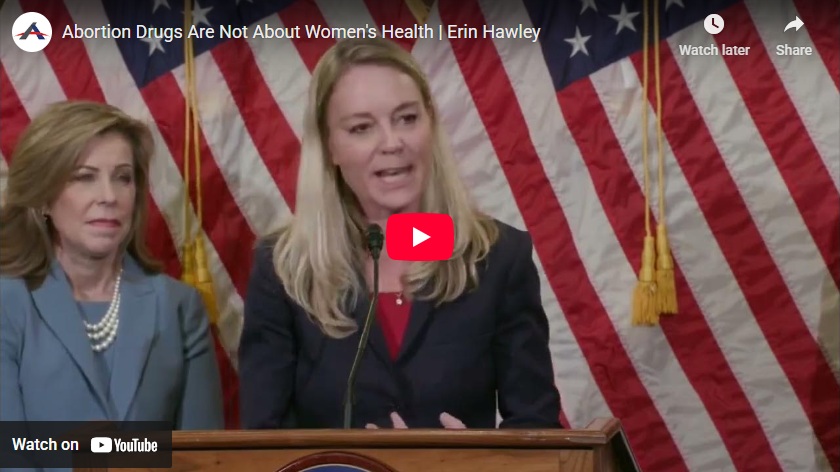
Abortion Drugs Are Not About Women’s Health

Our friends at Alliance Defending Freedom recently released a video highlighting how abortion drugs are not about women’s health.

Right now, Alliance Defending Freedom is working in court to protect women and unborn children from mail-order abortion drugs.

In June of 2022 the Supreme Court overturned Roe v. Wade in its Dobbs v. Jackson Women’s Health Organization decision. That good decision let several states — including Arkansas — enforce pro-life laws generally prohibiting abortion.

But in January of 2023 the Biden Administration’s FDA permanently removed the in-person dispensing requirement for RU-486 and made abortion drugs available by mail.

In October of last year, ADF attorneys and the State of Louisiana sued the FDA for letting abortionists mail these drugs across state lines.

In February, Family Council joined 43 other pro-life leaders in an amicus brief supporting ADF’s lawsuit against the FDA.

The amicus brief argues that states have the authority to restrict or prohibit abortion, and that the FDA’s abortion drug rules undermine states’ authority to enforce their own pro-life laws.

New evidence shows that abortion drugs are much more dangerous than the FDA previously thought.

A recent study by the experts at the Ethics and Public Policy Center found abortion drugs are at least 22 times more dangerous than the U.S. Food and Drug Administration labeling indicates. Nearly 11% of women experience serious health complications from abortion pills — including sepsis, infection, and life-threatening hemorrhage.

These drugs should not be available at all — much less through the mail. We appreciate ADF’s commitment to defending life in federal court.

Articles appearing on this website are written with the aid of Family Council’s researchers and writers.