Senate Committee Backs Clarification to Arkansas Abortion Law

On Wednesday the Senate Public Health Committee passed a good bill to clarify Arkansas’ abortion laws.

Since 2022, Arkansas law has prohibited abortion except to save the life of the mother in a medical emergency. However, state law does not provide clear guidance about how doctors determine if a woman’s life is in jeopardy.

H.B. 1610 by Rep. Robin Lundstrum (R — Elm Springs) and Sen. Jimmy Hickey (R — Texarkana) would clarify the definition of “medical emergency” in Arkansas’ pro-life law.

The bill would strengthen legal protections for doctors who treat pregnant women. It would also close loopholes in the current abortion law — making it clear that abortion in Arkansas is prohibited except to save the mother’s life.

Arkansas has been named the most pro-life state in America, and over the years lawmakers have enacted dozens of good measures protecting women and unborn children from abortion.

H.B. 1610 is a good bill that would bring better clarity to Arkansas’ abortion laws and make it easier for the state to continue protecting innocent human life. The bill now goes to the entire Arkansas Senate for consideration.

Below is video footage of Sen. Hickey presenting H.B. 1610 during Wednesday’s committee meeting.

Committee Backs Bill to Protect Women and Children from Abortion Drugs

On Tuesday the House Judiciary Committee passed a bill clarifying that abortion by fraud is a crime in Arkansas.

H.B. 1551 by Rep. Jimmy Gazaway (R — Paragould) makes it a felony to try to kill an unborn child by secretly giving a pregnant woman abortion-inducing drugs without her knowledge or consent.

Right now abortion in Arkansas is generally prohibited except to save the life of the mother, and it is illegal to deliver abortion-inducing drugs into the state. Arkansas also has laws prohibiting fetal homicide. However, Arkansas has no specific law addressing situations in which a person secretly gives abortion drugs like RU-486 to a pregnant woman.

The Associated Press has reported that in 2022 abortion drugs were secretly placed in Catherine Herring’s water in order to cause the death of her unborn child.

Ms. Herring suffered serious health complications and had to be hospitalized as a result. Since then, states have begun proposing laws like H.B. 1551 to prevent this type of crime.

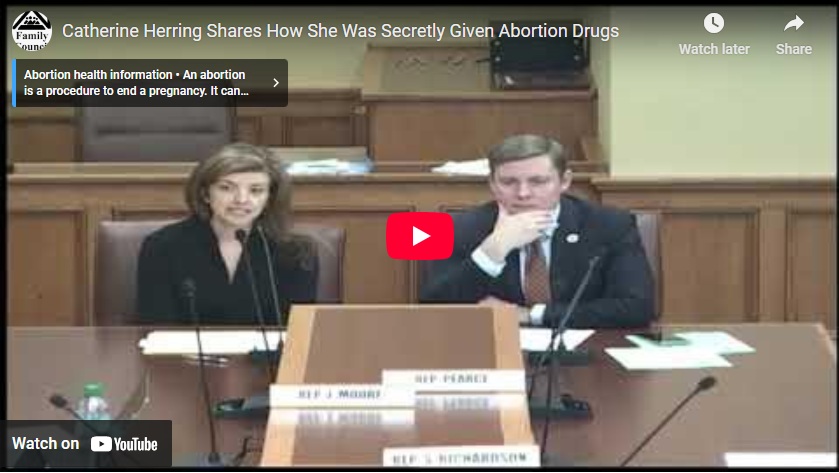
Ms. Herring testified in support of H.B. 1551 during Tuesday’s committee meeting, and shared her story as a survivor of domestic violence with Arkansas lawmakers.

H.B. 1551 is a good bill that will help prevent horrific crimes like this one from happening in Arkansas. The bill now goes to the entire Arkansas House of Representatives for consideration.

Articles appearing on this website are written with the aid of Family Council’s researchers and writers.

Marijuana Bust Shows Legalization Hasn’t Killed California’s Black Market

Authorities in California recently busted yet another industrial-scale marijuana operation.

Contrary to popular belief, legalization of marijuana has actually emboldened drug cartels. Marijuana is legal in California, but last year the state’s Unified Cannabis Enforcement Task Force seized 154,000 pounds of illegal marijuana intended for sale on the black market.

KTVU reports that last week California Highway Patrol investigators executed a search warrant at an Oakland warehouse, where they found 25,276 illegal marijuana plants along with firearms and illicit pesticides. Authorities reportedly are concerned about possible links to organized crime and indicated that illegal marijuana operations like this one may be tied to “Chinese money-laundering for Mexican cartels.”

Instead of weakening the black market, legalization appears to have made it easier for illicit marijuana to go unnoticed in states like California.

Chinese organized crime is dominating black market marijuana in many parts of the country. The U.S. Department of Justice says Chinese drug cartels may be making millions of dollars from illegal marijuana in states like Maine, New York, Massachusetts, and elsewhere.

Illegal marijuana operations often are linked to labor trafficking and violent crime — contributing to what some have dubbed “modern day slavery on American soil.”

And CNN reports that “illegal pot production . . . provides a glimpse of a hidden world – one that mirrors a trend playing out not only in California, but in states such as Oklahoma, Oregon, New Mexico and Maine: groups of people with apparent ties to foreign countries – most notably China – producing weed in colossal volumes.”

All of this is very concerning in light of the fact that multiple proposals at the Arkansas legislature would weaken the state’s drug laws.

H.B. 1722 by Rep. Jeremiah Moore (R — Clarendon) would effectively repeal Act 629 of 2023. This bad bill would legalize products containing THC made from industrial hemp — that is, cannabis plants that are supposed to be low in THC. THC is the primary psychoactive ingredient in marijuana. Many states are looking for ways to restrict or prohibit THC products. This bill would legalize these products in Arkansas.

H.B. 1578 by Rep. Aaron Pilkington (R — Knoxville) would legalize drinks containing THC made from industrial hemp. The bill sets age restrictions, licensing requirements, and manufacturing guidelines for these drinks, but it does not clearly restrict the amount of THC a hemp-derived drink could contain.

Legalizing drugs — whether it’s marijuana itself or THC extracted from cannabis — has not worked as intended in places like California. Arkansas should think twice before making the same mistake these states have made.