U.S. Issues Sanctions Against Foreign Organization that Aided Violent Pro-Abortion Group “Jane’s Revenge”
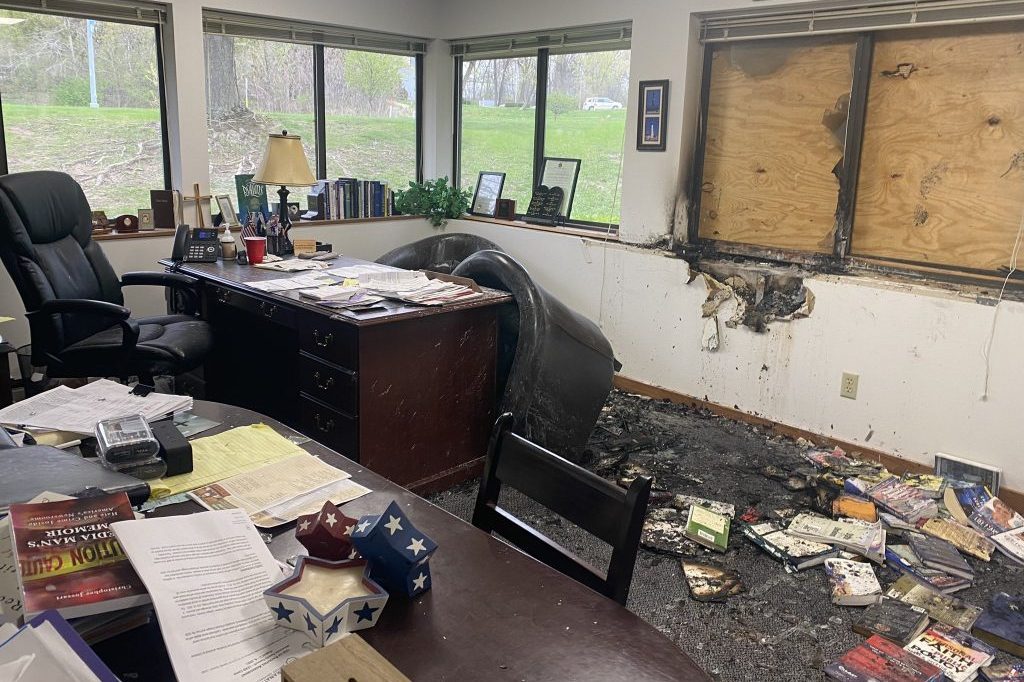
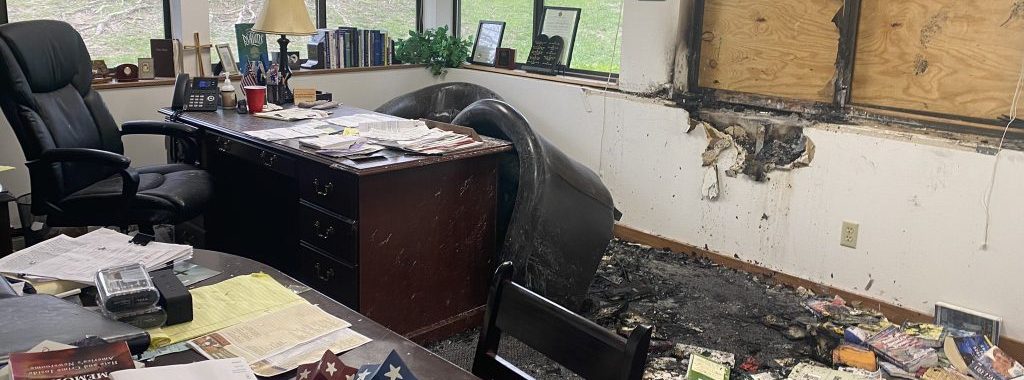
Above: Arsonists firebombed the Wisconsin Family Action office in Madison on Mother’s Day in 2022. The pro-abortion domestic terror group Jane’s Revenge took credit for the attack. In 2023, Hridindu Sankar Roychowdhury pleaded guilty for the firebombing.

Last month, the federal government imposed sanctions on a left-wing terrorist organization accused of aiding violent groups like Jane’s Revenge.

In May of 2022, a draft opinion of the U.S. Supreme Court’s Dobbs decision overturning Roe v. Wade was leaked to the media. After the leak, the domestic terror group Jane’s Revenge fueled violence against dozens of pro-life organizations and claimed credit for attacks like the 2022 firebombing of Wisconsin Family Action.

In response, more than 100 congressmen — including all four congressmen from Arkansas — urged the U.S. Department of Justice to take action against Jane’s Revenge, and U.S. Sen. Tom Cotton (R – AR) wrote a letter urging the DOJ to investigate Jane’s Revenge as a domestic terror group.

Four members of Jane’s Revenge were eventually brought to justice. Now the United States government is issuing sanctions against a foreign terrorist group it says supported Jane’s Revenge, Antifa, and other violent organizations.

On August 26, the U.S. Department of State designated Autistici/Inventati (A/I Collective) as a Specially Designated Global Terrorist.

In a statement, the department said, “The A/I Collective is an Italy-based extremist group that supplies the digital infrastructure for Antifa cells and other radical left-wing networks in the United States, Europe, and elsewhere across the world.”

The State Department says A/I Collective provided encryption tools and digital infrastructure to anarchist terror cells in Europe and the United States — including Jane’s Revenge — writing:

“The violent far-left extremists, ‘Jane’s Revenge,’ who waged a firebombing campaign against crisis pregnancy centers across the United States, relied on A/I Collective tools and services to publish official communiqués and claims of responsibility for violent and criminal acts and to incite copycat attacks. Four members of the group were later charged for violating federal law and engaging in a ‘conspiracy against rights’ through threats of force and intimidation.”

It’s taken a long time to reach this point, but the federal government is finally taking action not only against Jane’s Revenge, but also against the other people who aided and abetted the violence Jane’s Revenge caused.

Hopefully, this means we will never again see the kind of pro-abortion violence that we did in 2022.

Articles appearing on this website are written with the aid of Family Council’s researchers and writers.
Gov. Sarah Huckabee Sanders Declares January 22 ‘Day of Tears’ in Arkansas

Last week Arkansas Governor Sarah Huckabee Sanders issued a proclamation designating January 22, 2025, as the “Day of Tears.”

In 2021 the Arkansas General Assembly passed H.C.R. 1007 recognizing January 22 — the anniversary of the U.S. Supreme Court’s infamous Roe v. Wade abortion decision — as The Day of Tears in Arkansas and encouraging Arkansans to lower their flags to half-staff every year on January 22.

Even though Roe v. Wade has been overturned and abortion is prohibited in Arkansas except to save the life of the mother, it is good to set aside time to reflect on how abortion took the lives of women and unborn children for so many decades — and how many lives it still takes in America today.

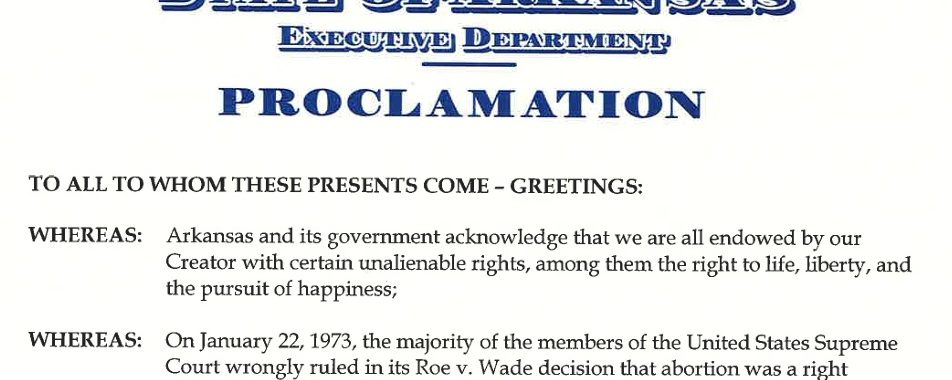
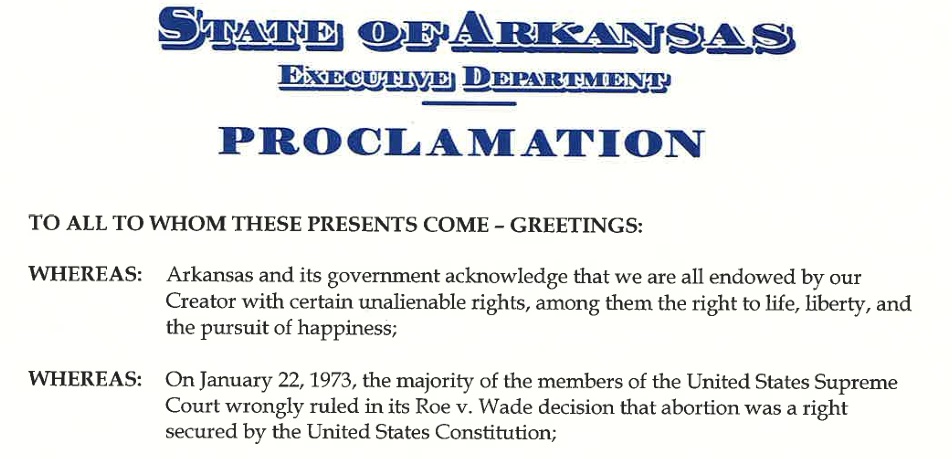
Gov. Sanders’ proclamation says:

TO ALL TO WHOM THESE PRESENTS COME – GREETINGS:

WHEREAS: Arkansas and its government acknowledge that we are all endowed by our Creator with certain unalienable rights, among them the right to life, liberty, and the pursuit of happiness;

WHEREAS: On January 22,1973, the majority of the members of the United States Supreme Court wrongly ruled in its Roe v. Wade decision that abortion was a right secured by the United States Constitution;

WHEREAS: Before the United States Supreme Court decision of Roe v. Wade, Arkansas had already enacted laws protecting women and unborn children from abortion; 

WHEREAS: From January 22, 1973, to June 24, 2022, the United States Supreme Court decision in Roe v. Wade prevented Arkansas from protecting women and unborn children from abortion;

WHEREAS: In Act 310 of 2023 the 94th General Assembly estimated that during that time at least two hundred thirty-six thousand, two hundred forty-three (236,243) elective abortions occurred in this State, jeopardizing the health and safety of pregnant women and depriving these unborn children of their respective rights to life, liberty, and the pursuit of happiness; and

WHEREAS: The Ninety-Third General Assembly resolved in H.C.R. 1007 of 2021 that January 22 should be recognized in perpetuity as the “Day of Tears” in Arkansas and encouraged Arkansans to lower their flags to half-staff “to mourn the innocent unborn children who have lost their lives to abortion.”

NOW, THEREFORE, I, SARAH HUCKABEE SANDERS, Governor of the State of Arkansas, by virtue of the authority vested in me by the laws of the State of Arkansas, do hereby proclaim January 22, 2025, as 

“THE DAY OF TEARS IN ARKANSAS”

You can download a copy of the proclamation here.

Family Council is deeply grateful to Gov. Sanders and the general assembly for recognizing January 22 as the Day of Tears in Arkansas, and we urge all of our friends to take time this month to remember the lives lost to abortion.

What Does Arkansas’ Abortion Ban Actually Say?

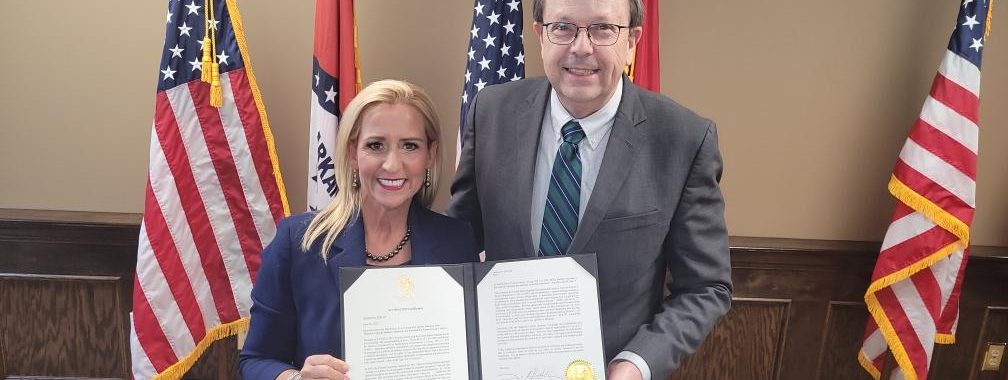
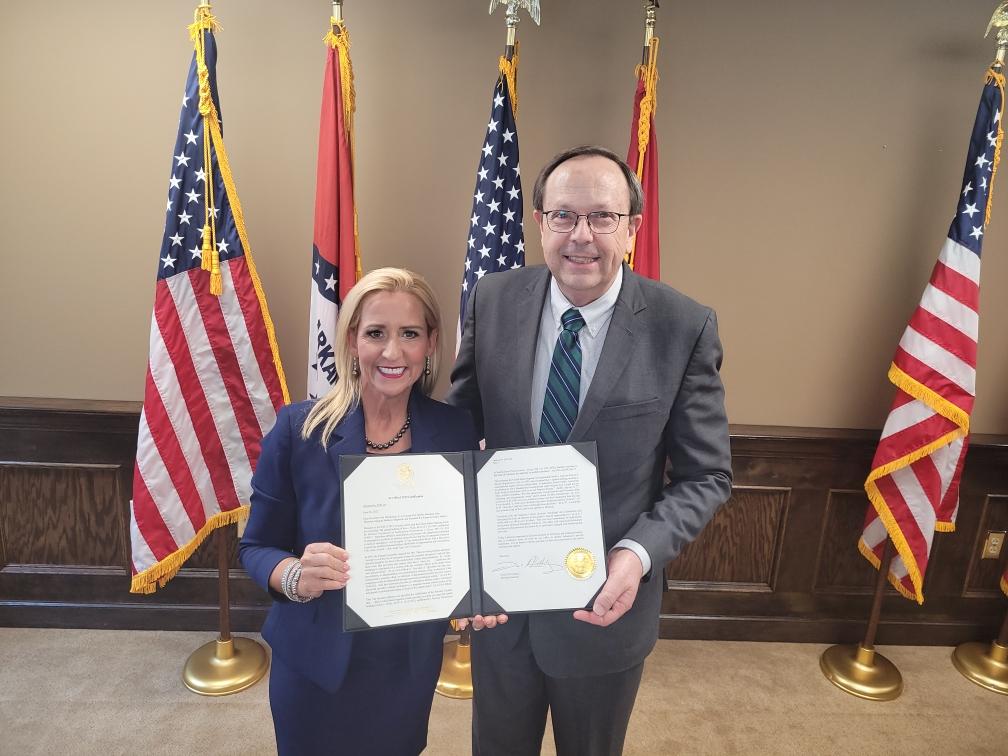
Arkansas Attorney General Leslie Rutledge (left) and Family Council President Jerry Cox hold the official certification that Roe is reversed and Act 180 of 2019 is in effect.

Following the U.S. Supreme Court’s decision to reverse Roe v. Wade, Arkansas Attorney General Leslie Rutledge certified that Act 180 of 2019 prohibiting abortion except to save the life of the mother is in effect.

Family Council worked in support of Act 180 with our friends in the Arkansas Legislature and with other pro-life organizations.

Below is a brief overview of the law:

  • Act 180 is a “trigger law” that was designed to take effect when Roe v. Wade was overturned.
  • Act 180 prohibits abortion in Arkansas except to save the mother’s life.
  • It says anyone who performs an illegal abortion can be fined up to $100,000 and imprisoned for up to 10 years.
  • It does not prosecute a woman who has an illegal abortion.
  • It doesn’t criminalize miscarriage.
  • The law permits procedures to remove an unborn baby who has died as a result of a miscarriage.
  • It doesn’t apply to ectopic pregnancies.
  • Act 180 doesn’t prohibit an OB/GYN from inducing labor or performing an emergency C-section.
  • It contains clear exceptions for contraception—including the “morning after” pill or Plan B.
  • Act 180 doesn’t prevent a pregnant woman from receiving medical treatments—such as chemotherapy—that carry risk for the unborn child.

Act 180 of 2019 had 47 legislative sponsors and co-sponsors.

Three-quarters of the Arkansas Legislature voted in favor of the measure, and Governor Hutchinson signed it on February 19, 2019.

Public opinion polling shows 79% of likely voters in Arkansas believe abortion should be either completely illegal or legal only under certain circumstances.

Act 180 reflects that. It generally prohibits abortion, but it makes exceptions for serious medical complications—like an ectopic pregnancy—and for circumstances when the mother’s life is in jeopardy.

Articles appearing on this website are written with the aid of Family Council’s researchers and writers.