Planned Parenthood Still Pushes Publicly Funded Sex-Education Despite Past Failures
Planned Parenthood is still promoting publicly funded sex-education despite the program’s past failures.

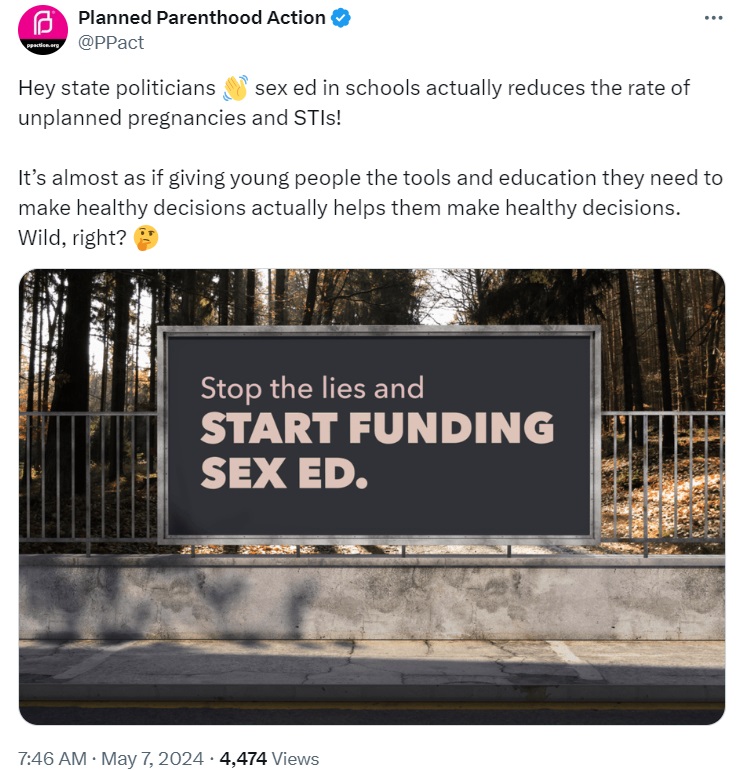
On Tuesday the nation’s leading abortion provider posted on X,

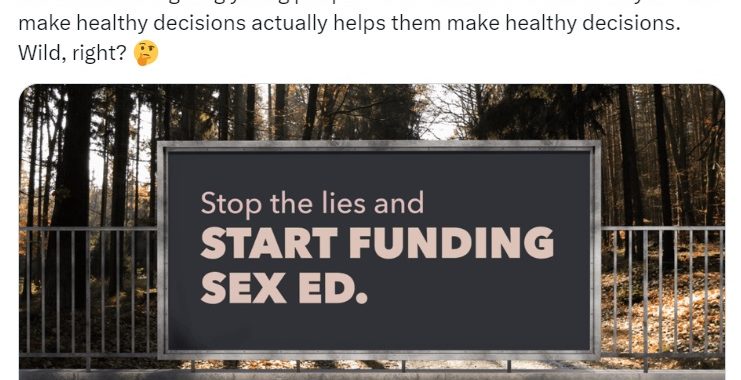
Hey state politicians sex ed in schools actually reduces the rate of unplanned pregnancies and STIs!

It’s almost as if giving young people the tools and education they need to make healthy decisions actually helps them make healthy decisions. Wild, right?

The irony is that government evaluations have shown Planned Parenthood’s publicly funded sex-education and family planning strategies simply do not work the way Planned Parenthood claims they do.

Several years ago the Obama Administration gave Planned Parenthood millions of dollars to conduct teen pregnancy prevention programs in the Pacific Northwest.

Afterwards, evaluations of Planned Parenthood’s sex-education program found students who went through it were often more likely to become pregnant or cause a pregnancy.

In other words, Planned Parenthood’s multimillion dollar sex-education program did exactly the opposite of what the federal government wanted.

In the 1980s and 1990s, public officials in Arkansas promoted Planned Parenthood-style sex-education, but the programs failed to have a meaningful impact on teen pregnancy and abortion in Arkansas.

Then in 1997 the Arkansas Legislature and Governor Mike Huckabee began promoting abstinence education in Arkansas. From 1997 to 2005, Arkansas’ teen birthrate decreased 17% — and Arkansas’ teen abortion rate plummeted a staggering 48%.

Governor Huckabee’s abstinence education model was so successful in Arkansas that it drew national recognition.

In 2016 — again, while President Barack Obama was still in office — the federal Centers for Disease Control released a 208-page report concluding teenagers who practice abstinence were healthier in nearly every way than teenagers who are sexually active.

The report looked at everything from seatbelt and bike helmet use to substance abuse, diet, exercise, and even tanning bed use.

The CDC found sexually-active teens were less healthy and engaged in riskier behavior across the board.

The report underscored that not only were abstinence education models like Arkansas’ effective at reducing teen pregnancy and abortion, but they also promoted healthier lifestyle choices across the board.

So while Planned Parenthood continues to promote public funding for its ineffective sex-education programs, Arkansas has shown there are much better ways to reduce teen pregnancy. Handing out tax dollars to abortion providers like Planned Parenthood simply is not the answer.

Articles appearing on this website are written with the aid of Family Council’s researchers and writers.


Governor Signs Measure Providing $2M in Grants to Support Pregnancy Centers, Maternal Wellness in Arkansas

On Tuesday Governor Sanders signed a budget measure providing $2 million to support pregnancy help organizations and maternal and infant wellness in Arkansas.

The funding will provide grants to pregnancy resource centers, maternity homes, adoption agencies, and other organizations that provide material support to women with unplanned pregnancies.

For years, states across America have taken steps to provide pregnancy resource centers with state and federal tax money to support the services they provide.

This funding helps serve families at the local level without creating new government programs.

In 2022 Family Council worked with the legislature and the governor to secure $1 million for pregnancy centers. This funding provided grants to more than 20 pregnancy help organizations.

Last year we worked with lawmakers to renew this funding, and since then more than two dozen good organizations across the state have applied for this money and used it to give women and families real assistance when faced with an unplanned pregnancy.

S.B. 64 makes improvements to the grant program. It increases state funding from $1 million per year to $2 million. This puts Arkansas’ funding on parr with funding in other states.

The law also clarifies that “pregnancy help organizations” include nonprofit organizations that promote infant and maternal wellness and reduce infant and maternal mortality by:

  • Providing nutritional information and/or nutritional counseling;
  • Providing prenatal vitamins;
  • Providing a list of prenatal medical care options;
  • Providing social, emotional, and/or material support; or
  • Providing referrals for WIC and community-based nutritional services, including but not limited to food banks, food pantries, and food distribution centers.

The measure includes language preventing state funds from going to abortionists and their affiliates.

This legislation is something Arkansans can be proud of. Family Council is grateful to the General Assembly for passing S.B. 64, and we appreciate Governor Sanders signing it into law. We look forward to seeing the state implement the expanded grant program in the coming fiscal year.

Companies Still Offering Women in Arkansas $50,000+ to be Surrogates

Companies are still offering women in Arkansas tens of thousands of dollars to bear children as commercial surrogates.

Commercial surrogacy agencies work with individuals and couples who pay women to be artificially inseminated and give birth to children for them as surrogates. Agencies often pay women thousands of dollars to act as surrogates.

For example, the company US Surrogacy has placed ads on Craigslist saying women in Arkansas can make $50,000 – $60,000 as commercial surrogates.

As we and others have said for years, commercial surrogacy exploits women and children. It treats babies like products that can be bought and sold, and it treats women like commodities.

In fact, many nations prohibit commercial surrogacy, because it is linked to the exploitation of women and children. However, commercial surrogacy laws in the U.S. tend to be lax.

In California, surrogate Brittney Pearson’s story shows some of the problems associated with surrogacy.

After Pearson was diagnosed with an aggressive form of cancer, doctors recommended inducing labor early and caring for the baby in the NICU while she started chemo. However, that isn’t what the same-sex couple paying Brittney Pearson as their commercial surrogate wanted.

Even though she was 24 weeks pregnant, and the baby might have been able to survive outside the womb, the men wanted Brittney to have an abortion. If the baby were born alive, the men asked that no life-saving measures be taken for the baby.

With her cancer having spread to her liver, Pearson found a hospital to induce birth. The child died shortly after being born on Father’s Day, June 18.

All of this was made possible by state laws that facilitate commercial surrogacy.

Stories like this one underscore why Family Council has opposed commercial surrogacy in Arkansas.

In 2017 we supported a bill to prohibit commercial surrogacy in Arkansas. Unfortunately, the measure never came up for a vote.

Commercial surrogacy violates the sanctity and dignity of human life, because it treats women like commodities, and it treats unborn children like property that can be manufactured, bought, sold, or destroyed at will.

To put it simply: People aren’t products.

Articles appearing on this website are written with the aid of Family Council’s researchers and writers.