
Public School Teachers Told to Stop Saying “Boys and Girls”

Teachers in one Nebraska school district have been instructed to stop using gender-specific language when addressing students.

According to National Review Online, teachers at the Lincoln Public Schools have been told that phrases like “boys and girls” are not “gender-inclusive” and should not be used in the classroom.

So what, you might ask, are teachers to call their students? The training handout says, “Create classroom names and then ask all of the ‘purple penguins’ to meet on the rug.”

Instead of lining students up as “boys and girls,” the training material advises teachers to separate students according to their likes or interests, such as “skateboards” or “listening.” It even suggests separating students according to whether or not they are athletes–as if that isn’t going to make the classroom a charged environment. Does anyone really think labeling students according to their athletic prowess is somehow better than calling them a “boy” or a “girl”?

What is most striking about the material, however, is its instruction that teachers literally should be intolerant of opposing views. The handout reads,

“Be intolerant of openly hostile attitudes or references towards others EVERY TIME you hear or observe them, but also use these as teachable moments. Take the opportunity to push the individual on their statements about gender. Being punitive may stop the behavior, at least in your presence. Being instructive may stop it entirely.”

But just a paragraph or two later, the material states,

“Help students recognize ‘all or nothing’ language by helping them understand the difference between patterns and rules. Teach them phrases like ‘That may be true for some people, but not all people,’ or ‘frequently, but not always,’ or ‘more common and less common.’ Avoid using ‘normal’ to define any behaviors.”
(more…)

Fayetteville Group Gathering Signatures to Vote on Ordinance

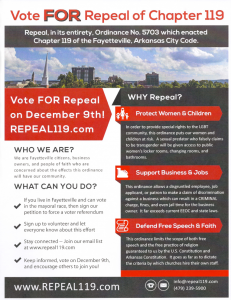
repealflyerA group of concerned citizens are hard at work gathering signatures to bring controversial Fayetteville Chapter 119 (the so-called “nondiscrimination” ordinance) up for a vote of the people.

The group now has a website with information about the effort: www.repeal119.com. There is also a flyer highlighting some of the consequences of Fayetteville’s new ordinance and articulating why it should be repealed.

If the petition drive is successful, voters in Fayetteville will have the opportunity to keep or repeal Chapter 119 at the ballot box later this year.

We have written repeatedly about the unintended consequences of this ordinance, including:

If you would like to know more about the effort to repeal Chapter 119, call (479) 239-5900 or email info@repeal119.com.

Mayor’s Actions Elevate Chamber Above Church

FOR IMMEDIATE RELEASE
Friday, August 29, 2014

On Friday, the Mayor of Fayetteville announced the establishment of a ten-member advisory board at the request of the Fayetteville Chamber of Commerce to receive input on the city’s controversial nondiscrimination ordinance passed on August 20.

Family Council President Jerry Cox released a statement, saying, “This is very troubling. Here you have an ordinance that is extremely unpopular and that citizens are actively working to repeal. Now that it has passed, the mayor says he is open to input, not because of concerns over public safety or religious liberties, but because the local Chamber of Commerce sent him a letter.”

Cox questioned why the Fayetteville Chamber of Commerce waited until after the ordinance passed to make its concerns known. “This ordinance was no secret. It was read and discussed at three separate City Council meetings. One of those meetings lasted nine hours. Hundreds of citizens and church leaders came out to voice their concerns about the ordinance, but most of those concerns were ignored. The council passed the ordinance. If the Chamber of Commerce had concerns about ambiguities in the ordinance, they should have made those concerns known before it passed.”

Cox said the mayor’s actions send the wrong message to local residents. “There’s little doubt in my mind this ordinance is bad for business, but the message the mayor is sending is that business leaders get special treatment other citizens do not get. They get a second chance to speak on the ordinance. I really wonder if the mayor would be doing this if the request had come from anyone else.”

Cox said this latest situation highlights some of the unintended consequences his group has discussed concerning the ordinance. “We said this would expand government and create unforeseen problems for the City of Fayetteville. That’s what is happening here. This is just one controversy Chapter 119 has caused, and the ordinance hasn’t even been engrossed into the city code yet.”

###