

Federal Government Strengthens Religious Liberty Protections
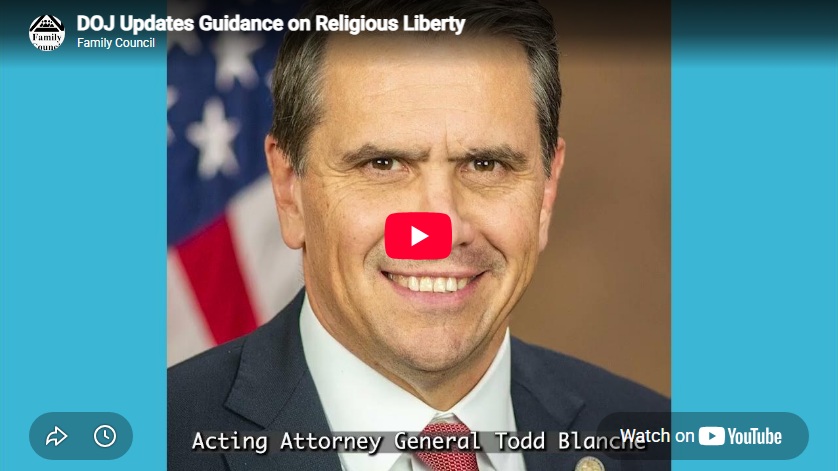
The U.S. Department of Justice has issued updated guidance directing every federal agency to protect the free exercise of religion.
Religious liberty is recognized and protected under the First Amendment, and it is one of the hallmarks of our nation. But religious freedom has repeatedly come under attack in court, in government, and elsewhere.
Acting Attorney General Todd Blanche announced the updated guidance on July 23. It is the first change to the DOJ’s religious liberty guidelines since 2017, and it reflects nearly a decade of important U.S. Supreme Court decisions that have expanded protections for people of faith.
The updated guidance includes several important protections. It reaffirms that the government cannot interfere in how churches and religious organizations govern themselves. It protects parents’ right to direct the religious upbringing of their children. It also ensures that religious organizations can compete for federal contracts and grants on equal footing with secular organizations — without being forced to give up their religious identity or hiring practices.
It also makes clear that religious exercise is not just about what people believe in private — it includes how people live out their faith in daily life.
Over the years, wedding venues, bakeries, photography studios, and florist shops have been dragged into court simply because their owners wanted to operate according to their deeply held convictions.
People of faith have faced pressure to check their convictions at the door in order to participate in government programs. This guidance pushes back against that.
Nobody should be forced to choose between their religious convictions and their livelihood, and nobody should be punished for obeying their conscience.
The free exercise of religion is a fundamental right — and it deserves to be treated that way at every level of government.
Arkansas is currently ranked number one in the nation on religious liberty by First Liberty Institute’s Center for Religion, Culture & Democracy. That ranking reflects years of hard work by Arkansas’ lawmakers who have passed strong protections for the free exercise of religion. For example, Arkansas’ Religious Freedom Restoration Act is one of the best in the country.
Strong federal guidance like this works hand in hand with strong state laws like Arkansas’. Together, they help ensure that Arkansans don’t have to worry about being forced to violate their faith.
Articles appearing on this website are written with the aid of Family Council’s researchers and writers.


Here’s a Look at How Arkansas’ Laws Properly Safeguard Religious Liberty

Last week Arkansas made headlines for being named number one in the nation on religious liberty. The free exercise of religion is a fundamental right protected by state and federal law, and Arkansas has some of the best safeguards for religious liberty in the country. That is something to celebrate.
But one of the questions that comes up about religious liberty is how to protect the free exercise of religion without letting someone use that freedom to commit crimes or harm innocent people. Arkansas has at least two laws that navigate that issue very well.
The first is Arkansas’ Religious Freedom Restoration Act, which was passed in 2015 and made stronger in 2023 and 2025.
Over the past 200 years, courts have had to address situations where cult leaders wanted to commit crimes in the name of their religion, where cities and counties denied building permits to churches, and where conscientious objectors wanted to avoid military service during times of war.
In situations like these, courts traditionally asked two questions:
First, does the government have a “compelling interest” at stake in this situation—like providing for national defense or protecting people from violent crime?
And second, can the government protect that compelling interest without burdening someone’s free exercise of religion?
Under this test, cult leaders who broke the law went to prison, conscientious objectors in the military were assigned to non-combat duties, and churches that were denied a building permit typically were allowed to build anyway.
Unfortunately, over the years, state and federal courts abandoned this standard and began issuing bad rulings that made it easier for the government to run roughshod over religious freedom—even when it did not have a compelling interest at stake or did not have to burden someone’s free exercise of religion. We have all heard stories of wedding venues, bakeries, photography studios, and florist shops taken to court because their owners wanted to operate according to their deeply held convictions. That’s a problem.
That’s why Arkansas has passed laws like its Religious Freedom Restoration Act. The law protects every person’s free exercise of religion except in serious situations where the government can demonstrate it has a compelling interest at stake. In those cases, the government may burden the free exercise of religion, but it must do so as little as possible.
Arkansas’ Religious Freedom Restoration Act is one of the best in the country, because it gives strong protections to religious liberty while still making it possible for our government to punish criminals and enforce other important laws.
The second law that Arkansas has passed is Act 980 of 2017. Act 980 protects religious freedom and other liberties while prohibiting courts from enforcing foreign systems of law, like Sharia Law. The government certainly has a compelling interest in preserving our basic liberties and the rule of law. Act 980 helps the State of Arkansas do that.
Arkansas has the very best religious freedom laws in the country. Family Council is committed to working with our friends in the Arkansas Legislature to keep it that way, and we plan to look into any other laws Arkansas may need to pass to properly safeguard the free exercise of religion in our state.
Articles appearing on this website are written with the aid of Family Council’s researchers and writers.