

Pro-Life Advocate Speaks Out Against Surrogacy

Pro-life advocate Dr. Abby Johnson recently posted a statement on social media opposing surrogacy, calling it “child abuse.”

Dr. Johnson was a Planned Parenthood clinic director until 2009, but she became pro-life after witnessing an ultrasound-guided abortion. Today she is a pro-life author and speaker and an advocate for women and unborn children.

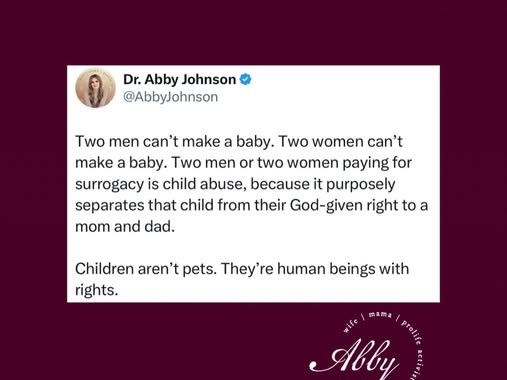
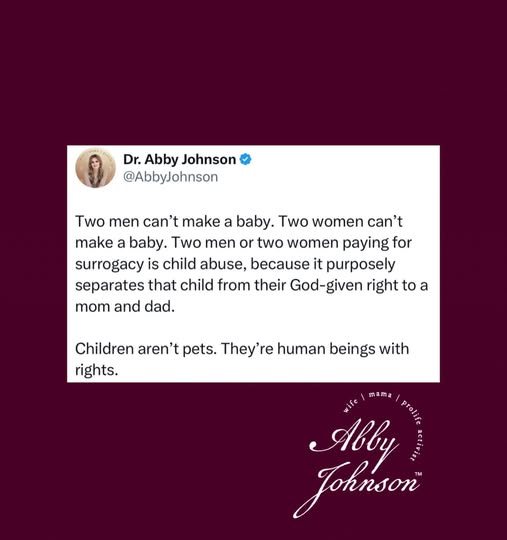
In a statement posted last week, Dr. Johnson criticized gestational surrogacy, saying:

Two men can’t make a baby. Two women can’t make a baby. Two men or two women paying for surrogacy is child abuse, because it purposely separates that child from their God-given right to a mom and dad. Children aren’t pets.

They’re human beings with rights.

We have written many times about how surrogacy — especially commercial surrogacy — exploits women and hurts children.

In commercial surrogacy arrangements, corporate agencies hire women to carry children for paying customers.

Unlike many other countries, the United States has relatively few regulations when it comes to surrogacy — and that’s a problem.

Last year, news outlets reported that a sex offender convicted of crimes involving children was able to obtain a child through surrogacy in Pennsylvania as a result of lax state regulations.

The New Yorker reported last week that a wealthy couple in Los Angeles allegedly used a surrogacy agency they operated to hire dozens of women across the U.S. to carry more than 20 children for them. According to the magazine, the children were removed from the home and placed in foster care after one of them was hospitalized with injuries “consistent with ‘those sustained during a car accident or from being shaken.'”

Last year The Wall Street Journal uncovered how Chinese billionaires are exploiting America’s surrogacy industry to create what some call “mega-families” with dozens or even hundreds of children.

The Wall Street Journal also has written about allegations of financial fraud among commercial surrogacy businesses.

In December, The New York Times and NBC News both reported about investigations into a surrogacy agency that abruptly shutdown, causing clients to lose an estimated $2 – $5 million total.

Stories like these underscore why social commentators and policymakers worldwide have raised concerns about commercial surrogacy and how it financially pressures women.

It’s bad when commercial surrogacy goes wrong — but it’s important to remember that surrogacy never “goes right” either.

Commercial surrogacy deliberately deprives children of their biological mothers or fathers.

It treats pregnancy like a “service” that can be purchased.

It treats women like commodities, and it treats children like products that can be made to order and sold for profit.

Commercial surrogacy also relies heavily on in vitro fertilization and other reproductive technologies that have serious problems of their own.

Family Council has opposed commercial surrogacy in Arkansas, but unfortunately, Arkansas’ commercial surrogacy laws are very lax.

Since 2017, Family Council has supported legislation to prohibit commercial surrogacy in Arkansas. So far, those restrictions have not passed.

Human beings are not products that can be made to order, bought, and sold. That’s why Family Council opposes commercial surrogacy — and why we will continue to oppose it.

Articles appearing on this website are written with the aid of Family Council’s researchers and writers.
Children Are Greater Than Our Desires: Guest Column

“Babies aren’t a tool for adult validation,” and other messages society seems primed to hear.

Recently, singer Meghan Trainor posted a picture of herself in a hospital bed, teary-eyed, and holding a newborn for skin-to-skin contact. The woman who carried and birthed the child, however, was nowhere in sight. Trainor and her husband used a surrogate.  

Of course, as images go these days, this one is preferable to men pretending to be postpartum, having just bought a child via the surrogacy market. But that just shows how disordered our society is about marriage, sex, and babies.  

Many people, including many Christians, consider surrogacy a harmless and helpful technological advancement. People want babies, and more babies are good, the thinking goes. All the while, a blind eye is turned to the severe moral problems inherent in the mechanics of surrogacy, including the commodification of children and the desecration of the maternal bond. Not to mention, the system is so underregulated, pedophiles and child abusers have been able to acquire victims.

Thankfully, more are learning the truth about this practice and this industry. As Katy Faust of Them Before Us put it in response to Trainor’s post: 

Thousands are finally speaking up against surrogacy. The tide is turning. We’re grateful your baby is here, alive, and loved. But we won’t pretend the method was harmless. No child should be created through a system that turns women into means and babies into products. 

That system is enabled and protected by the 2015 Obergefell Supreme Court decision. Severing marriage in law from the intrinsically biological realities of male and female also severed the connection between children and those whose union creates them. Marriage is presumed now, both in culture and in law, to be an institution of adult feelings. Kids are accessories.  

As Faust told The Colson Center: 

Across the globe 38 countries have legalized gay marriage. Exactly 0 of them have simultaneously strengthened children’s claim to their own mother and father. All of them have either abolished or significantly weakened the idea that children belong to the two people responsible for their existence. 

This week, Faust announced the formation of a coalition of leaders and organizations called Greater Than. Advocates of same-sex “marriage” campaigned on the promise of marriage equality, posting memes of equal signs across social media. Greater Than proclaims the hard truth that children are treated as less than when they are deprived of mom and dad. As Faust described,  

Greater Than is a coalition of pastors, parents, influencers, policy makers, theologians, lawyers, students, and normie Americans who are all speaking with one voice. What are we saying? “Don’t touch the kids.” Marriage does not exist as a tool for adult validation. It is God’s Plan A for child protection, and we intend to retake it on their behalf. 

Rather than seeing kids as truly equal and deserving adult protection, the dangerous combination of abortion, surrogacy, and redefining marriage reduces them to one option among many, as a means to fulfill adult desires. Legally, just as Roe v. Wade deprived preborn children of their right to life, Obergefell is depriving children of their right to their mom and dad. Just as a culture of death enables the holocaust of abortion, a culture of sexual autonomy enables the commodification of children. As pro-lifers have done for decades now on the issue of abortion, so the Greater Than coalition is committed to the legal and cultural work necessary to protect children. 

The Colson Center is proud to join this list of 43 (and growing!) organizations and leaders. The Greater Than website features answers to difficult questionsopportunities to get involved, and the latest news and information about this pressing problem

Join the movement. As the Greater Than website puts it: 

The line has been crossed. The cost is our kids. It’s time to fight back—with truth, courage, and conviction. It is our responsibility to give kids their identity, security, and childhood back. 

Copyright 2026 by the Colson Center for Christian Worldview. Reprinted from BreakPoint.org with permission.

Chinese Billionaires Exploit U.S. Surrogacy Laws to Build “Mega-Families”

A troubling report from The Wall Street Journal reveals how Chinese billionaires are exploiting America’s largely unregulated surrogacy industry to create what some call “mega-families” with dozens or even hundreds of children.

Commercial surrogacy is a practice where companies and wealthy couples pay women thousands of dollars to carry children for them.

The newspaper uncovered the case of a Chinese video game executive who claims to have fathered more than 100 children through American women hired as surrogate mothers. A California family court judge noticed multiple requests from the same Chinese billionaire filed surrogacy petitions seeking parental rights to multiple unborn children.

The Wall Street Journal writes,

Several of his kids were being raised by nannies in nearby Irvine as they awaited paperwork to travel to China. He hadn’t yet met them, he told the judge, because work had been busy. . . .

The judge denied his request for parentage—normally quickly approved for the intended parents of a baby born through surrogacy, experts say. The decision left the children he’d paid for to be born in legal limbo.

The article highlights other cases — including a wealthy Chinese executive who “hired U.S. models and others as egg donors to have 10 girls, with the aim of one day marrying them off to powerful men.”

Social commentators and policymakers worldwide have raised concerns about how commercial surrogacy financially pressures women into providing children for paying customers.

Unlike many other countries, the United States has few regulations governing surrogacy arrangements. This creates opportunities for exploitation and abuse that harm women, children, and families.

It’s bad when commercial surrogacy goes wrong — but it’s important to remember that surrogacy never “goes right” either.

Commercial surrogacy deliberately deprives children of their biological mothers or fathers.

It treats pregnancy like a “service” that can be purchased.

It treats women like commodities, and it treats children like products that can be made to order and sold for profit.

Commercial surrogacy also relies heavily on in vitro fertilization and other reproductive technologies that have serious problems of their own.

In California, surrogate Brittney Pearson’s story shows some of what is wrong with surrogacy.

After Pearson was diagnosed with an aggressive form of cancer, doctors recommended inducing labor early and caring for the baby in the NICU while she started chemo. However, that isn’t what the same-sex couple paying Brittney Pearson as their commercial surrogate wanted.

Even though she was 24 weeks pregnant and the baby might have been able to survive outside the womb, the men wanted Brittney to have an abortion. If the baby were born alive, the men asked that no life-saving measures be taken for the baby.

With her cancer having spread to her liver, Pearson found a hospital to induce birth. The child died shortly after being born on Father’s Day, June 18, 2023.

All of this was made possible by state laws that facilitate commercial surrogacy and treat the intended parents in surrogacy arrangements as the legal parents of the child.

Stories like these underscore why Family Council has opposed commercial surrogacy in Arkansas. Unfortunately, Arkansas’ commercial surrogacy laws are very lax.

Since 2017, Family Council has supported legislation to prohibit commercial surrogacy in Arkansas. So far, those restrictions have not passed.

Human beings are not products that can be bought or sold. That’s why Family Council opposes commercial surrogacy — and will continue to oppose it.

Articles appearing on this website are written with the aid of Family Council’s researchers and writers.