
Why is Support for Same-Sex Marriage and Other Pro-LGBT Issues Falling?

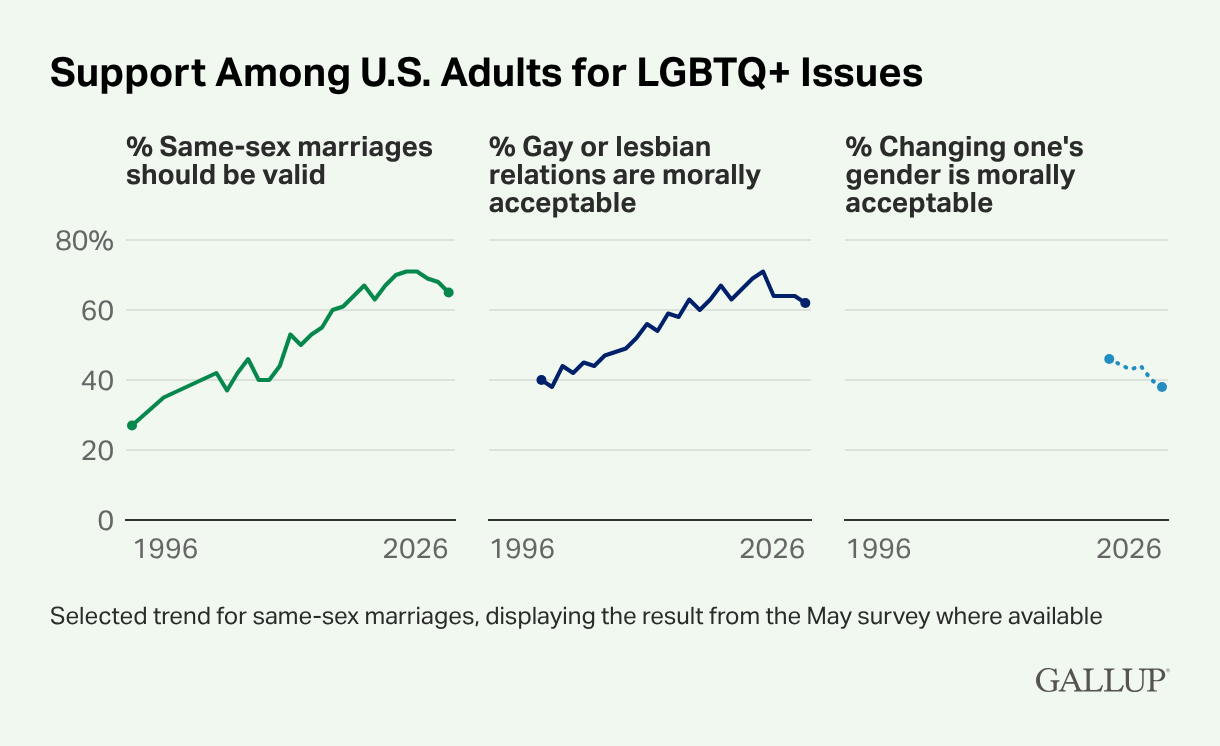
Last week, pollsters at Gallup reported that support for same-sex marriage and other pro-LGBT issues “remains down” in the U.S.

For years, survey data indicated a growing share of Americans were pro-LGBT and supported same-sex marriage. That trend seemed to culminate in 2015 when the U.S. Supreme Court overturned state marriage laws nationwide with its Obergefell v. Hodges decision.

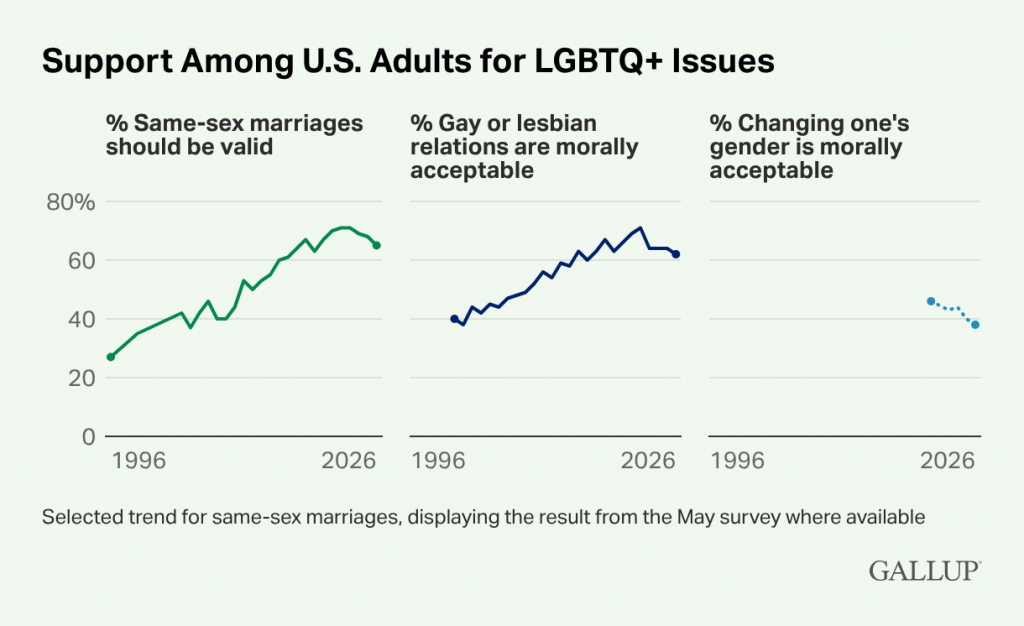
But since 2024, polling data has showed a drop in support for same-sex marriage.

The latest numbers from Gallup reveal 65% of U.S. adults support same-sex marriage. That’s still a high number, but it is down from 71% in 2022.

Gallup also found 57% of adults believe it is morally wrong to change genders. That’s a major increase from 51% in 2021.

Gallup says Republicans are “largely responsible” for the shift in attitudes on same-sex marriage and pro-LGBT issues, but the truth may be more complicated.

Gallup found only 37% of Republicans now say same-sex marriage should be legal — which is down 18 points since 2022.

But Gallup’s data also shows support for same-sex marriage has fallen among Independent voters as well.

And although it may not be statistically significant, support for same-sex marriage among Democrats has been up and down from year to year.

So why have pro-LGBT attitudes started falling the past few years? It could be the same reasons that corporate Pride has fizzled and Fortune 500 companies have abandoned the pro-LGBT Equality Index: Pro-LGBT groups keep putting more and more demands on their “allies.”

According to organizations like the Human Rights Campaign, it isn’t enough to support same-sex marriage. Employers must provide “transgender-inclusive” health insurance plans, demonstrate “outreach to and engagement with the LGBTQ+ community,” and so forth.

In other words, it seems like there’s no such thing as being pro-LGBT “enough.”

There has also been nationwide pushback against pro-LGBT pandering since Obergefell.

Major companies from Walmart to Target and John Deere to Lowe’s have rolled back pro-LGBT and DEI policies in response to consumer backlash. Entertainment giants like Pixar and Disney have removed pro-LGBT elements from their storylines in response to moviegoers.

When the U.S. Supreme Court issued the Obergefell decision, many people said redefining marriage would erode religious liberty, erase distinctions between men and women, fundamentally change parenthood, and hurt children. In fact, children arguably are the victims hurt most by the Obergefell and the pro-LGBT movement.

Pro-LGBT activists and medical organizations spent years citing each other’s work in a circular pattern to manufacture a fake consensus about performing sex-change procedures on kids. Since then, whistleblowers have come forward testifying about how they were rushed through gender transitions as children without understanding the procedures’ risks, consequences, or alternatives.

All of this seems to have caused many people to rethink same-sex marriage and pro-LGBT activism in general. Gallup’s survey findings may be a reflection of that.

Articles appearing on this website are written with the aid of Family Council’s researchers and writers.

Guest Column: “There Is No Mama”

A recent video exposed the injustice at the heart of same-sex marriage and commercial surrogacy. In it, a man bouncing a baby on his lap asks, “Who do you want? Dada or Pop?” The baby answered, “Mama!” To which, both the man and his unseen partner behind the camera laughed and said, “There is no Mama.” They continue to badger the child, who then begins to cry.  

The most obvious evil portrayed in the video is the relentless teasing of a baby. The deeper evil, however, is not that the men were mean. In fact, being mean was only the insult added to the injury of forcing their farcical arrangement on a baby and calling it a family. 

Because, and everyone knows this including these two men suppressing the truth by their wickedness, there is a mama. She is not included in the video, nor is she in the life of the baby she carried and who needs her, but she exists. She’s been cut out of her child’s life, presumably by her own choice. The baby, however, did not make a choice. And now two men who have appropriated the title of “parents” are badgering the baby into affirming their lifestyle choice. 

Perhaps, the infant is only doing what infants often do, babbling out those syllables that are often among the first learned by young ones across times and places and culture. But of course, these syllables always refer to the same person. They are, in the end, a primal cry of children for a particular someone who should always be there for them. 

Anyone who has spent time around babies understands what is playing out in this scene. For little ones, mama is the world. In fact, according to childhood policy expert Dr. Dan Wuori, kids often say “Dada” before “Mama” not because the mom doesn’t matter as much but because she matters so much more. In their tiny, growing minds, they recognize “Dad” as a distinct person before they realize that “Mom” isn’t part of themselves. This innate and beautiful bond is intentionally broken when we pretend that a man can replace a mom, or whenever a child is acquired through surrogacy. 

Just as tragic is the embrace of same-sex “marriage” or such reproductive technologies by individuals, governments, medical authorities, and Christians, while failing to even take a cursory glance to consider what is best for the child. Any ethical concerns around in vitro fertilization and surrogacy have been deferred in order to protect the feelings and desires of adults. In fact, both in policy and in public discourse, we’ve lost the ability to even discern the difference between couples who suffer with infertility and same-sex couples who have chosen inherently sterile relationships but then demand children. As a result, what children need is tossed aside in the name of adult desires. Children become commodities in the marketplace of consumer-driven reproductive technologies. 

As Katy Faust, founder of the children’s rights group Them Before Us and the Greater Than campaign, said to the Colson Center: 

We’ve been sounding the alarm about surrogacy for years. The mother loss, the commodification, the fact that children often go home with unrelated adults, increasing risk of abuse and neglect. But videos like this do something that arguments and studies never can. They spark righteous rage that leads people to come out of the closet as defenders of the natural family. It is more and more clear that gay marriage didn’t just have to do with what takes place “in the privacy of the bedroom.” It impacts children. And when we see those children cry on camera, it motivates us to action. 

It should, at least. The word “natural” is accurate. Having chosen unnatural relationships, to quote Paul, these two dads now demand that even a baby must affirm what is unnatural. Even if they had not made that demand in such a cruel way in a video shared for social media clicks, great harm has been done to this child. And a culture that affirms their choice is complicit in that harm.  

Babies need their mamas. There are few things more obvious than that. Denying that reality is a tragedy. Harming children should be a crime.

Copyright 2026 by the Colson Center for Christian Worldview. Reprinted from BreakPoint.org with permission.

Guest Column: Jesus Would Have Baked the Cake

. . . and other nonsense Jesus would not have done.

On a Saturday morning in 2012, sitting on my porch reading an actual newspaper, I first learned of a Denver baker named Jack Phillips. A gay couple, having been “married in a different state,” asked Jack, owner of Masterpiece Cakeshop, to custom design a cake for their same-sex “wedding” celebration. Jack offered them service and any cake in his store that was already made. What he could not do, he said, was use his creative talent to communicate a message that violated his conscience and said what he knew to be untrue. 

To say that a lot has happened since is, to put it mildly, an understatement. He was harassed by the state of Colorado, specifically the Civil Rights Commission. He was slandered online and subjected to death threats against him and his family. He was sued, not only by the state but also by a man—who claimed to be a woman—who repeatedly asked him to bake perverted and disgusting cakes. In the end, his case, which went all the way to the Supreme Court, has been pivotal in advancing the rights of conscience, suppressing state hostility to religion, and attracting many to Christ. 

But I also remember the chorus of voices, many of them Christian leaders, saying at the time, “Just bake the cake.” Or even, “Jesus would’ve baked the cake.” Jack was accused of hate, intolerance, and bigotry. But he stood courageously, even in the face of great criticism from brothers and sisters in Christ. 

Thank God he did. Recently, at an event hosted by Colorado Christian University and featuring the brilliant Ayaan Hirsi Ali—one of those who was inspired by Jack’s story—I asked Jack, and Kristen Waggoner, Jack’s attorney and CEO of the Alliance Defending Freedom what he thinks now as he looks back on the past decade and a half. 

Here’s Jack: 

God tells us to live by a truth. He says we need to know the truth and that the truth will set us free. Jesus is the Truth, and we just have to know Him. And we get to know Him better and more clearly through His Word, through good teaching, and by spending time with Him. The more time you spend with Him, the better you know Him, and you don’t want to disappoint somebody you know well.  

It would have been a huge disappointment to Jesus if I’d have [baked the cake] when He’s given us the power to live by what He says. And people want good news. There are tons of people who I’ve talked to who have been encouraged by this story. I think if I had made the cake . . . I don’t know because we’ve had so many things that have just happened that have been so good. Tonight is one of them. 

Kristin Waggoner added more context: 

In Jack’s situation, Jack modeled tolerance, and the other side did not. And so, it’s not about refusing to serve, because Jack serves everyone. Everybody. But when the government can compel you to speak messages and affirm lies that violate your conscience, then there is no limit to the government’s power. . .. So that’s really what that was about—it was “the message” that Jack was being asked to communicate.  

I can tell you, having talked to hundreds of people over the last 10 years, that they have said that courage begets courage. And they’ve modeled that because they heard of Jack’s story, and it caused them to consider Christ and come to salvation. But it also caused them to be courageous in their moment.  

One example that comes to mind is Sher Lori from Downtown Hope Center. She runs a homeless shelter in Alaska, and a man who identifies as a woman wanted to come into that shelter sleeping three feet away from the women in the shelter. As she’s coming down the stairs, she knows that the man is at the door wanting to come in. He had a reputation that would suggest that would not be a good thing. Even aside from the fact that he’s a man, he had violent tendencies and things like that. And what goes through her mind is, remember the baker. So, she gives that man cab money to go to the hospital to get his wounds cared for because he was in a fight earlier. But she does not let him in. She keeps that safe space for those women. So that’s what I think of; all the people who were inspired by Jack as well. 

Praise God. The entire conversation, preceded by a stunning and brilliant speech by Ayaan Hirsi-Ali, is now available on YouTube. And, of course, the stories of Jack Phillips and Ayaan Hirsi-Ali are told in Truth Rising: The Study and the Truth Rising documentary. Learn more at colsoncenter.org/truth.

Copyright 2026 by the Colson Center for Christian Worldview. Reprinted from BreakPoint.org with permission.