South Dakota Officials Investigate Out-of-State Abortion Pill Ads

News outlets say a national pro-abortion group is placing ads for abortion pills at gas stations in South Dakota, prompting state officials to launch an investigation into whether the ads violate state laws.

The ads from Mayday Health ask “Pregnant? Don’t want to be?” and direct women to a website that helps them order abortion pills through the mail.

The New York-based abortion group reportedly placed the ads at 30 gas stations for a six-week campaign, specifically targeting states with strong pro-life protections.

South Dakota Governor Larry Rhoden asked Attorney General Marty Jackley to investigate whether the campaign violates the state’s abortion ban and constitutes deceptive trade practices.

This isn’t the first time Mayday Health has targeted pro-life states. In July, Arkansas Attorney General Tim Griffin sent a cease-and-desist letter to the group after it promoted abortion pills in Arkansas.

Since 2022, Arkansas has generally prohibited abortion except to save the life of the mother, and state law prohibits abortion drugs from being delivered or distributed in the state. However, pro-abortion states are protecting abortionists who ship abortion drugs across the country.

Attorney General Griffin has said entities in these states are deliberately targeting women in pro-life states like Arkansas.

Abortion drugs carry significant health risks for women — including risks of sepsis and death.

A recent study by the experts at the Ethics and Public Policy Center found the abortion drugs mifepristone and misoprostol are at least 22 times more dangerous than the U.S. Food and Drug Administration labeling indicates.

Researchers noted that from 2017 to 2023, nearly one in nine women suffered serious health complications like sepsis, infection, and hemorrhaging as a direct result of abortion drugs.

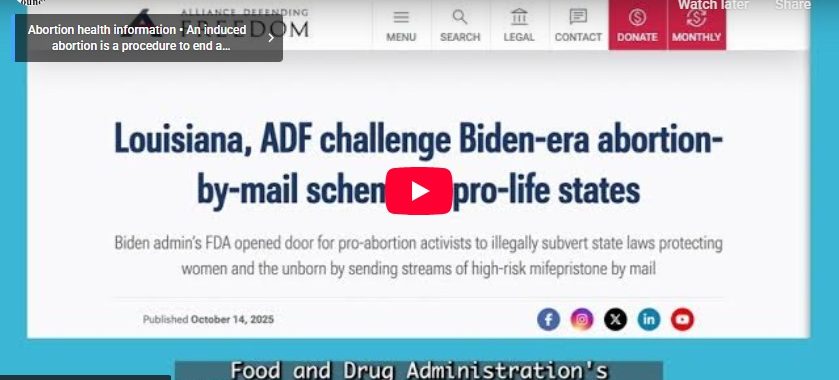
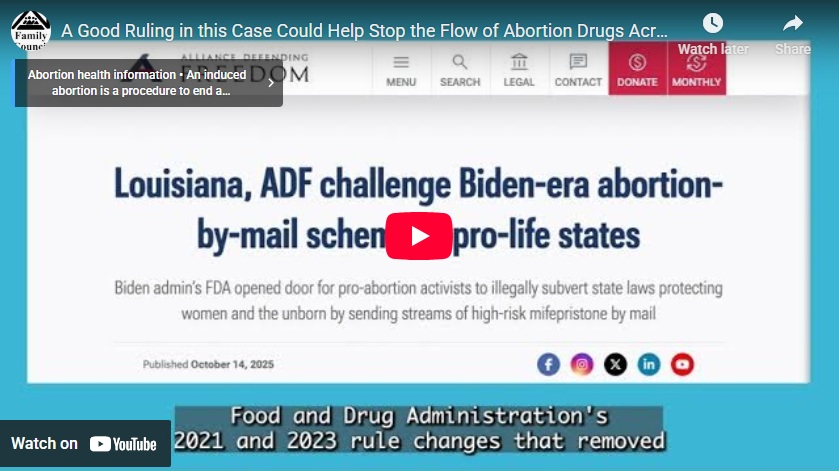
All of this has prompted the U.S. Department of Health and Human Services to launch a formal investigation into the drugs and their safety.

Abortion drugs end the lives of unborn children, and they hurt women. They simply should not be for sale in America.

Articles appearing on this website are written with the aid of Family Council’s researchers and writers.

Ohio House Passes Pro-Life “Baby Olivia” Bill Similar to Arkansas Measure

On November 19, the Ohio House of Representatives passed a bill that would help educate public school students about unborn children.

Ohio House Bill 485, The Baby Olivia Act, makes it possible for public school students to see a recording of a high-definition ultrasound video as well as Live Action’s computer-animated “Meet Baby Olivia” video that teaches about human development from conception to birth.

Ohio’s bill is nearly identical to legislation proposed and passed in Arkansas earlier this year.

H.B. 1180, The Baby Olivia Act, by Rep. Mary Bentley (R — Perryville) and Sen. Clint Penzo (R — Springdale) would have let public school students in Arkansas see an ultrasound recording and watch the Baby Olivia video as part of sex education and human development courses.

Arkansas’ Baby Olivia Act passed with overwhelming support in the Arkansas House, but it failed repeatedly in the Senate Education Committee.

Fortunately, the Arkansas Legislature did eventually pass S.B. 450 by Sen. Breanne Davis (R — Russellville) and Rep. Kendra Moore (R — Lincoln). The law does not reference the Baby Olivia video, but it does let public school students see a recording of a high-definition ultrasound and learn important facts about how unborn children develop in the womb.

Ultrasound images help demonstrate that unborn children are human beings.

Very few medical advancements have done more to change hearts and minds on abortion than ultrasound technology. In fact, research has shown that some women are less likely to have an abortion if they see an ultrasound image of their unborn child.

With that in mind, it’s good for states like Arkansas to pass laws teaching students about unborn children.

Below is the “Meet Baby Olivia” video by Live Action that Ohio House Bill 485 would let public schools show to students.

Articles appearing on this website are written with the aid of Family Council’s researchers and writers.

Pregnancy Centers Provided Hundreds of Millions of Dollars in Goods and Services Last Year

A new report from our friends at the Charlotte Lozier Institute shows pro-life pregnancy resource centers provided hundreds of millions of dollars in goods and services to families last year.

Pregnancy resource centers provide material support to women facing unplanned pregnancies.

Many offer everything from pregnancy tests and ultrasounds to adoption referrals and parenting classes to maternity clothes, diapers, and formula — all typically free of charge. 

The Charlotte Lozier Institute report looked at the work of 2,775 pregnancy centers nationwide. The report found these centers provided over $452 million in medical care, education services, material goods, and other types of support in 2024.

The report also found pregnancy resource centers served one million new clients last year. All of that is great news.

Since the 2022 Dobbs decision reversing Roe v. Wade, state legislatures around the country have begun appropriating funding for pregnancy help organizations, because they are so effective when it comes to helping women and families.

Texas, Tennessee, Louisiana, Oklahoma, Kansas, Ohio, and many other states provide millions of dollars in state funding for pregnancy resource centers.

Lawmakers in Arkansas have also voted to provide grant funding for pregnancy resource centers.

In April, Governor Sanders signed Act 1006 of 2025, by the legislature’s Joint Budget Committee, providing $2 million for grants to pregnancy help organizations — including pregnancy resource centers, maternity homes, adoption agencies, and other charities that provide material support to women with unplanned pregnancies.

The State of Arkansas has funded this grant program every year since 2022 to help promote alternatives to abortion.

In July, DFA received 39 applications for grant funding under the program. However, the department has not taken any action on the applications and reportedly does not have a timeline for awarding grants to the pregnancy help organizations.

Now that abortion is generally prohibited in Arkansas except to save the life of the mother, the state needs to make abortion unthinkable and unnecessary. As the Charlotte Lozier Institute’s report shows, supporting the work of pregnancy help organizations is one way we can do that.

Articles appearing on this website are written with the aid of Family Council’s researchers and writers.