Presidential Commission Issues Draft Report on Ways to Protect Religious Freedom

As our nation prepares to mark 250 years of independence, the Presidential Religious Liberty Commission has issued a preliminary report on ways the federal government could uphold the free exercise of religion.

Religious liberty is recognized and protected under the First Amendment, and it is one of the hallmarks of our nation. But religious freedom has repeatedly come under attack in court, in government, and elsewhere.

News outlets and congressional testimony have alleged that government policies and government agencies have been weaponized against people of faith — especially conservative and Christian groups.

Last year President Trump signed an executive order establishing the Presidential Religious Liberty Commission. The commission is responsible for “producing a comprehensive report on the foundations of religious liberty in America, strategies to increase awareness of and celebrate America’s peaceful religious pluralism, current threats to religious liberty, and strategies to preserve and enhance protections for future generations.”

Over the past twelve months, the commission has heard testimony from Americans who are deeply concerned about protecting the free exercise of religion. In a summary of its draft report, the commission highlighted some of the ways religious freedom has been infringed, writing:

For example, elementary student Shea Encinas was bullied for standing up for his Christian faith when he was forced to read his peer a book that told him he could choose his gender—the school refused to help and doubled down on pushing gender ideology onto the students. Teacher Marisol Arroyo-Castro was told she had to remove a cross near her desk or lose her job. Jennifer Mead’s 11-year-old daughter was pressured by school authorities to believe she was a boy. Navy Seal Blake Martin lost his pension when he was just three years away from retirement eligibility because he objected to the COVID-19 vaccine. Dr. Eithan Haim was indicted by the Biden Department of Justice for blowing the whistle on Texas Children’s Hospital’s gender mutilation surgeries for minors. Shabbos Kestenbaum was targeted on Harvard’s campus simply for being Jewish. And Lacey Smith was fired from her flight attendant position at Alaska Airlines because she answered the invitation to respectfully share her thoughts on the Equality Act. These Americans have suffered greatly for their religious beliefs.

The commission also released a list of 12 ways the federal government could strengthen religious liberty for all Americans — such as by repealing the Johnson Amendment and by directing federal agencies to “issue ‘Know Your Rights’ Posters for students, parents, public school teachers and administrators, religious leaders, religious institutions, healthcare workers, and military servicemembers.”

People should be free to live and operate according to their deeply held religious convictions. That is why it is so important for our laws — and the government agencies that enforce those laws — to protect religious liberty as much as possible.

Over the years, Arkansas has enacted a number of good laws that do exactly that.

For example, in 2015 Gov. Hutchinson signed Arkansas’ Religious Freedom Restoration Act into law, and in 2023 lawmakers passed additional legislation to further strengthen that good law.

In 2021 Arkansas passed Act 462 protecting healthcare workers’ rights of conscience. Before 2021, Arkansas’ conscience protections were narrowly written, and they protected very few people. Act 462 helped broaden those protections for all healthcare workers.

Last year, the Arkansas Legislature passed Act 400, the Religious Rights at Public Schools Act of 2025. This good law by Sen. Mark Johnson (R — Little Rock) and Rep. Alyssa Brown (R — Heber Springs) affirms public school students’ and teachers’ religious liberties.

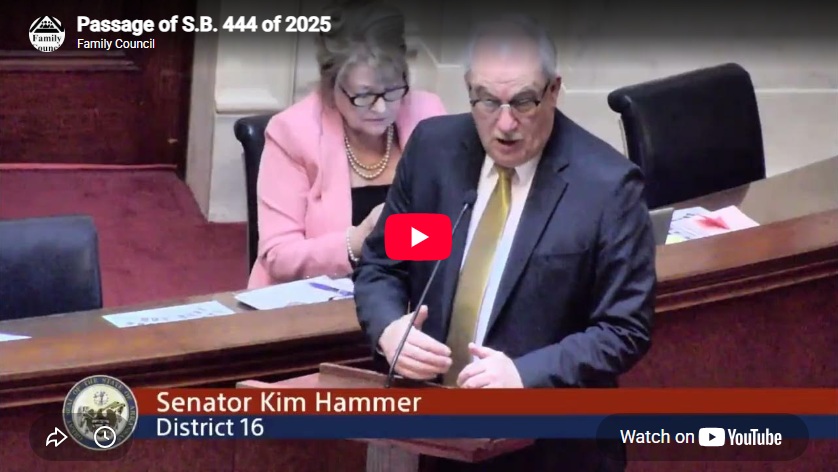
Lawmakers also enacted Act 677 of 2025 by Rep. Robin Lundstrum (R — Elm Springs) and Sen. Gary Stubblefield (R — Branch) ensuring that religious organizations and religious individuals are not penalized for living out their deeply held religious convictions, and Act 970 by Sen. Kim Hammer (R — Benton) and Rep. Lee Johnson (R — Greenwood) strengthening the healthcare workers’ rights of conscience law Arkansas passed in 2021.

Family Council deeply appreciates our policymakers at the state and federal levels working diligently to protect the free exercise of religion. It’s a fundamental freedom that is truly worth protecting.

Articles appearing on this website are written with the aid of Family Council’s researchers and writers.
Data Shows 141 Arkansas Students Took Academic Study of the Bible Courses this Year

Data from the Arkansas Department of Education shows 141 public school students enrolled in courses to study the Bible academically this school year.

Since 2013, the Arkansas General Assembly has enacted laws that let public schools offer elective, academic courses on the Bible.

According to the Arkansas Department of Education’s academic framework for the classes, the course is offered as a one-semester elective in which students learn about the Bible and its influence on literature, art, music, and culture.

If a public school offers the course, it must be objective and nonsectarian. It must meet the same academic standards as other elective courses offered in public schools. And instructors must be licensed to teach in the State of Arkansas.

Over the past 12 years, different school districts in the state have chosen to offer academic courses on the Bible under state law.

Now data from the Arkansas Department of Education shows at least 141 public school students enrolled in elective, academic courses on the Bible at 13 schools for the 2025-2026 school year.

It’s good that Arkansas lets students learn about the Bible at school. After all, no single book has been more influential on our civilization. Of course, Christians believe the Bible is meant to be learned and lived out in daily life. Still, studying the Bible academically is a great opportunity.

Below is a list of school districts offering courses on the Bible this year.

SCHOOL DISTRICTCOURSENUMBER OF STUDENTS
SEARCY COUNTY SCHOOL DISTRICTAcademic Study of the Bible (0.5 credit)27
VAN BUREN SCHOOL DISTRICTAcademic Study of the Bible (0.5 credit)24
SOUTH SIDE SCHOOL DISTRICT (Van Buren)Academic Study of the Bible (0.5 credit)17
NETTLETON SCHOOL DISTRICTAcademic Study of the Bible (0.5 credit)16
MAGNOLIA SCHOOL DISTRICTAcademic Study of the Bible (0.5 credit)13
MARMADUKE SCHOOL DISTRICTAcademic Study of the Bible (0.5 credit)11
FORDYCE SCHOOL DISTRICTAcademic Study of the Bible (0.5 credit)7
LONOKE SCHOOL DISTRICTAcademic Study of the Bible (0.5 credit)7
DEWITT SCHOOL DISTRICTAcademic Study of the Bible (0.5 credit)5
SOUTH CONWAY COUNTY SCHOOL DISTRICTAcademic Study of the Bible (0.5 credit)4
DES ARC SCHOOL DISTRICTAcademic Study of the Bible (0.5 credit)4
ACADEMICS PLUS PUBLIC CHARTER SCHOOLSAcademic Study of the Bible (0.5 credit)4
PREMIER HIGH SCHOOLS OF ARKANSASAcademic Study of the Bible (0.5 credit)2
Total141

Articles appearing on this website are written with the aid of Family Council’s researchers and writers.

LifeWise Academy Expands Rapidly Across Arkansas in 2025-26 School Year, Serving Hundreds of Students

The following is a press release from LifeWise Academy.

Little Rock, AR (June 1, 2026) – LifeWise Academy in Arkansas today announced continued growth across the state, following a banner 2025–26 school year marked by strong local demand and expanding participation in Bible-based character education programs.

In Arkansas, LifeWise currently serves approximately 1,260 students with 12 live programs in 16 schools, reflecting significant year-over-year growth as more families see the significant benefits of released time religious instruction.

“Arkansas families are clearly looking for ways to support character development and address the many challenges that children face today,” said Jeff Wilkerson, State Director for LifeWise Academy. “We are seeing tremendous momentum as communities come together to offer students the opportunity to engage with the Bible during school hours.”

Growth in Arkansas has been driven by local families, with new programs launching and
additional communities currently exploring program development.

Highlights from LifeWise in Arkansas during the 2025-26 school year include:

● Served approximately 1,260 students across 16 schools
● Expanded into new communities, including Benton, Bentonville, and Bryant
● Continued strong parent participation and community support

The survey of 1,000 public school parents and 200 public school educators across the country was conducted by Scott Rasmussen’s RMG Research. Among the poll’s findings:

  • Nearly 90% favor teaching moral and character education to public school students
  • Nearly 70% say voluntary, off-campus Bible-based character education programs would be helpful for their child’s school.
  • Over 85% would favor a released time religious instruction program if it were
    offered

“Families across Arkansas are looking for solutions that help students build strong character, purpose, and values,” said Jeff Wilkerson. “The overwhelming support reflected in this polling mirrors what we are seeing in communities throughout the state — parents and educators want students to have access to positive moral and character education opportunities, and LifeWise is helping meet that demand.”

Key Facts About Released Time Religious Instruction (RTRI):

  • The U.S. Supreme Court ruled in 1952 that public school students could receive religious instruction during the school day so long as it is off school property, privately funded and parent-permitted.
  • Thirty-one states have laws clarifying the practice of released time for religious instruction.
  • Since launching in 5 Ohio schools in 2019, LifeWise Academy has grown to more than 1,000 schools across 37 states — an 11,640% increase in participation. To date, LifeWise has served more than 100,000 students.

###

About LifeWise Academy: LifeWise Academy is a nonprofit that provides Bible education to public school students during school hours under released time religious instruction laws. Hundreds of communities have launched local LifeWise programs through a 10-step process that begins with collecting community signatures at lifewise.org.