



Arkansas Receives a Failing Grade It Can Be Proud Of

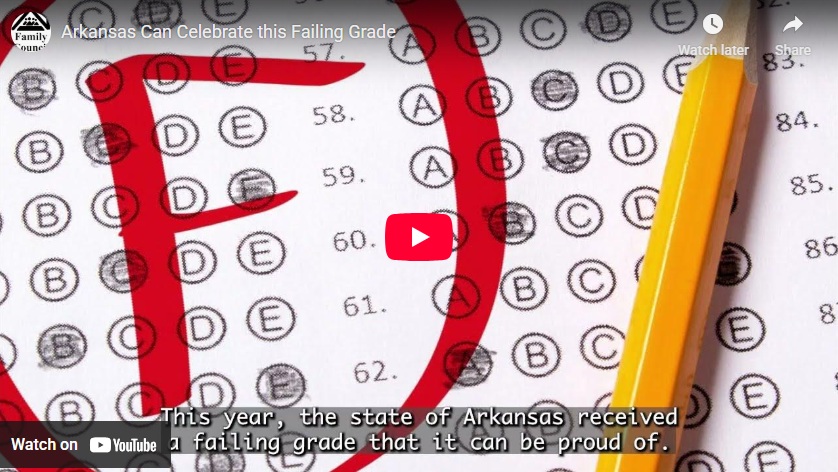
This year the State of Arkansas received a failing grade that it can be proud of.
The radical group Sexuality Information and Education Council of the United States (SIECUS) gave Arkansas an ‘F’ grade on its 2025 United States Sex Education report card.
Part of SIECUS’s mission is “ensuring sex education drives social change.” The group has a reputation of promoting inappropriate sexual material in schools.
SIECUS gave Arkansas a failing grade largely thanks to good legislation conservatives in Arkansas have enacted to protect children from groups like SIECUS.
The 2025 SIECUS report card for Arkansas specifically criticized the state’s laws protecting students from explicit material and pro-LGBT indoctrination at school. It also took issue with Arkansas’ sexual risk avoidance education program that promotes abstinence, and it criticized the state’s good, pro-life laws — including laws that keep abortionists and their affiliates out of public schools.
In 2021, Family Council obtained nearly 1,400 pages of documents that revealed how Planned Parenthood — the nation’s largest abortion provider — had spent several years conducting sex education classes in Pulaski County public schools. We know from experience that the kind of sex education that Planned Parenthood and SIECUS promote simply is ineffective.
Throughout the 1980s and 1990s liberals in Arkansas promoted comprehensive sex education in Arkansas’ public schools.
In 1997 the Arkansas Legislature and the Mike Huckabee Administration switched to abstinence education in Arkansas.
Under Governor Huckabee’s abstinence education program, Arkansas’ teen birthrate decreased 17%, and Arkansas’ teen abortion rate plummeted a staggering 48%.
The abstinence education model was so successful in Arkansas that it drew national recognition.
After his election in 2008, President Obama’s administration gave Planned Parenthood millions of dollars in funding for comprehensive teen pregnancy prevention programs.
Experts later found students who went through Planned Parenthood’s sex education program were often more likely to become pregnant or cause a pregnancy afterwards.
In other words, Planned Parenthood’s multimillion-dollar sex education program did exactly the opposite of what it was intended to do.
In 2016 — while President Barack Obama was still in office — the federal Centers for Disease Control released a 208-page report concluding teenagers who practice abstinence are healthier in nearly every way than teenagers who are sexually active.
The CDC’s report looked at everything from seatbelt and bike helmet use to substance abuse, diet, exercise, and even tanning bed use.
Their conclusion was that sexually active teens were less healthy and engaged in riskier behavior across the board.
In spite of all of this, groups like SIECUS and Planned Parenthood still promote comprehensive sex education in public schools instead of abstinence and risk avoidance education.
Given comprehensive sex education’s track record, receiving a failing grade on the SIECUS’s report card is something Arkansans can actually be proud of.
Articles appearing on this website are written with the aid of Family Council’s researchers and writers.

New Zealand Joins Growing List of Countries Protecting Children from Puberty Blockers
New Zealand has become the latest country to stop prescribing puberty blockers to children with gender dysphoria. The move comes as nations examine the risks and lack of long-term studies on these experimental treatments.
Starting in mid-December, doctors in New Zealand will no longer be allowed to prescribe these drugs to new patients, though those currently taking them can continue.
This decision puts New Zealand more or less alongside the U.K., Sweden, Finland, most states in the U.S., and other nations that have stepped back from so-called “gender-affirming care” for children.
Public health experts and policymakers have found that science simply does not support giving puberty blockers and cross-sex hormones to kids. These drugs and procedures carry serious risks — including infertility, sexual dysfunction, impaired bone density, and cardiovascular problems.
As the U.S. Department of Health and Human Services has demonstrated, the so-called “medical consensus” regarding transgender procedures on children has been largely manufactured by pro-LGBT activists.
Whistleblowers have come forward to testify about how they were rushed through gender transitions as children without understanding the procedures’ risks, consequences, or alternatives.
In January, President Trump signed an executive order prohibiting federal funding from being used for sex-change procedures on kids, and the federal government is soon expected to propose new rules that could help protect children from sex-change procedures nationwide.
Earlier this summer, the Federal Trade Commission (FTC) announced a public inquiry into whether U.S. doctors and clinics may have deceived parents and children about the risks of these procedures. The U.S. Department of Justice also subpoenaed doctors and medical facilities involved in performing sex-change procedures on minors.
In September, the U.S. Department of Justice sent Congress the federal Victims of Chemical or Surgical Mutilation Act. The proposed federal law would generally prevent doctors, hospitals, and clinics from performing sex-change surgeries on children or giving them puberty blockers or cross-sex hormones.
In 2021, lawmakers in Arkansas passed the Save Adolescents from Experimentation (SAFE) Act. This good law generally prohibits doctors from performing sex-change procedures on children or giving them puberty blockers and cross-sex hormones. The SAFE Act has been upheld in federal court and is protecting children in Arkansas right now.
The fact that more countries are putting a stop to these transgender procedures proves that Arkansas was right to pass the SAFE Act in 2021. Other states should follow Arkansas’– and New Zealand’s — example by protecting children from experimentation.
Articles appearing on this website are written with the aid of Family Council’s researchers and writers.