

Faith, Family Deter Teen Sexual Activity: New CDC Report

A Centers for Disease Control report released this month shows that faith and family are two primary reasons teenagers choose not to be sexually active.

The CDC’s “Sexual Activity, Contraceptive Use, and Childbearing” report surveyed teens between 2015 and 2019, and compared data to similar reports released in previous years.

The CDC’s findings underscore the ways faith and family affect teenage sexual activity.

First, researchers found “the main reason most commonly chosen by female teenagers for not having had sex, among the options provided, was ‘against religion or morals’ (32.5%) . . . Among male teenagers, the most commonly chosen main reason for not having had sex was ‘haven’t found the right person yet’ (35.3%), followed by ‘against religion or morals’ (26.2%).”

In other words, a teen’s religious beliefs play a significant role in whether he or she will be sexually active.

Second, teens who lived in a two-parent household with their biological or adoptive parents were less likely to engage in sexual activity than their peers.

The study also found sexual activity was higher among teenagers who did not live with both biological or adoptive parents.

The researchers concluded,

The probability of having had sex by age 17 was lowest for females who lived with both biological or adoptive parents at age 14 (42%) compared with those who lived in other parental living arrangements (64%–67%). The same pattern held by parental living arrangement for males ages 15–24.

To put it plainly: Moms and dads matter, and they have a profound impact on their children.

This latest report is reminiscent of a 208-page report the CDC released in 2016 regarding teenage sexual activity.

The 2016 report examined sexual activity and health trends among youth. It looked at everything from seatbelt and bike helmet use to substance abuse, diet, exercise, and even tanning bed use.

The 2016 report concluded teenagers who practiced abstinence were healthier in nearly every way than teenagers who were sexually active.

It also determined that sexually-active teens were less healthy and were more likely to engage in risky behavior.

The CDC’s newest report echoes some of these points, noting that, among other things, sexually active teens and young adults face increased risk of sexually transmitted diseases.

All of this underscores the important role that faith and family play in the lives of teens and young adults. 

Having a strong faith and a good life at home doesn’t just discourage a teen from having sex. In the process, it also has other positive impacts on that child’s life. That’s something to keep in mind as parents, educators, and policymakers discuss sex-education and related issues.

Articles appearing on this website are written with the aid of Family Council’s researchers and writers.


Prioritizing Parental Rights and Abstinence in Sex-Education

This is part of Family Council’s ongoing series outlining the importance of traditional family values in society. Today’s installment focuses on appropriate sex-education in schools.

Sex-education has been a topic of intense debate in Arkansas and across the country over the decades.

Family Council generally opposes so-called “comprehensive sex-education” programs, because they encourage teens to engage in immoral behavior, and research shows they are generally ineffective or even counter-productive.

Instead, we support abstinence education, which has a good track record in Arkansas and elsewhere.

Below are a few points to consider.

Respecting Parental Rights in Sex-Education

Parents are the primary educators of their children, especially when it comes to topics like sex, and the state must respect parental rights.

Parents should have the right to teach their values, beliefs, and morals to their children. Comprehensive sex-education programs can undermine parental authority and encroach on the values parents want to impart to their kids.

The LEARNS Act that Gov. Sanders recently signed into law actually addresses this point by letting parents review potentially-objectionable public school material before it is taught to their children, and the law lets parents exempt their children from the curriculum if they want.

Age-Appropriate Instruction in Sex-Education

Comprehensive sex-education programs often fail to tailor the information to the child’s age and maturity level. That means they may expose young children to explicit images or other inappropriate content.

The LEARNS Act that Gov. Sanders recently signed into law actually addresses this by prohibiting sexual material in classroom instruction before fifth grade.

This includes instruction regarding sexual intercourse, sexual reproduction, sexual orientation, and gender identity.

This component of the LEARNS Act is similar to legislation enacted in Florida and elsewhere addressing inappropriate sexual material in elementary schools.

Arkansas has other laws in place that promote abstinence education in public schools after fifth grade.

Abstinence Education is Linked to Healthier Lifestyles Among Teens

Family Council supports abstinence sex-education, in part because research shows that encouraging abstinence addresses more than STDs and unintended pregnancies.

According to the CDC, teenagers who practice abstinence are healthier in nearly every way than teenagers who are sexually active.

Sexually-active teens have been found to be less healthy and engage in riskier behavior.

In other words, abstinence is linked to healthier lifestyles overall.

Comprehensive sex-education programs often focus on contraceptives and risk reduction without encouraging abstinence as a viable option. This leads to riskier behavior among teens.

Abstinence Sex-Education Has a Good Track Record in Arkansas

In the 1980s and 1990s, public officials in Arkansas promoted comprehensive sex-education. The programs failed to have a meaningful impact on teen pregnancy and abortion in Arkansas.

These programs focused on teaching public school students about contraceptive use.

During that time, Arkansas’ teen birth rate remained high, and teenagers were among those most likely to have an abortion.

In 1997 the state switched strategies, promoting abstinence-based sex-education in public schools. The results were nothing short of staggering.

Teen birth rates and teen abortion rates in Arkansas plummeted.

From 1997 to 2003, the teen abortion rate fell by approximately 37%, and the teen birth rate fell by 16%.

Governor Huckabee’s abstinence-based sex education of the late 1990s and early 2000s was more than twice as effective combating teen pregnancy and teen abortion as Governor Clinton’s and Governor Tucker’s contraceptive-based sex-education programs.

Family Council was pleased to support Arkansas’ good abstinence education program.

Conclusion

Three decades of data shows that abstinence education doesn’t just work; it’s much better than the comprehensive sex-education programs that groups like Planned Parenthood promote.

Comprehensive sex-education may infringe on parental rights, encourage teens to engage in risky behavior, and expose children to inappropriate material at school.

When it comes to sex-education, the choice is clear: Teaching abstinence is the way to go.

Articles appearing on this website are written with the aid of Family Council’s researchers and writers.
Arkansas Governor Asa Hutchinson Signs Law to Keep Planned Parenthood Out of Public Schools

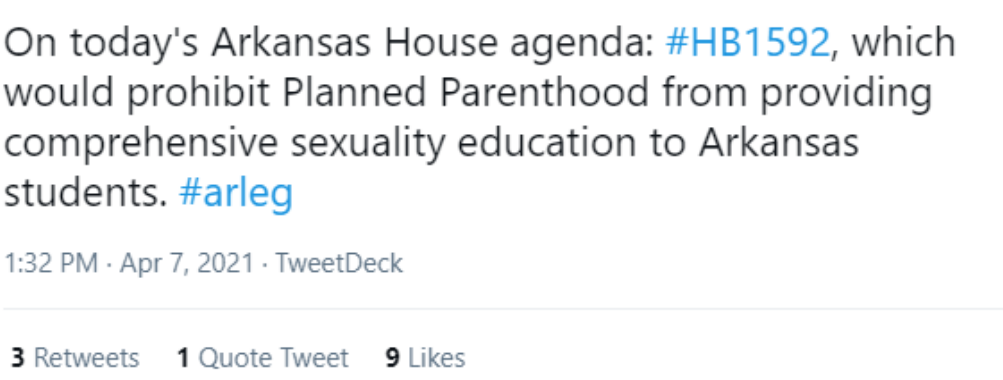
On Wednesday Arkansas Governor Asa Hutchinson signed H.B. 1592, the Student Protection Act, into law.

This good law by Rep. Mark Lowery (R – Maumelle) prohibits public schools in Arkansas from engaging in transactions with abortion providers. It passed the Arkansas Legislature with strong support.

In March, Family Council obtained nearly 1,400 pages of documents that revealed how Planned Parenthood has worked in public schools in Pulaski County for several years.

We know from experience that the kind of sex-education that Planned Parenthood promotes simply is not as effective as other programs.

In the 1980s and 1990s liberals in Arkansas promoted Planned Parenthood-style sex-education in Arkansas’ public schools.

From 1991 to 1997 Arkansas’ teen birthrate decreased by 11% and Arkansas teen abortion rate decreased by 18%.

In 1997 the Arkansas Legislature and the Mike Huckabee Administration began promoting abstinence education in Arkansas.

From 1997 to 2005, Arkansas’ teen birthrate decreased 17%, but Arkansas’ teen abortion rate plummeted a staggering 48%.

Governor Huckabee’s abstinence education model was so successful in Arkansas that it drew national recognition.

In 2016 — while President Barack Obama was still in office — the federal Centers for Disease Control released a 208-page report concluding teenagers who practice abstinence are healthier in nearly every way than teenagers who are sexually active.

The CDC’s report looked at everything from seatbelt and bike helmet use to substance abuse, diet, exercise, and even tanning bed use.

Their conclusion was that sexually-active teens were less healthy and engaged in riskier behavior across the board.

H.B. 1592 will help make sure that abortionists don’t have access to Arkansas’ public school students, and it will help encourage schools to seek out better sex-ed curricula than what Planned Parenthood has to offer.