
Guest Column: Why Gen Z “Nones” Are Reconsidering Religion
Gen Z is the least religious cohort in American history. 43% of this generation born roughly between 1996 and 2012 identify as religious “nones.” While there have been many reports since Charlie Kirk’s assassination indicating increased interest in religion and increased church attendance, according to statistician Ryan Burge, there is not yet statistical evidence of religious revival among young people.

There is, however, ample evidence that these Zoomers are looking for meaning and willing to reconsider religion. Specifically, though these trends may not be large enough to be captured in statistics, there seems to be a growing interest in more rigorous forms of faith.

In a recent article in Tablet magazine, Ani Wilcenski, a Zoomer herself, examined this phenomenon. While acknowledging that Gen Z is less religious than previous generations, Wilcenski, researched those bucking that trend, including converts to Islam, Jews who are becoming more observant, Latin Mass Catholics, Orthodox Christians, and others who are joining stricter, more traditional religious groups.

According to Wilcenski, Gen Z has been raised with the “illusion of infinite horizons,” and grew up “without sturdy institutions or fulfilling rites of passage.” As a result, for this generation, “[e]verything—career, identity, relationships—unfolds as a series of self-directed experiments,” something that has been labeled “liquid modernity.” Sociologist Zygmunt Bauman coined that phrase to describe the experience of life as unstable and non-permanent, without fixed distinctions, and no foundation for cultivating identity.

The experience of “liquid modernity” is why, according to Wilcenski, the ideological capture of Gen Z has been so comprehensive. For example, nearly one-quarter of the generation identify as LGBTQ, up nearly 20 points from previous generations. Ideology gives the illusion of a solid cause and offers a purpose for life where otherwise there is none.

Of course, that is the role religion traditionally played in Western culture. As Wilcenski noted, the draw of religion is that it provides a firm source of virtue and belonging, focus, and a sense of permanence. That’s what the Zoomers who are exploring more demanding forms of faith are most likely seeking.

As Wilcenski put it,

These faiths don’t adapt to the age—they expect the age to conform to them. Their rituals inconvenience, their authorities override preference, their truths don’t negotiate. And in a society allergic to absolutes, that refusal to dilute themselves holds a powerful magnetism.

As an example, Wilcenski quoted a 23-year-old woman who explained her decision to join a Carmelite monastery in Plough magazine: “I figured if I was going to do something crazy for our Lord I might as well go all in.” Like Wilcenski, the Plough article noted that young women who join strict religious orders are committing to something stable and permanent.

According to Wilcenski, when the Gen Zers turning to religion offer reasons why, they

sound more like escapes from modern chaos than declarations of faith…. [T]heir newfound religiosity is less about belief than about orienting life around something ultimate—something greater than the self.

That, of course, also leaves them vulnerable to religious falsehoods. Remember, Wilcenski not only researched conversions to Christianity but also to conservative forms of Judaism and Islam. The desire to escape “liquid modernity” says nothing about the genuineness of any faith that follows. The same motivation can explain the growing number of young men who are embracing political extremism, from Antifa to white nationalism.

It has long been the case that laxer forms of religion have declined while more demanding forms have grown or at least declined more slowly. The divide within this segment of Gen Z seems to be even more pronounced. This group will not be interested in churches that accommodate themselves to American culture. The seeker-sensitive model will not work. It probably never has.

The Church must be countercultural, unapologetic about even the weird things we believe, and unafraid to ask for serious commitment from people. It needs to explore the depths of the Gospel; it must explain life and its meaning, including hard truths about the human condition, rather than offer only shallow therapeutic or pragmatic applications. A church that does this will not only be able to counter destructive ideologies vying for all generations but will also be able to offer meaning and stability to a generation that is looking for both.

Copyright 2026 by the Colson Center for Christian Worldview. Reprinted from BreakPoint.org with permission.

Making Sense of Mixed Signals on Church Attendance, Religious Affiliation in America

Public opinion polling seems to be sending mixed signals when it comes to Americans’ religious affiliation.

Bible reading surged in 2024 and 2025, and last year news outlets reported how a large share of American adults have rediscovered Christianity in the wake of the COVID-19 pandemic. According to Barna, Millennial and Gen Z churchgoers attend services approximately twice a month, on average, and teens are “very motivated to learn about Jesus.Gallup even announced last June that a growing share of Americans actually see religion’s influence increasing.

But earlier this month, Gallup released a poll showing that “religious engagement” in America is still low. Religiously unaffiliated “Nones” in America rose to 24% last year. Less than half of U.S. adults now say religion is “very important,” and less than one in three attend church weekly. Some predict the U.S. could see as many as 100,000 churches close in the next few years.

Some reports seem to show Christianity growing in America while others suggest it’s declining. Which is it?

There are a few possible explanations.

One may be that the distinction between religious and non-religious people is becoming more pronounced.

Few people may go to church weekly, but the ones who do go to church are highly committed to their faith.

Some people may describe this as a decline in cultural or “nominal” Christianity: People who don’t take their faith seriously may be less likely to call themselves Christians or attend church. But those who do profess to be Christians are very devout.

That could help explain why we see so much engagement with the Bible and so many headlines about young adults going to church even as the number of religious “Nones” has gone up.

Another point to consider is that Americans’ church preferences may be changing.

For decades Christians have shifted away from mainline churches and denominations in favor of less formal evangelical or nondenominational churches.

If some churches are shrinking — or closing altogether — while others are remaining stable or growing, that doesn’t represent a decline in Christianity. It may just mean that Christians’ church and denominational preferences are still changing.

On a broader level, in 2017, Pew Research Center found a growing share of Americans identify as “spiritual but not religious.” Many people may think they can be spiritual or even follow Christ without going to church. But being part of a local community of believers is an important part of discipleship. Christians encourage one another and help build each other up in the faith. Church isn’t optional for Christians. It’s essential.

Articles appearing on this website are written with the aid of Family Council’s researchers and writers.

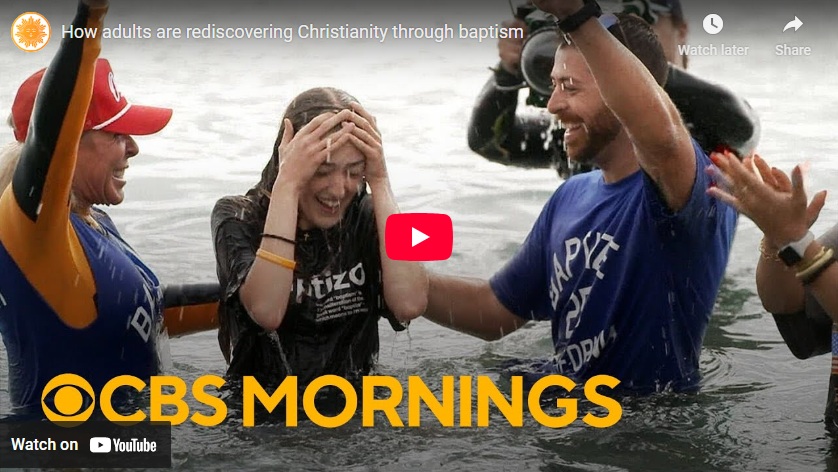
How Adults are Rediscovering Christianity Through Baptism: CBS Reports

CBS Mornings recently reported that since the COVID-19 pandemic, a large number of adults — particularly Gen Z men — have been baptized into the Christian faith.

During its news segment, CBS highlighted a massive baptism service recently held on the California coast.

We have shared before about the “quiet revival” taking place in America and the U.K.

Bible sales in America skyrocketed in 2024, and this year the American Bible Society released its annual “State of the Bible” report that examines Bible use and scripture engagement. The report found, “Millennials are leading the way in this move toward greater Bible Use, and in every generation men are using the Bible more.” The report also found a little more than one in three Gen Z adults (36%) qualify as Bible Users.

While pollsters have reported for years about the decline of weekly church attendance, Gallup announced in June that a growing share of Americans actually see religion’s influence increasing.

It’s good to see more Americans coming to faith in Jesus and engaging with scripture. As President Reagan said during a speech in 1984:

The truth is, politics and morality are inseparable. And as morality’s foundation is religion, religion and politics are necessarily related. We need religion as a guide. We need it because we are imperfect, and our government needs the church, because only those humble enough to admit they’re sinners can bring to democracy the tolerance it requires in order to survive. . . .

Without God, there is no virtue, because there’s no prompting of the conscience. Without God, we’re mired in the material, that flat world that tells us only what the senses perceive. Without God, there is a coarsening of the society. And without God, democracy will not and cannot long endure. If we ever forget that we’re one nation under God, then we will be a nation gone under.

Hopefully this “quiet revival” is one that will continue to spread.

Articles appearing on this website are written with the aid of Family Council’s researchers and writers.