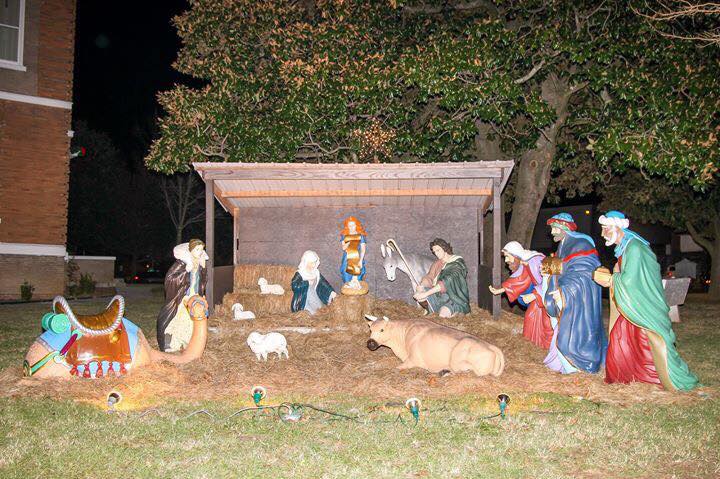
But courts have said that schools and local governments can celebrate Christmas — including by placing Nativity scenes and similar decorations on public property.
The U.S. Constitution lets public school students celebrate Christmas. And most Americans approve of Christmas celebrations at school. That’s a good thing.
Articles appearing on this website are written with the aid of Family Council’s researchers and writers.
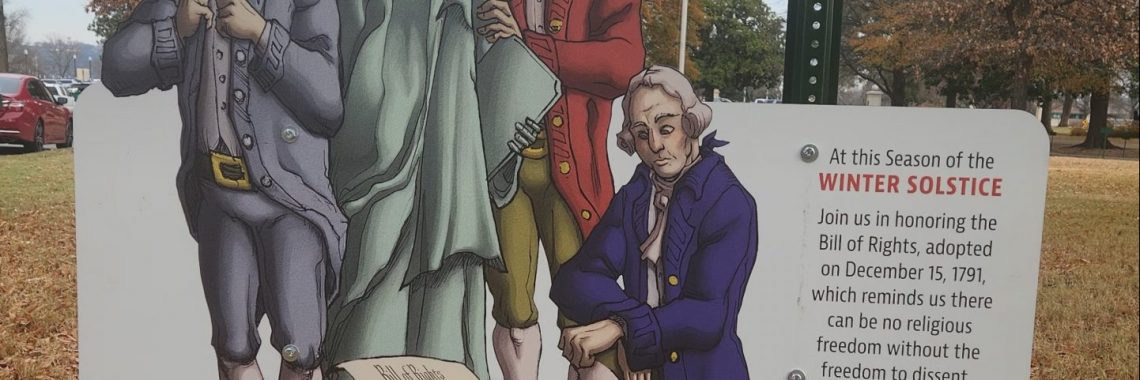
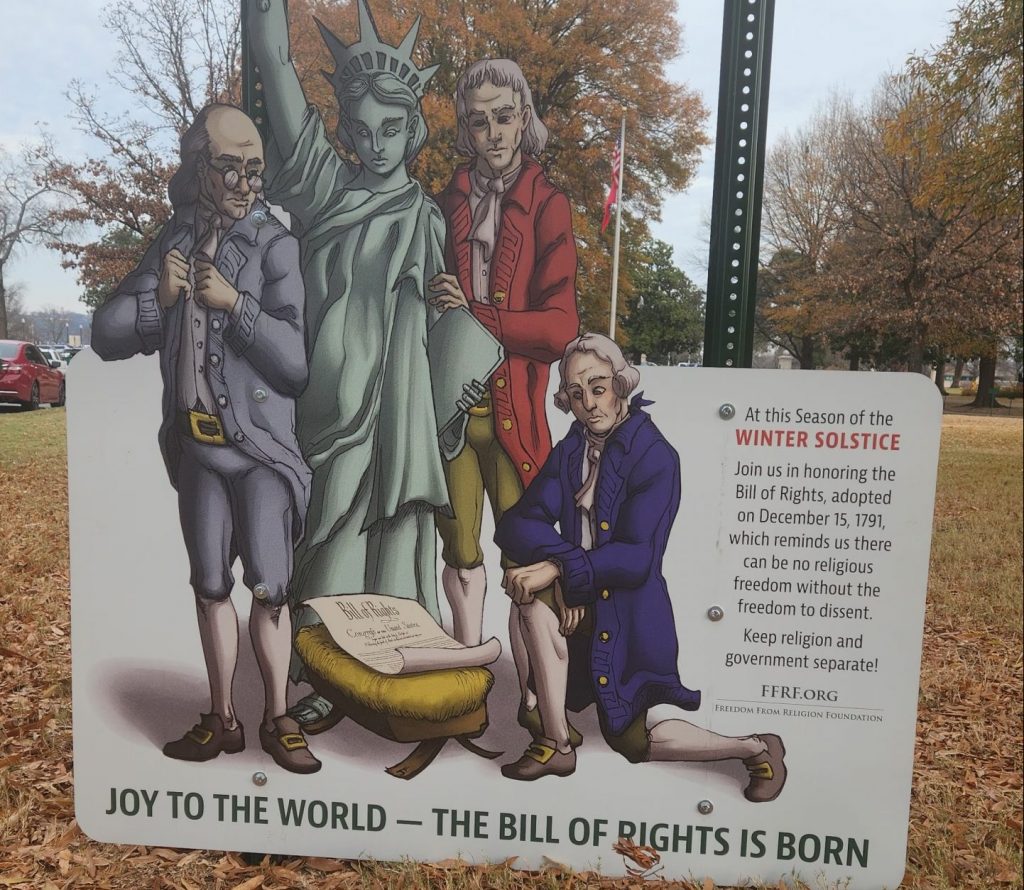
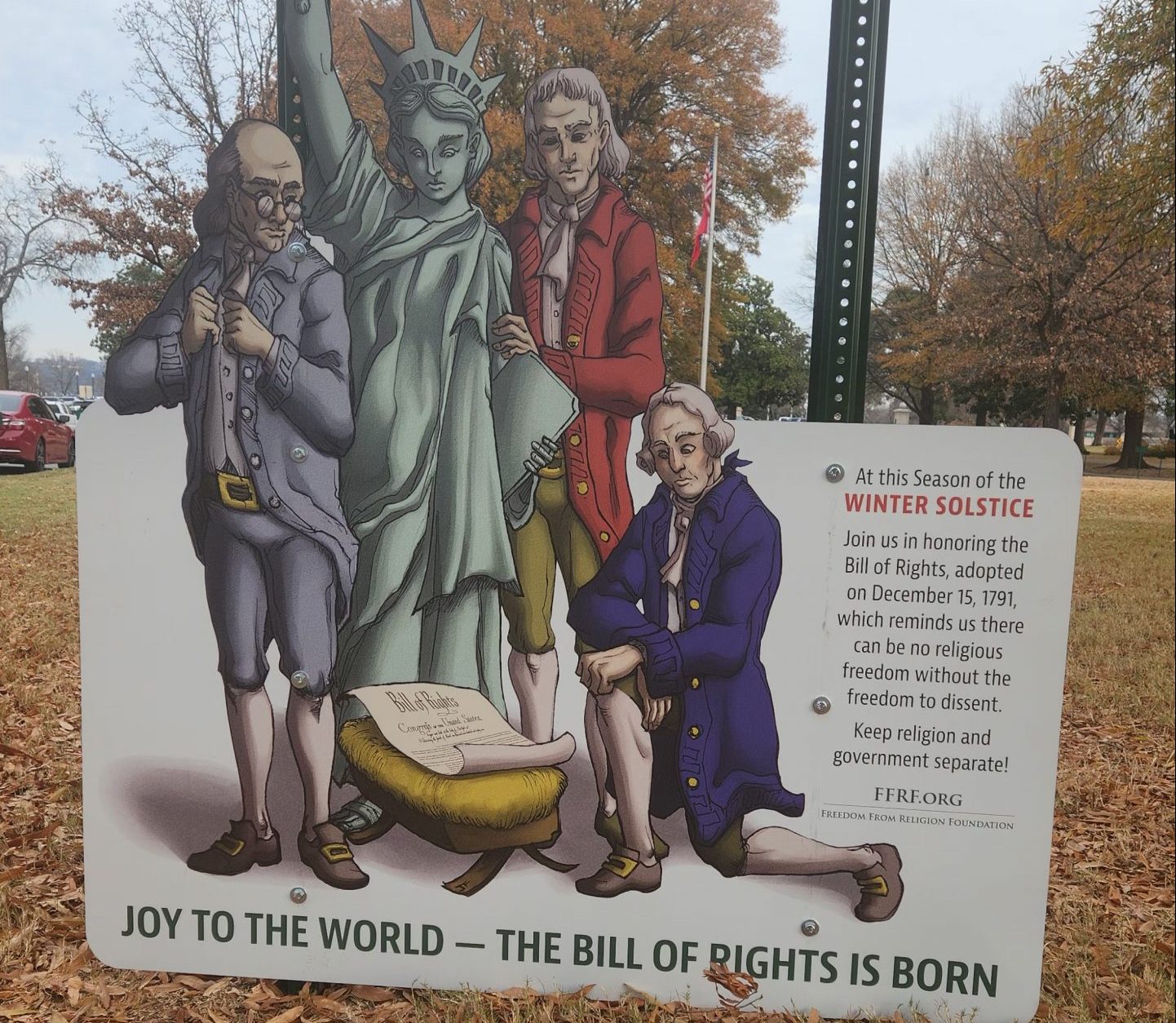
This week the Freedom From Religion Foundation announced atheists in Arkansas placed a “Winter Solstice” display on the Arkansas Capitol Lawn proclaiming “Joy To The World — The Bill of Rights is Born” and advocating, “Keep religion and government separate!”
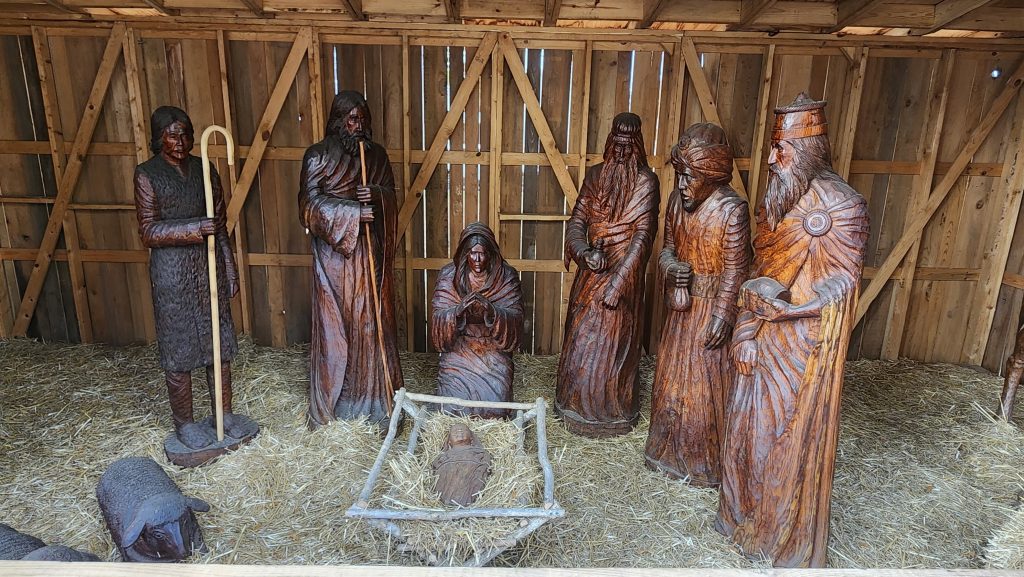
The atheist display appears alongside the state’s longstanding Nativity display carved by Arkansas artisans and another atheist display by the Arkansas Society of Freethinkers.
In 2009 a federal judge in Little Rock ruled Arkansas’ Secretary of State was obligated to allow a local group of atheists to put up a display marking the winter solstice on the Capitol grounds.
The Secretary of State and the Arkansas Legislature likely could prevent these types of displays from appearing on the capitol grounds each December by redesignating its lawn as a limited public forum intended to celebrate state and federal holidays like Christmas.
The irony is that America’s Bill of Rights — which the Freedom From Religion Foundation display celebrates — is the product of a Judeo-Christian worldview.
For example, historians have long recognized the Ten Commandments as one of the earliest examples of the rule of law in human history, and they profoundly shaped our nation’s legal system and ideas about justice.
That’s why there is a carving of Moses holding the Ten Commandments at the apex of the U.S. Supreme Court Building in Washington, D.C.
The Christian understandings of personal liberty, self-government, and rule of law were woven into the founding of our country. Without the birth of Christ, the Bill of Rights arguably never would have been born either.
As Founding Father John Adams put it in 1798, “Our Constitution was made only for a moral and religious people. It is wholly inadequate to the government of any other.”
Or as President Ronald Reagan said at the 1984 Ecumenical Prayer Breakfast in Dallas, Texas:
Without God, there is no virtue, because there’s no prompting of the conscience. Without God, we’re mired in the material, that flat world that tells us only what the senses perceive. Without God, there is a coarsening of the society. And without God, democracy will not and cannot long endure. If we ever forget that we’re one nation under God, then we will be a nation gone under.
The Nativity Scene above adorns Arkansas’ Capitol Lawn each year.
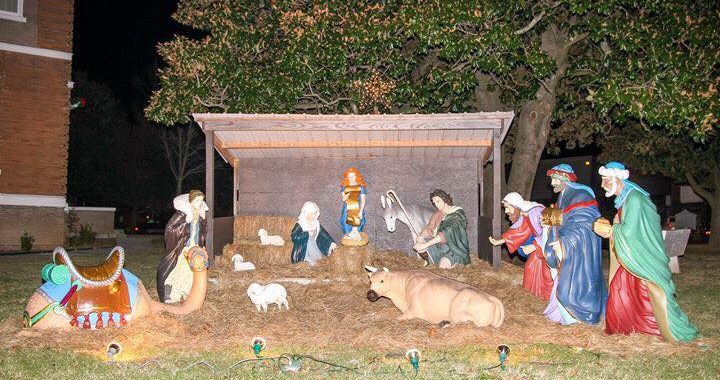
Fox 16 News reports that Bradley County officials have opted not to place their traditional Nativity scene on the courthouse lawn after receiving letters from the ACLU.
In a written statement, Bradley County Judge Klay McKinney indicated that the county opted not to display the Nativity Scene on public property in part because officials in Mountain Home lost a lawsuit over a Nativity Scene in 2015.
However, it’s worth pointing out that the U.S. Supreme Court has ruled Nativity scenes on public property constitutional in the past.
In Lynch v. Donnellythe court ruled a Nativity scene on city property did not violate the Establishment Clause.
Christmas is a federal holiday, and Americans have celebrated it since before the American Revolution.
Contrary to the claims of the ACLU and others, local governments can celebrate Christmas — including by placing Nativity scenes and similar decorations on public property.
Updated at 4:00 PM on 12/3/2019:
KATV now reports that the Nativity scene will be displayed at a church down the street from the courthouse.