U.S. Sen. Cotton Praises Pregnancy Resource Center for “Doing the Lord’s Work,” Building Strong Families

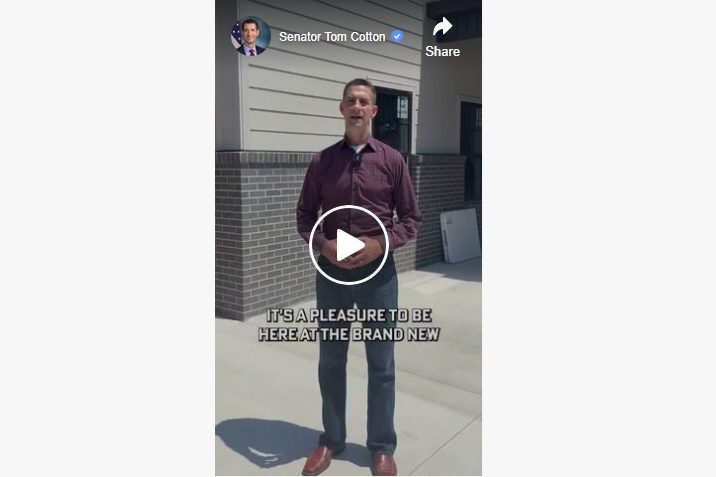
Last week, U.S. Senator Tom Cotton from Arkansas posted a video at the New Beginnings Pregnancy Center in Saline County.

In the video, Cotton praised the center saying, “They’re doing the Lord’s work for young moms and dads and babies, helping to turn them into strong families.”

Cotton said protecting the unborn is one of his top priorities in the U.S. Senate.

Pregnancy resource centers and other types of pregnancy help organizations play a critical role in the fight to protect innocent human life.

These centers give women real options besides abortion. They can provide women with everything from maternity clothes and baby formula to adoption referrals and parenting information — often free of charge.

Since 2022, the State of Arkansas has awarded millions of dollars in grant funding to help these charities support women and families with unplanned pregnancies.

Arkansas isn’t the only state doing this. A growing number of states provide these organizations with public funding, because they help women choose life.

After the U.S. Supreme Court overturned Roe v. Wade, Family Council outlined a three-part plan for eliminating abortion:

  • Encourage the Enforcement of Existing Pro-Life Laws
  • Work to Pass Any Additional Laws Necessary to End Abortion
  • Expand Our Efforts to Assist Pregnancy Help Organizations

Supporting pregnancy resource centers is a major part of that plan. We deeply appreciate the Arkansas Legislature, Governor Sarah Sanders, and leaders like Sen. Tom Cotton for championing the good work that these centers do.

Articles appearing on this website are written with the aid of Family Council’s researchers and writers.

U.S. Senators Ask TikTok to Answer for its “Depraved” Safety Experiment on Children

Two U.S. senators are demanding answers from TikTok over a “depraved” experiment it ran that involved secretly withholding a safety feature from millions of users — including children — on its platform.

With an estimated one billion users worldwide — including upwards of 135 million in the U.S. — TikTok is one of the most popular social media platforms on the planet. Its Chinese-based parent company, ByteDance, has been valued at $300 billion.

But for years, TikTok has been under scrutiny for struggling to protect private user data from entities in China — including the Chinese Communist Party — and the platform has been accused of serving users a steady “diet of darkness” online.

TikTok’s attorneys and representatives have often denied or downplayed accusations against the platform, arguing the company takes safety very seriously. But a recent Bloomberg report shows that in 2022, the social media giant knowingly endangered teens and other users by disabling a key safety measure on TikTok’s algorithm for millions of users.

The LA Times says TikTok disabled the safety feature as part of an experiment to see how the feature affected user behavior. The news has prompted letters from at least two U.S. senators.

Last Thursday, U.S. Senators Marsha Blackburn (R-Tenn.) and Richard Blumenthal (D-Conn.) sent a letter demanding answers from TikTok.

The letter says TikTok failed to tell the public about “its depraved decision to intentionally withhold these protections from approximately 10 percent of its U.S. users—a control group that reportedly represented approximately 15 million Americans at the time.”

The letter says that in January of 2022, TikTok disabled safety features on 16-year-old Chase Nasca’s TikTok account, causing him to be inundated with “thousands of videos involving themes of sadness, hopelessness, loneliness, suicide, and self-harm” on TikTok.

The following month, Chase died by suicide.

The senators ask TikTok to provide detailed information about the secret experiment and any others TikTok has run.

Leaders in Arkansas have raised concerns about harmful content on TikTok for the past several years.

In 2023, Arkansas Attorney General Tim Griffin filed a pair of consumer protection lawsuits against TikTok in state court.

The legal complaints call the TikTok app “a Chinese ‘Trojan Horse’ unleashed on unsuspecting American consumers,” and highlight how TikTok fails to protect private user data.

The Attorney General’s office argues that TikTok’s algorithm “force-feeds” objectionable content to users — including “illegal drug use, sex, violence, and self-harm.”

The A.G.’s team says that TikTok deceptively labeled its app as being appropriate for ages 13 and up when it really should have been rated 17+.

As we have said again and again, there is growing evidence that social media platforms may deliberately addict users, promote objectionable content, and put people’s personal information at risk.

Social media platforms are more than just phone apps or websites. These are multibillion-dollar businesses, and the adults who profit from them need to be held accountable when they harm innocent people.

Articles appearing on this website are written with the aid of Family Council’s researchers and writers.

Colorado’s Assisted Suicide Reports Show Incomplete Medical Data, Lack of Mental Health Evaluations

Public health data from Colorado shows that patients approved for assisted suicide likely are not being screened by mental health experts, and the assisted suicide reports that doctors submit to the State are sometimes incomplete.

Colorado legalized assisted suicide under its 2016 End-of-Life Options Act. Since then, the State has recorded nearly 2,600 prescriptions for lethal drugs under the law.

Assisted suicide’s supporters have claimed the law contains strong safeguards to protect vulnerable patients, but statistical data from the State of Colorado raises questions about whether that really is the case.

For example, last year 580 patients were approved for assisted suicide in Colorado. Out of all of those patients, only one reportedly was referred to a mental health professional for evaluation. That’s due in part to the fact that mental health evaluations are optional in Colorado. Under the End-of-Life Options Act, mental health referrals typically are limited to cases where the physician prescribing the drugs has doubts about the patient’s decision-making ability. Doctors are not required to get a mental health professional’s opinion about whether the patient may be suffering from mental illness.

It’s very troubling that doctors would let patients end their lives via assisted suicide without referring them to mental health professionals first. But it is also troubling that official reports from Colorado show some of those doctors may be submitting incomplete patient data to the State when they fill prescriptions for assisted suicide.

For example, Colorado law says the patient’s primary medical provider must consult with a second provider to verify that the patient’s condition is terminal and to help ensure the patient is not being coerced into requesting assisted suicide. Patients must also record their request for assisted suicide in writing.

All of this information is supposed to go to the Colorado Department of Public Health and Environment when providers write prescriptions for assisted suicide.

But statistical data shows that since 2017, there have been at least 88 cases in which public health officials did not receive copies of the patient’s written request for assisted suicide. There were also 126 cases in which the paperwork did not include documentation from a secondary provider who reviewed the patient’s case.

The 2025 assisted suicide report from Colorado’s Department of Public Health explains these gaps in the data by saying:

“While reporting of the required documentation (including prescribing forms, patients’ written requests, consulting providers’ written confirmations, and mental health provider confirmation when applicable) may be incomplete, attending/prescribing forms received contained providers’ signed attestations that all requirements of the Colorado End-of-Life Options Act have been met, and that required documentation is complete and contained in patients’ records. Efforts continue to educate health care providers about reporting requirements.”

In other words, Colorado’s public health officials will accept incomplete records as long as doctors say they are following the law.

But without proper oversight, there really is no way to know if doctors are following state law.

For example, a 2024 peer-reviewed article found that people with eating disorders like anorexia may sometimes be approved for assisted suicide in Colorado.

A case study published in 2022 revealed a Colorado doctor specializing in anorexia treatment helped patients obtain assisted suicide.

Cases like these are deeply concerning.

But even with government oversight, assisted suicide is still a problem.

Assisted suicide fundamentally changes the doctor-patient relationship from healing to killing.

Experts say that in some places where assisted suicide and euthanasia are legal, palliative care specialists are being driven to quit practicing medicine. That hurts everyone.

Once doctors and policymakers decide some lives are not worth living, it’s practically impossible to choose where to draw the line on assisted suicide.

In parts of the U.S. where assisted suicide is legal, insurance companies have refused to pay for patients’ medical care, but have offered to cover assisted suicide drugs.

Patients in Europe and Canada reportedly have been denied care or actively euthanized as a result of assisted suicide laws.

Next year, Canada could expand assisted suicide to include people suffering solely from mental health conditions like depression or personality disorders.

All of this underscores why Family Council has strongly opposed assisted suicide in Arkansas. In 2019 and 2021, Arkansas lawmakers wisely rejected very bad end-of-life laws that were flawed and fundamentally disrespected the right to life. Family Council worked closely with our friends in the legislature to stop those proposals.

Being pro-life means believing innocent human life is sacred from conception until natural death.

Just like abortion, euthanasia and assisted suicide violate the sanctity of innocent human life.

Articles appearing on this website are written with the aid of Family Council’s researchers and writers.