Why is Support for Same-Sex Marriage and Other Pro-LGBT Issues Falling?
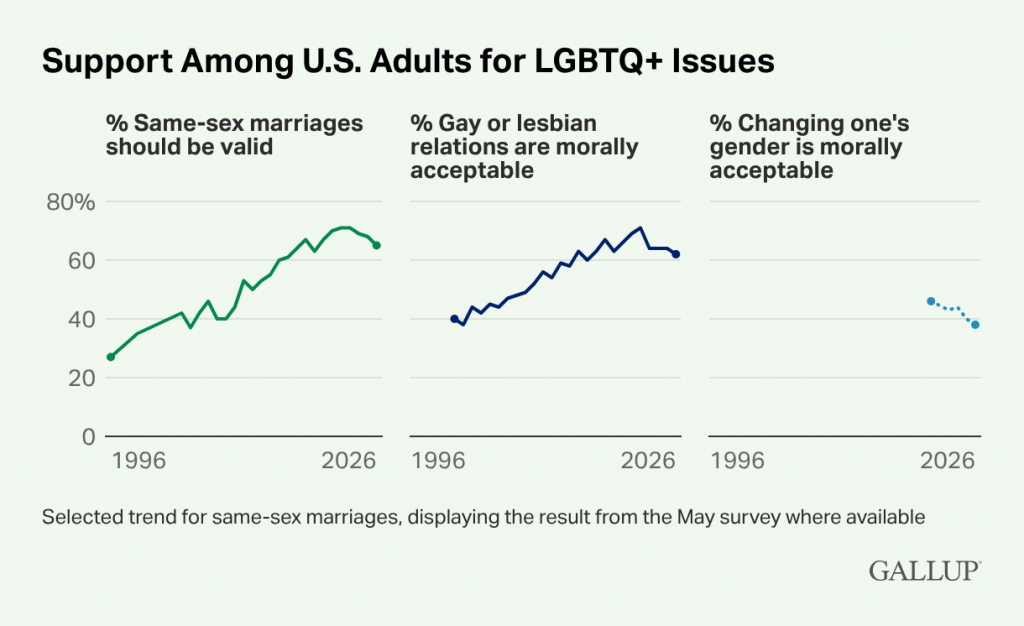
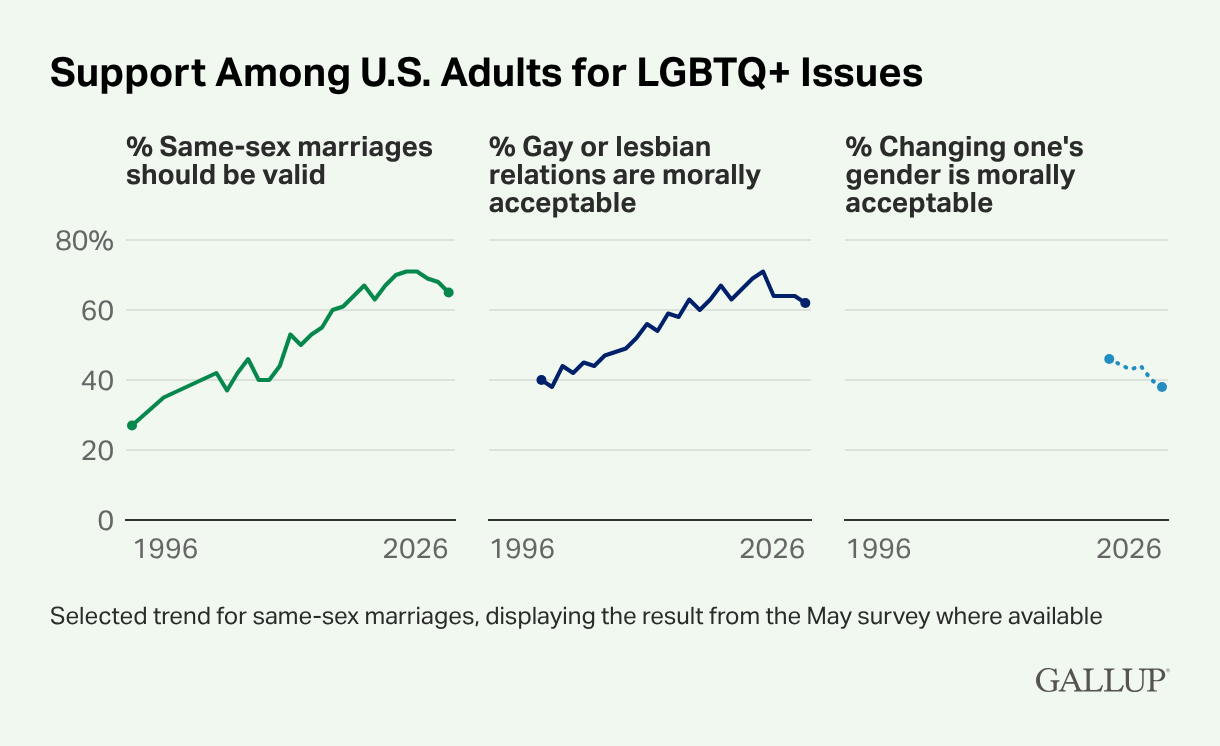
Last week, pollsters at Gallup reported that support for same-sex marriage and other pro-LGBT issues “remains down” in the U.S.

For years, survey data indicated a growing share of Americans were pro-LGBT and supported same-sex marriage. That trend seemed to culminate in 2015 when the U.S. Supreme Court overturned state marriage laws nationwide with its Obergefell v. Hodges decision.

But since 2024, polling data has showed a drop in support for same-sex marriage.

The latest numbers from Gallup reveal 65% of U.S. adults support same-sex marriage. That’s still a high number, but it is down from 71% in 2022.

Gallup also found 57% of adults believe it is morally wrong to change genders. That’s a major increase from 51% in 2021.

Gallup says Republicans are “largely responsible” for the shift in attitudes on same-sex marriage and pro-LGBT issues, but the truth may be more complicated.

Gallup found only 37% of Republicans now say same-sex marriage should be legal — which is down 18 points since 2022.

But Gallup’s data also shows support for same-sex marriage has fallen among Independent voters as well.

And although it may not be statistically significant, support for same-sex marriage among Democrats has been up and down from year to year.

So why have pro-LGBT attitudes started falling the past few years? It could be the same reasons that corporate Pride has fizzled and Fortune 500 companies have abandoned the pro-LGBT Equality Index: Pro-LGBT groups keep putting more and more demands on their “allies.”

According to organizations like the Human Rights Campaign, it isn’t enough to support same-sex marriage. Employers must provide “transgender-inclusive” health insurance plans, demonstrate “outreach to and engagement with the LGBTQ+ community,” and so forth.

In other words, it seems like there’s no such thing as being pro-LGBT “enough.”

There has also been nationwide pushback against pro-LGBT pandering since Obergefell.

Major companies from Walmart to Target and John Deere to Lowe’s have rolled back pro-LGBT and DEI policies in response to consumer backlash. Entertainment giants like Pixar and Disney have removed pro-LGBT elements from their storylines in response to moviegoers.

When the U.S. Supreme Court issued the Obergefell decision, many people said redefining marriage would erode religious liberty, erase distinctions between men and women, fundamentally change parenthood, and hurt children. In fact, children arguably are the victims hurt most by the Obergefell and the pro-LGBT movement.

Pro-LGBT activists and medical organizations spent years citing each other’s work in a circular pattern to manufacture a fake consensus about performing sex-change procedures on kids. Since then, whistleblowers have come forward testifying about how they were rushed through gender transitions as children without understanding the procedures’ risks, consequences, or alternatives.

All of this seems to have caused many people to rethink same-sex marriage and pro-LGBT activism in general. Gallup’s survey findings may be a reflection of that.

Articles appearing on this website are written with the aid of Family Council’s researchers and writers.


LifeWise Academy Expands Rapidly Across Arkansas in 2025-26 School Year, Serving Hundreds of Students

The following is a press release from LifeWise Academy.

Little Rock, AR (June 1, 2026) – LifeWise Academy in Arkansas today announced continued growth across the state, following a banner 2025–26 school year marked by strong local demand and expanding participation in Bible-based character education programs.

In Arkansas, LifeWise currently serves approximately 1,260 students with 12 live programs in 16 schools, reflecting significant year-over-year growth as more families see the significant benefits of released time religious instruction.

“Arkansas families are clearly looking for ways to support character development and address the many challenges that children face today,” said Jeff Wilkerson, State Director for LifeWise Academy. “We are seeing tremendous momentum as communities come together to offer students the opportunity to engage with the Bible during school hours.”

Growth in Arkansas has been driven by local families, with new programs launching and
additional communities currently exploring program development.

Highlights from LifeWise in Arkansas during the 2025-26 school year include:

● Served approximately 1,260 students across 16 schools
● Expanded into new communities, including Benton, Bentonville, and Bryant
● Continued strong parent participation and community support

The survey of 1,000 public school parents and 200 public school educators across the country was conducted by Scott Rasmussen’s RMG Research. Among the poll’s findings:

  • Nearly 90% favor teaching moral and character education to public school students
  • Nearly 70% say voluntary, off-campus Bible-based character education programs would be helpful for their child’s school.
  • Over 85% would favor a released time religious instruction program if it were
    offered

“Families across Arkansas are looking for solutions that help students build strong character, purpose, and values,” said Jeff Wilkerson. “The overwhelming support reflected in this polling mirrors what we are seeing in communities throughout the state — parents and educators want students to have access to positive moral and character education opportunities, and LifeWise is helping meet that demand.”

Key Facts About Released Time Religious Instruction (RTRI):

  • The U.S. Supreme Court ruled in 1952 that public school students could receive religious instruction during the school day so long as it is off school property, privately funded and parent-permitted.
  • Thirty-one states have laws clarifying the practice of released time for religious instruction.
  • Since launching in 5 Ohio schools in 2019, LifeWise Academy has grown to more than 1,000 schools across 37 states — an 11,640% increase in participation. To date, LifeWise has served more than 100,000 students.

###

About LifeWise Academy: LifeWise Academy is a nonprofit that provides Bible education to public school students during school hours under released time religious instruction laws. Hundreds of communities have launched local LifeWise programs through a 10-step process that begins with collecting community signatures at lifewise.org.

Guest Column: The Slippery Slope Keeps Slipping

If killing critically ill newborns isn’t the line, where is it for medically assisted suicide?

Back in April, a reckless assisted suicide bill looked like it was going to pass and be made British law. Instead, it was shut down by the House of Lords. Then, in May, the Irish parliament rejected an expanded abortion bill by a vote of 85-30. On this side of the Atlantic, things are headed in the opposite direction. 

Like all such “mercy” killing laws, Canada’s MAiD was promised as an option only for those facing imminent death and who could consent. Things are long past that and will likely go even further. Recently, a Quebec physician suggested that the nation’s already draconian MAiD program be expanded to include babies. In response, Brandan Tran of Canada’s Campaign Life Coalition said

Canadian law currently permits the withdrawal of life-sustaining treatment for critically ill newborns. This medical practitioner’s proposal goes further. He calls for the calculated killing of an infant. These are patients, babies, who cannot speak, cannot consent, and cannot ask for help. If we cannot draw the line here, I am not sure where medical professionals imagine the line to be. 

Physician-assisted suicide is always sold to the public as a “compassionate” measure, necessary to spare those with no reasonable chance of recovery fromunbearable pain and suffering during the last days of their lives. In every context in which it has been made legal, however, assisted suicide has never remained limited to the rare instances for which it was sold.  

There are reasons this slope has proven so slippery everywhere it has been made legal. Once it’s decided that certain lives are not worth living, the list of people eligible for assisted suicide inevitably grows. It becomes easier to re-evaluate lives based on some criteria other than intrinsic value, such as convenience or financial costs. It’s a small step indeed from “eligible to die” to “expected to die.”  

That’s why, wherever physician-assisted suicide has been legalized, it happens by a series of bait-and-switch claims to the public. “Terminal” illness is often expanded to include “chronic” illnesses and permanent disabilities. In Belgium, the Netherlands, and Canada, even mental illness and depression are considered sufficient justification for suicide. Given this trajectory, it’s only a matter of time before the requirement of an actual illness is dispensed with. 

For example, the original promise was that only those certifiably in their right minds could be euthanized. But that was always a lie. Anyone who goes into an American emergency department claiming they want to die would be diagnosed with “suicidal ideation,” admitted, and put on a psych hold. To not do so, in fact, would be medical malpractice. Suicidal ideation is rightly regarded as a symptom of an underlying mental disorder. People with untreated mental illnesses are not allowed to make life-and-death decisions. 

Or at least they weren’t. In Oregon, for example, since physician-assisted suicide was legalized, over 96% of people given lethal drugs did not undergo a psychiatric evaluation. This is why, as a “What Would You Say” video on the topic so clearly explained, there’s nothing compassionate about physician-assisted suicide. In fact, it is the exact opposite of compassion, the abdication of a civilized society’s responsibility to offer care to those who need it most when they need it most.  

In his book The Thanatos Syndrome, Walker Percy described how a society devolves to the point of thinking that killing patients instead of healing them is compassion. A psychiatrist, Percy wrote of well-trained and exquisitely credentialed doctors who “turn their backs on the oath of Hippocrates and kill millions of old useless people, unborn children, born malformed children, for the good of mankind.” What Percy wrote in 1987 has become reality. Some form of assisted suicide is now legal in 13 states and the District of Columbia.  

Like abortion, the legal fight against assisted suicide is only part of the battle. It must become unthinkable to strip away the intrinsic and indelible dignity every human possesses, no matter their life condition. Otherwise, there is no way to stop from sliding down a slope so slippery.

Copyright 2026 by the Colson Center for Christian Worldview. Reprinted from BreakPoint.org with permission.